


Review
doi: 10.2174/138945011795378559.
Triple threat: the Na+/Ca2+ exchanger in the pathophysiology of cardiac arrhythmia, ischemia and heart failure
Affiliations
- PMID: 21291388
- PMCID: PMC4406235
- DOI: 10.2174/138945011795378559
Item in Clipboard
Review
Triple threat: the Na+/Ca2+ exchanger in the pathophysiology of cardiac arrhythmia, ischemia and heart failure
Curr Drug Targets.
2011 May.
Abstract
The Na(+)/Ca(2+) exchanger (NCX) is the main Ca(2+) extrusion mechanism of the cardiac myocyte and thus is crucial for maintaining Ca(2+) homeostasis. It is involved in the regulation of several parameters of cardiac excitation contraction coupling, such as cytosolic Ca(2+) concentration, repolarization and contractility. Increased NCX activity has been identified as a mechanism promoting heart failure, cardiac ischemia and arrhythmia. Transgenic mice as well as pharmacological interventions have been used to support the idea of using NCX inhibition as a future pharmacological strategy to treat cardiovascular disease.
Figures
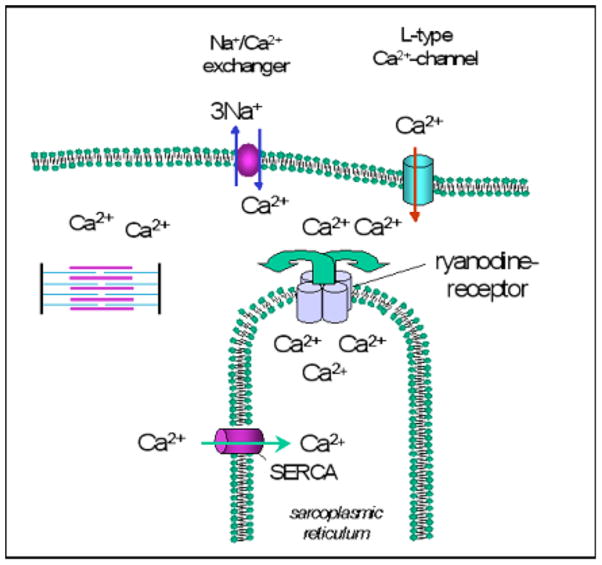
Role of NCX in cellular Ca2+ cycling during excitation-contraction
coupling in cardiac myocytes. During the action potential Ca2+ enters
the myocyte via the voltage dependent sarcolemmal L-type Ca2+ channel,
and thus triggers further Ca2+ release from the sarcoplasmic reticulum
via sarcoplasmic Ca2+ release channels (ryanodine receptors). The
released Ca2+ diffuses towards the myofilaments and induces the
contraction. During diastole Ca2+ is shifted back into sarcoplasmic
reticulum by the Ca2+ ATPase of the sarcoplasmic reticulum (SERCA). The
Na+/Ca2+ exchanger extrudes
Ca2+ from the cytosol into the extracellular space.
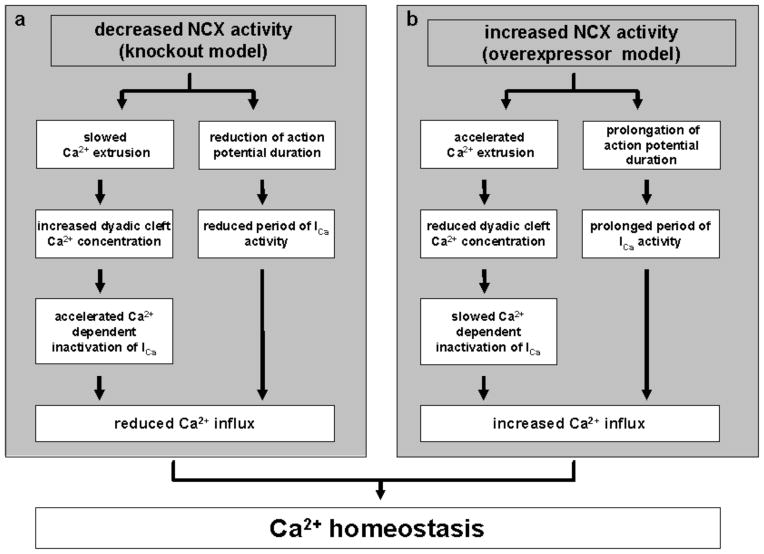
Concept of cellular mechanisms of adaptation to reduced and increased NCX activity as
modelled from studies in NCX knockout (a, [32, 35]) and overexpressor mice
(b, [68]).
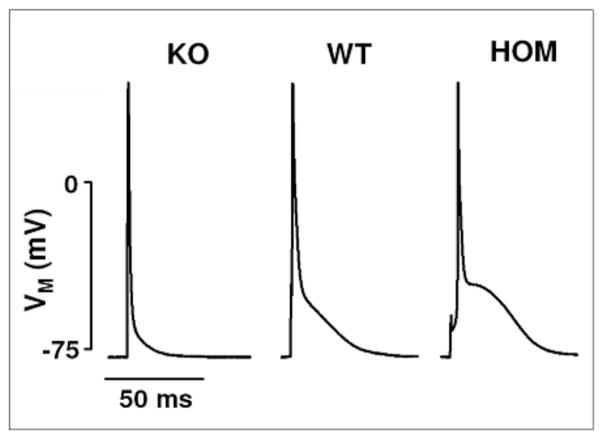
NCX activity regulates AP repolarization in adult cardiac myocytes. Middle column:
typical “pyramid”-like mouse AP recorded in a myocyte isolated from a WT
animal. Left column: A lack of the plateau phase due to a faster repolarization of the AP
is observed in myocytes isolated from NCX KO mice. Right column: In myocytes isolated from
mice that homozygously overexpress NCX (HOM), a slowed repolarization with a pronounced
plateau phase can be observed (modified from [35, 68]).
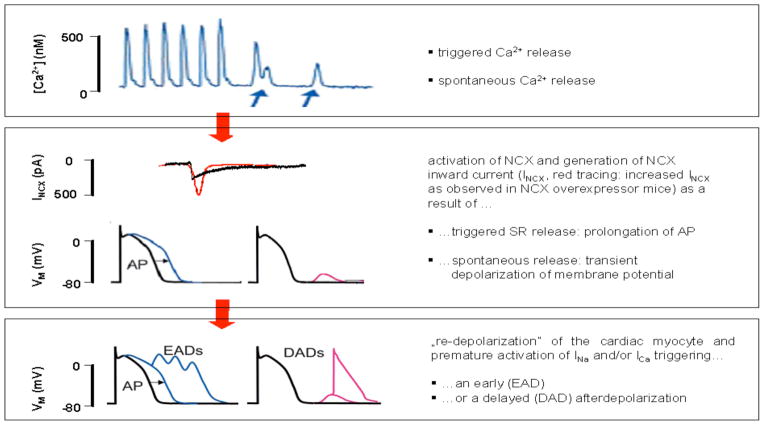
Pathophysiological concept on the role of NCX in the mediation of cardiac arrhythmia
(modified from [76]).
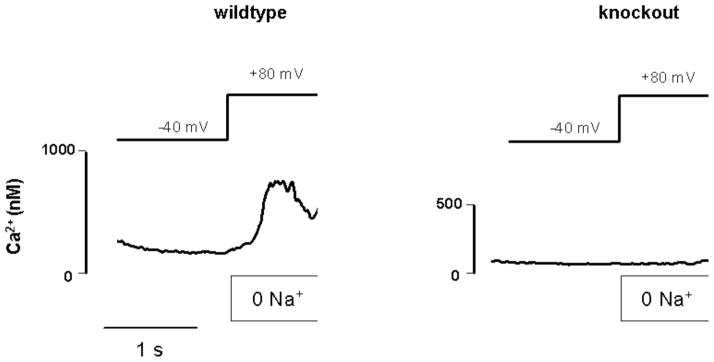
Ca2+ entry induced by Na+ depletion is absent in
NCX KO myocytes: Recording of cytosolic Ca2+ concentration in patch
clamped cardiac myocytes isolated from NCX KO and WT mice. Ca2+ entry
via NCX reverse mode was induced in WT myocytes by hyperpolarization and simultaneous
rapid removal of external Na+. Under these conditions, no increase in
cytosolic Ca2+ concentration was observed in NCX KO cells. (Modified
from [12]).
References
-
- Eckardt L, Haverkamp W, Breithardt G. Antiarrhythmic therapy in heart failure. Heart Fail Monit. 2002;2:110–9. - PubMed
-
- Scott J. Pathophysiology and biochemistry of cardiovascular disease. Curr Opin Genet Dev. 2004;14:271–9. - PubMed
-
- Dulhunty AF, Casarotto MG, Beard NA. The ryanodine receptor: a pivotal Ca2+ regulatory protein and potential therapeutic drug target. Curr Drug Targets. :XXX. - PubMed
Publication types
MeSH terms
Substances
Grants and funding
LinkOut - more resources
Full Text Sources
Other Literature Sources
Medical
Miscellaneous