


Severe cases of pandemic (H1N1) 2009 in children, Germany
- PMID: 21291587
- PMCID: PMC3204773
- DOI: 10.3201/eid1702.101090
Severe cases of pandemic (H1N1) 2009 in children, Germany
Abstract
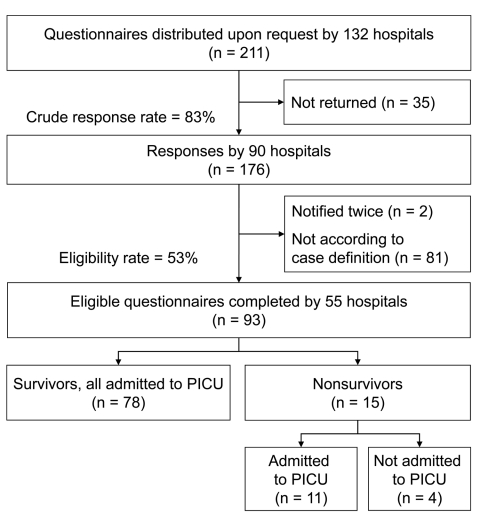
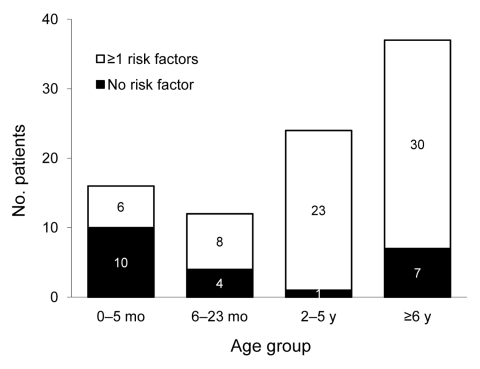
In a hospital-based observational study in Germany, we investigated children admitted to pediatric intensive care units and deaths caused by confirmed pandemic (H1N1) 2009 to identify risk factors and outcomes in critically ill children. Ninety-three children were eligible for our study, including 9 with hospital-acquired infections. Seventy-five percent had underlying chronic medical conditions; neurodevelopmental disorders were most prevalent (57%). The proportion of patients having ≥1 risk factor increased with age in years (odds ratio 1.21, p = 0.007). Of 15 deaths, 11 occurred in a pediatric intensive care unit (case-fatality rate 12%, 95% confidence interval 6%-21%). Only 9% of the children had been vaccinated against pandemic (H1N1) 2009; all survived. Our results stress the role of underlying risk factors, especially neurodevelopmental disorders, and the need for improving preventive measures to reduce severe disease and adverse outcomes of pandemic (H1N1) 2009 in children.
Figures
References
-
- World Health Organization. Pandemic (H1N1) 2009. —update 101. 2010 May 21 [cited 2010 May 22]. http://www.who.int/csr/don/2010_05_21/en/print.html
-
- Robert Koch Institute. Influenza—weekly report, Germany, 2010. [in German] [cited 2010 May 19]. http://influenza.rki.de/Wochenberichte/2009_2010/2010-19.pdf
-
- Centers for Disease Control and Prevention. 2009 pandemic influenza A (H1N1) virus infections—Chicago, Illinois, April–July 2009. MMWR Morb Mortal Wkly Rep. 2009;58:913–8. - PubMed
-
- Kelly H, Grant K. Interim analysis of pandemic influenza (H1N1) 2009. in Australia: surveillance trends, age of infection and effectiveness of seasonal vaccination. Euro Surveill. 2009;14:pii:19288. - PubMed
-
- European Center for Disease Prevention and Control. Risk assessment. Pandemic H1N1 2009. [cited 2009 Dec 20]. http://ecdc.europa.eu/en/healthtopics/H1N1/Documents/1001_RA_091217.pdf
Publication types
MeSH terms
LinkOut - more resources
Full Text Sources
Medical