. 2011 Feb;17(2):233-41.
doi: 10.3201/eid1702.091666.

Arbovirus prevalence in mosquitoes, Kenya

Affiliations

Arbovirus prevalence in mosquitoes, Kenya

A Desiree LaBeaud et al. Emerg Infect Dis. 2011 Feb.

Abstract

Few studies have investigated the many mosquito species that harbor arboviruses in Kenya. During the 2006-2007 Rift Valley fever outbreak in North Eastern Province, Kenya, exophilic mosquitoes were collected from homesteads within 2 affected areas: Gumarey (rural) and Sogan-Godud (urban). Mosquitoes (n = 920) were pooled by trap location and tested for Rift Valley fever virus and West Nile virus. The most common mosquitoes trapped belonged to the genus Culex (75%). Of 105 mosquito pools tested, 22% were positive for Rift Valley fever virus, 18% were positive for West Nile virus, and 3% were positive for both. Estimated mosquito minimum infection rates did not differ between locations. Our data demonstrate the local abundance of mosquitoes that could propagate arboviral infections in Kenya and the high prevalence of vector arbovirus positivity during a Rift Valley fever outbreak.


Figures

Figure 1
Figure 1
Location of Masalani Division of Ijara District, North Eastern Province, Kenya.
Figure 2
Figure 2
PCR gel showing positive Rift Valley fever virus bands (90 bp). Lane 1, molecular mass ladder; lane 2, Rift Valley fever virus MP-12 positive control; lane 3, negative control; lane 4, pool 103 (positive); lane 5, pool 86 (negative); lane 6, pool 104 (negative); lane 7, pool 87 (negative); lane 8, pool 105 (positive).
Figure 3
Figure 3
Identification of mosquitoes trapped, Gumarey and Sogan-Godud, Masalani Division of Ijara District, Kenya, 2006–2007. A) Mosquito species trapped during sampling effort. B) Mosquitoes trapped by date. Aedes spp. mosquitoes were found in traps only in December 2006 and Mansonia spp. mosquitoes only in January 2007. C) Temporal comparison of mosquitoes trapped in Gumarey. D) Mosquitoes trapped by study area, December 2006.
Figure 4
Figure 4
Distribution of human population and infected and uninfected mosquitoes across the selected study areas, Gumarey and Sogan-Godud, Masalani Division of Ijara District, Kenya. A) Area homestead locations (circles) and relative area density of human population (contours, 500-m kernel density; darker color indicates higher values). B) Study trap locations (triangles) and area density of mosquitoes (contours for average mosquitoes per trap, 500-m kernel density). C) Homestead locations of mosquito pools testing positive (white circles) and negative (black circles) for Rift Valley fever virus. Relative local density of positive pools per 500 m is indicated by contours. D) Homestead locations of mosquito pools testing positive (white circles) and negative (black circles) for West Nile virus. Relative density of positive pools is indicated by contours.
Figure 5
Figure 5
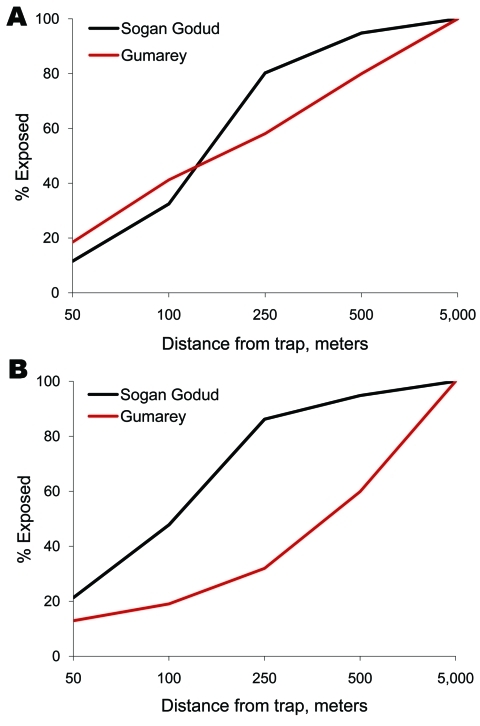
Cumulative proportion of residents within range of Rift Valley fever virus (RVFV)–positive (A) and West Nile virus (WNV)–positive (B) mosquito pools, by village, Gumarey and Sogan-Godud, Masalani Division of Ijara District, Kenya.

References

    1. Gubler DJ. The global emergence/resurgence of arboviral diseases as public health problems. Arch Med Res. 2002;33:330–42. 10.1016/S0188-4409(02)00378-8 - DOI - PubMed
    1. LaBeaud AD, Muchiri EM, Ndzovu M, Mwanje MT, Muiruri S, Peters CJ, et al. Interepidemic Rift Valley fever virus seropositivity, northeastern Kenya. Emerg Infect Dis. 2008;14:1240–6. 10.3201/eid1408.080082 - DOI - PMC - PubMed
    1. Labeaud AD, Ochiai Y, Peters C, Muchiri EM, King CH. Spectrum of Rift Valley fever virus transmission in Kenya: insights from three distinct regions. Am J Trop Med Hyg. 2007;76:795–800. - PMC - PubMed
    1. Sanders EJ, Borus P, Ademba G, Kuria G, Tukei PM, LeDuc JW. Sentinel surveillance for yellow fever in Kenya, 1993 to 1995. Emerg Infect Dis. 1996;2:236–8. 10.3201/eid0203.960314 - DOI - PMC - PubMed
    1. Okello GB, Agata N, Ouma J, Cherogony SC, Tukei PM, Ochieng W, et al. Outbreak of yellow fever in Kenya. Lancet. 1993;341:489. 10.1016/0140-6736(93)90237-B - DOI - PubMed

Publication types

MeSH terms

LinkOut - more resources