


Favorable changes in cardiac geometry and function following gastric bypass surgery: 2-year follow-up in the Utah obesity study
- PMID: 21292133
- PMCID: PMC3713780
- DOI: 10.1016/j.jacc.2010.10.017
Favorable changes in cardiac geometry and function following gastric bypass surgery: 2-year follow-up in the Utah obesity study
Abstract
Objectives: The objective of this study was to test the hypothesis that gastric bypass surgery (GBS) would favorably impact cardiac remodeling and function.
Background: GBS is increasingly used to treat severe obesity, but there are limited outcome data.
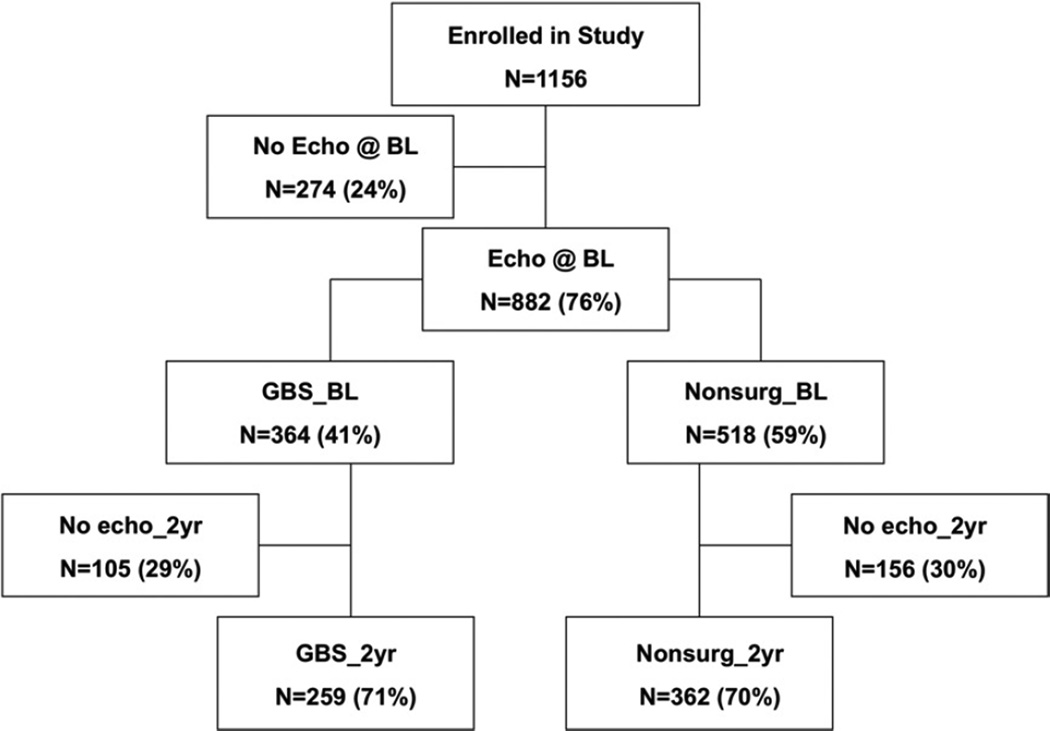
Methods: We prospectively studied 423 severely obese patients undergoing GBS and a reference group of severely obese subjects that did not have surgery (n = 733).
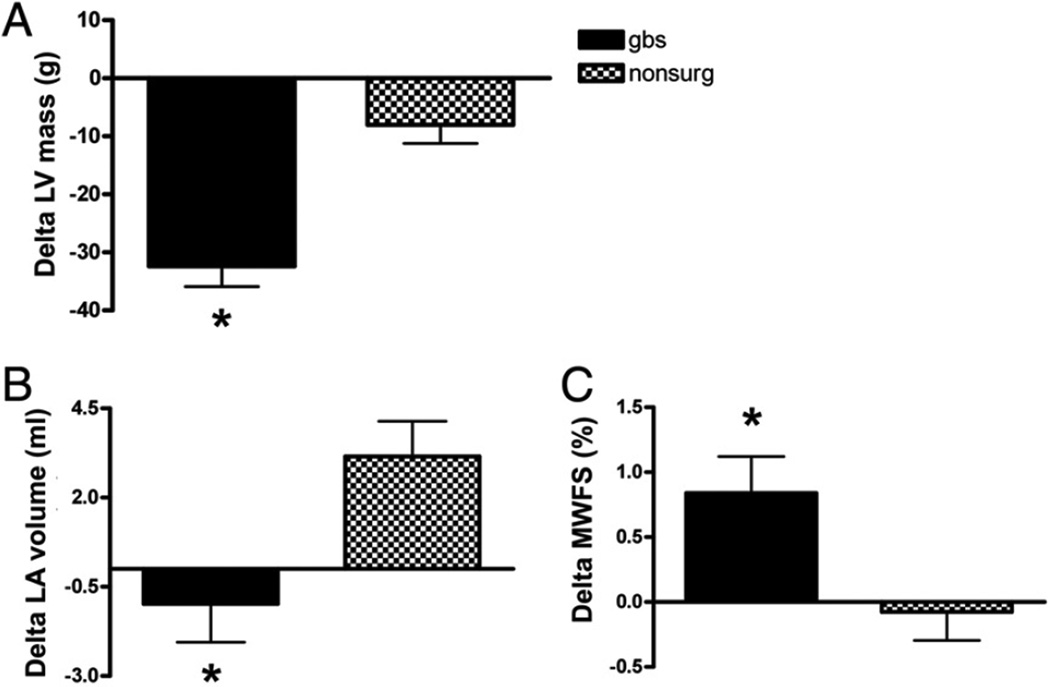
Results: At a 2-year follow up, GBS subjects had a large reduction in body mass index compared with the reference group (-15.4 ± 7.2 kg/m(2) vs. -0.03 ± 4.0 kg/m(2); p < 0.0001), as well as significant reductions in waist circumference, systolic blood pressure, heart rate, triglycerides, low-density lipoprotein cholesterol, and insulin resistance. High-density lipoprotein cholesterol increased. The GBS group had reductions in left ventricular (LV) mass index and right ventricular (RV) cavity area. Left atrial volume did not change in GBS but increased in reference subjects. In conjunction with reduced chamber sizes, GBS subjects also had increased LV midwall fractional shortening and RV fractional area change. In multivariable analysis, age, change in body mass index, severity of nocturnal hypoxemia, E/E', and sex were independently associated with LV mass index, whereas surgical status, change in waist circumference, and change in insulin resistance were not.
Conclusions: Marked weight loss in patients undergoing GBS was associated with reverse cardiac remodeling and improved LV and RV function. These data support the use of bariatric surgery to prevent cardiovascular complications in severe obesity.
Copyright © 2011 American College of Cardiology Foundation. Published by Elsevier Inc. All rights reserved.
Figures
Comment in
-
Obesity: long-term benefits of gastric bypass on cardiac structure and function.Nat Rev Cardiol. 2011 Apr;8(4):186. doi: 10.1038/nrcardio.2011.27. Nat Rev Cardiol. 2011. PMID: 21553724 No abstract available.
-
Changes in cardiac geometry and function after gastric bypass surgery.J Am Coll Cardiol. 2011 Oct 25;58(18):1924; author reply 1924. doi: 10.1016/j.jacc.2011.04.048. J Am Coll Cardiol. 2011. PMID: 22018304 No abstract available.
References
-
- Kenchaiah S, Evans JC, Levy D, et al. Obesity and the risk of heart failure. N Engl J Med. 2002;347:305–313. - PubMed
-
- Wang TJ, Parise H, Levy D, et al. Obesity and the risk of new-onset atrial fibrillation. JAMA. 2004;292:2471–2477. - PubMed
-
- Calle EE, Thun MJ, Petrelli JM, Rodriguez C, Heath CW., Jr Body-mass index mortality in a prospective cohort of U.S adults. N Engl J Med. 1999;341:1097–1105. - PubMed
-
- Gu D, He J, Duan X, et al. Body weight and mortality among men and women in China. JAMA. 2006;295:776–783. - PubMed
-
- Flegal KM, Graubard BI, Williamson DF, Gail MH. Excess deaths associated with underweight, overweight, and obesity. JAMA. 2005;293:1861–1867. - PubMed
Publication types
MeSH terms
Grants and funding
LinkOut - more resources
Full Text Sources
Other Literature Sources
Medical
