Review
. 2011 Apr;21(2):299-305.
doi: 10.1016/j.conb.2011.01.002. Epub 2011 Feb 1.

The influence of synaptic activity on neuronal health

Affiliations
Review

The influence of synaptic activity on neuronal health

Karen F S Bell et al. Curr Opin Neurobiol. 2011 Apr.

Abstract

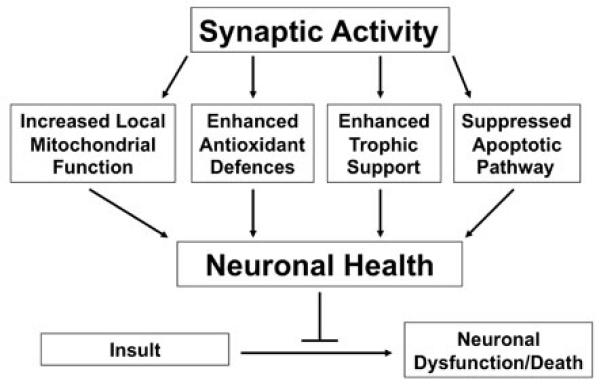
According to the theory of neuronal health, neurons exist in a spectrum of states ranging from highly resilient to vulnerable. An unhealthy neuron may be rendered dysfunctional or non-viable by an insult that would ordinarily be non-toxic to a healthy neuron. Over the years it has become clear that a neuron's health is subject to dynamic regulation by electrical or synaptic activity. This review highlights recently identified activity dependent signalling events that boost neuronal health through the transcriptional control of pro-apoptotic and anti-apoptotic genes, the enhancement of antioxidant defences, and the regulation of mitochondrial and neurotrophic factor availability. Furthermore, activity dependent signals have recently been shown to influence a variety of events specific to individual neurodegenerative diseases, which will also be highlighted.


Figures

Figure 1
Figure 1
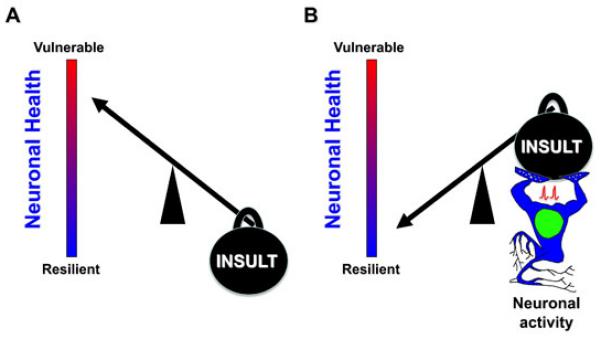
Neurons exist within a dynamic spectrum of health ranging from vulnerable to resilient as shown by the red to blue gradients. A neuron’s position within this spectrum is constantly influenced by a multitude of both beneficial and detrimental cues. In (A), we see that the weight of an “INSULT”, which represents a variety of detrimental events [e.g. oxidative stress, excitotoxicity, ischemia, pathology-associated burdens (amyloid beta protein, mutant huntingtin etc.)], burdens the neuron such that health is compromised and it is rendered vulnerable. In (B) however, neuronal activity, as represented by an active and muscular neuron, is able to boost neuronal health, enabling the neuron to withstand the same “INSULT” burden, whilst remain resilient, emphasizing the important neuroprotective influence of activity on neuronal health.
Figure 2
Figure 2
Schematic demonstrating the mechanisms through which synaptic activity boosts neuronal health, enabling the cell to better resist dysfunction or death. For full description see text.
Figure 3
Figure 3
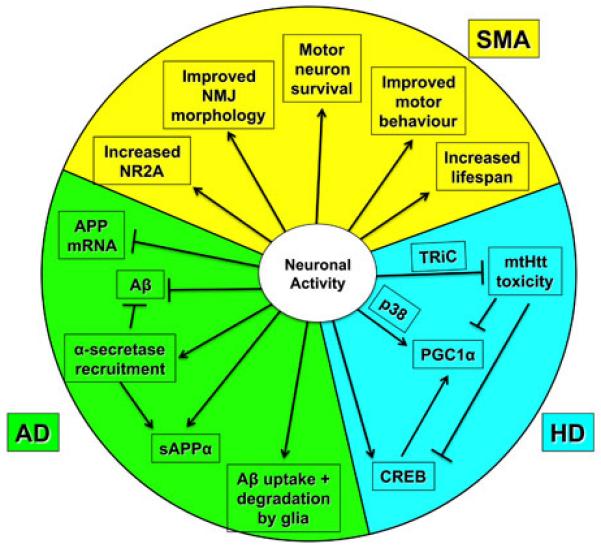
Neuronal activity has been shown to influence specific disease processes in a number of experimental models of neurodegenerative disease. Summarized in graphic format are disease-specific pathways reported as being influenced by neuronal activity, in experimental models of Alzheimer’s disease (AD), Huntington’s disease (HD) and Spinal Muscular Atrophy (SMA), as reviewed in greater detail in the text. Aβ = amyloid beta protein, APP = amyloid precursor protein, mtHtt = mutant Huntingtin, NMJ = neuromuscular junction, PGC1α = peroxisome proliferator-activated receptor-γ co-activator 1α, sAPPα = soluble Amyloid Precursor Protein alpha, TriC = T complex-1 (TCP-1) ring complex.

References

    1. Isacson O. On neuronal health. Trends Neurosci. 1993;16:306–308. - PubMed
    1. Mennerick S, Zorumski CF. Neural activity and survival in the developing nervous system. Mol Neurobiol. 2000;22:41–54. - PubMed
    1. Corredor RG, Goldberg JL. Electrical activity enhances neuronal survival and regeneration. J Neural Eng. 2009;6:055001. - PubMed
    1. Bessero AC, Clarke PG. Neuroprotection for optic nerve disorders. Curr Opin Neurol. 2010;23:10–15. - PubMed
    1. Tauskela JS, Fang H, Hewitt M, Brunette E, Ahuja T, Thivierge JP, Comas T, Mealing GA. Elevated synaptic activity preconditions neurons against an in vitro model of ischemia. J Biol Chem. 2008;283:34667–34676. - PMC - PubMed

Publication types