


Fibroblast activation protein is induced by inflammation and degrades type I collagen in thin-cap fibroatheromata
- PMID: 21292680
- PMCID: PMC3205479
- DOI: 10.1093/eurheartj/ehq519
Fibroblast activation protein is induced by inflammation and degrades type I collagen in thin-cap fibroatheromata
Abstract
Aims: Collagen degradation in atherosclerotic plaques with thin fibrous caps renders them more prone to rupture. Fibroblast activation protein (FAP) plays a role in arthritis and tumour formation through its collagenase activity. However, the significance of FAP in thin-cap human fibroatheromata remains unknown.
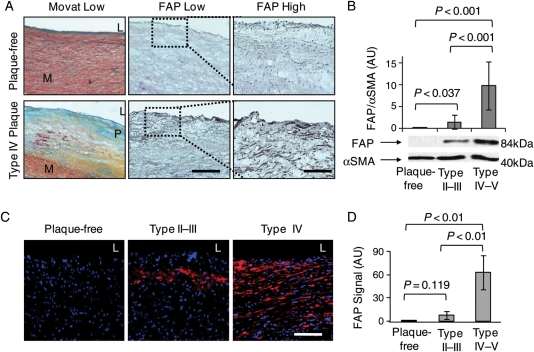
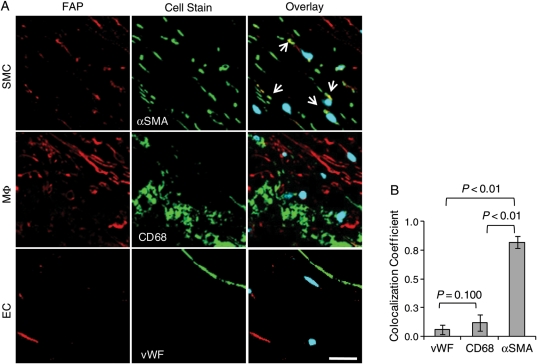
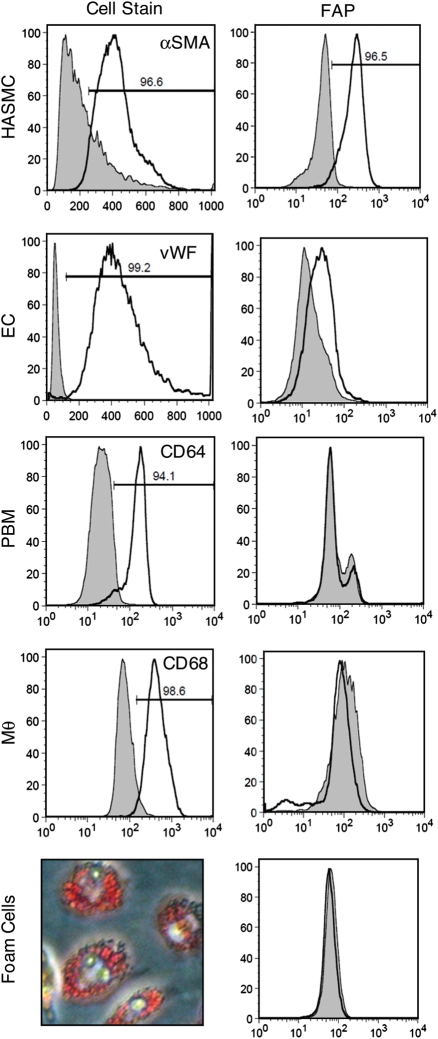
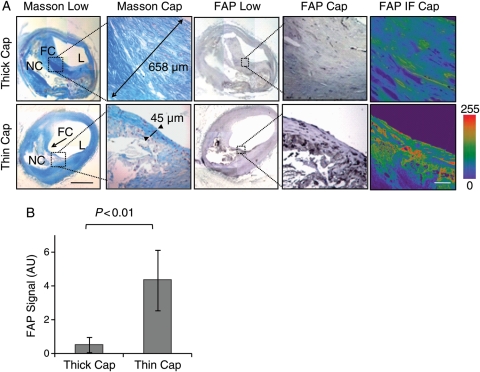
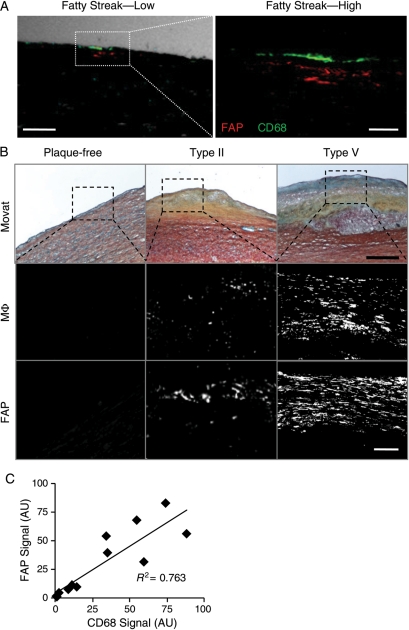
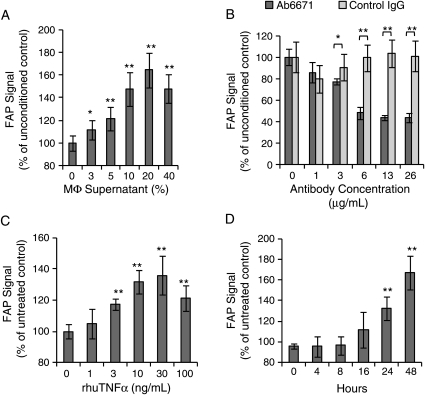
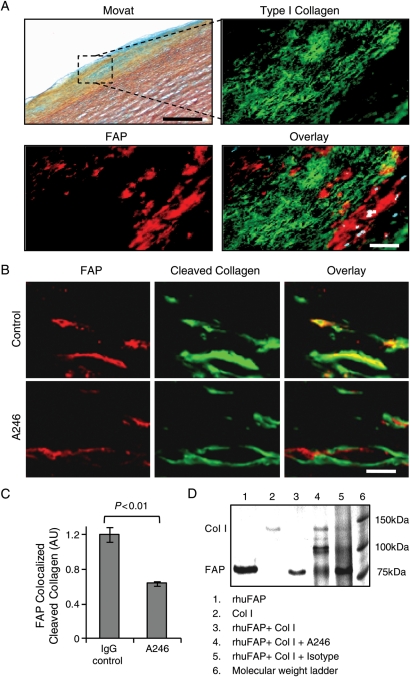
Methods and results: We detected enhanced FAP expression in type IV-V human aortic atheromata (n = 12), compared with type II-III lesions (n = 9; P < 0.01) and healthy aortae (n = 8; P < 0.01) by immunostaining and western blot analyses. Fibroblast activation protein was also increased in thin-cap (<65 µm) vs. thick-cap (≥ 65 µm) human coronary fibroatheromata (n = 12; P < 0.01). Fibroblast activation protein was expressed by human aortic smooth muscle cells (HASMC) as shown by colocalization on immunofluorescent aortic plaque stainings (n = 10; P < 0.01) and by flow cytometry in cell culture. Although macrophages did not express FAP, macrophage burden in human aortic plaques correlated with FAP expression (n = 12; R(2)= 0.763; P < 0.05). Enzyme-linked immunosorbent assays showed a time- and dose-dependent up-regulation of FAP in response to human tumour necrosis factor α (TNFα) in HASMC (n = 6; P < 0.01). Moreover, supernatants from peripheral blood-derived macrophages induced FAP expression in cultured HASMC (n = 6; P < 0.01), an effect abolished by blocking TNFα (n = 6; P < 0.01). Fibroblast activation protein associated with collagen-poor regions in human coronary fibrous caps and digested type I collagen and gelatin in vitro (n = 6; P < 0.01). Zymography revealed that FAP-mediated collagenase activity was neutralized by an antibody directed against the FAP catalytic domain both in HASMC (n = 6; P < 0.01) and in fibrous caps of atherosclerotic plaques (n = 10; P < 0.01).
Conclusion: Fibroblast activation protein expression in HASMC is induced by macrophage-derived TNFα. Fibroblast activation protein associates with thin-cap human coronary fibroatheromata and contributes to type I collagen breakdown in fibrous caps.
Figures
References
-
- Farb A, Burke AP, Tang AL, Liang Y, Mannan P, Smialek J, Virmani R. Coronary plaque erosion without rupture into a lipid core: a frequent cause of coronary thrombosis in sudden coronary death. Circulation. 1996;93:1354–1363. - PubMed
-
- Virmani R, Burke AP, Farb A, Kolodgie FD. Pathology of the vulnerable plaque. J Am Coll Cardiol. 2006;47:C13–C18. doi:10.1016/j.jacc.2005.10.065. - DOI - PubMed
-
- van der Wal A, Becker A, van der Loos C, Das P. Site of intimal rupture or erosion of thrombosed coronary atherosclerotic plaques is characterized by an inflammatory process irrespective of the dominant plaque morphology. Circulation. 1994;89:36–44. - PubMed
-
- Shah P, Falk E, Badimon J, Fernandez-Ortiz A, Mailhac A, Villareal-Levy G, Fallon J, Regnstrom J, Fuster V. Human monocyte-derived macrophages induce collagen breakdown in fibrous caps of atherosclerotic plaques. Potential role of matrix-degrading metalloproteinases and implications for plaque rupture. Circulation. 1995;92:1565–1569. - PubMed
-
- Rajavashisth TB, Xu X-P, Jovinge S, Meisel S, Xu X-O, Chai N-N, Fishbein MC, Kaul S, Cercek B, Sharifi B, Shah PK. Membrane type 1 matrix metalloproteinase expression in human atherosclerotic plaques. Circulation. 1999;99:3103–3109. - PubMed
Publication types
MeSH terms
Substances
LinkOut - more resources
Full Text Sources
Other Literature Sources
Medical
Miscellaneous
