


Antagonism of soluble guanylyl cyclase attenuates cutaneous vasodilation during whole body heat stress and local warming in humans
- PMID: 21292837
- PMCID: PMC3098662
- DOI: 10.1152/japplphysiol.00702.2010
Antagonism of soluble guanylyl cyclase attenuates cutaneous vasodilation during whole body heat stress and local warming in humans
Abstract
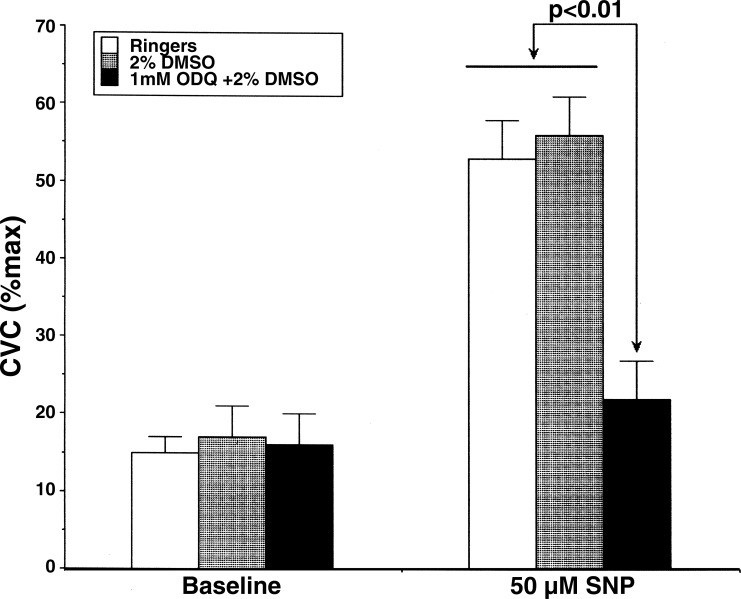
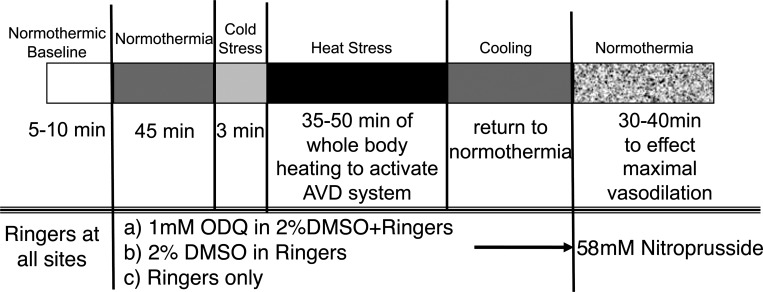
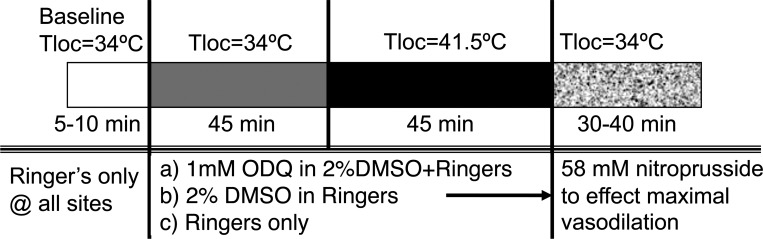
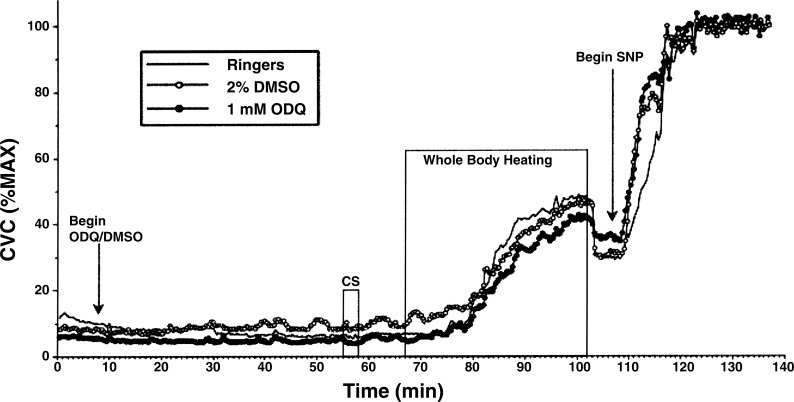
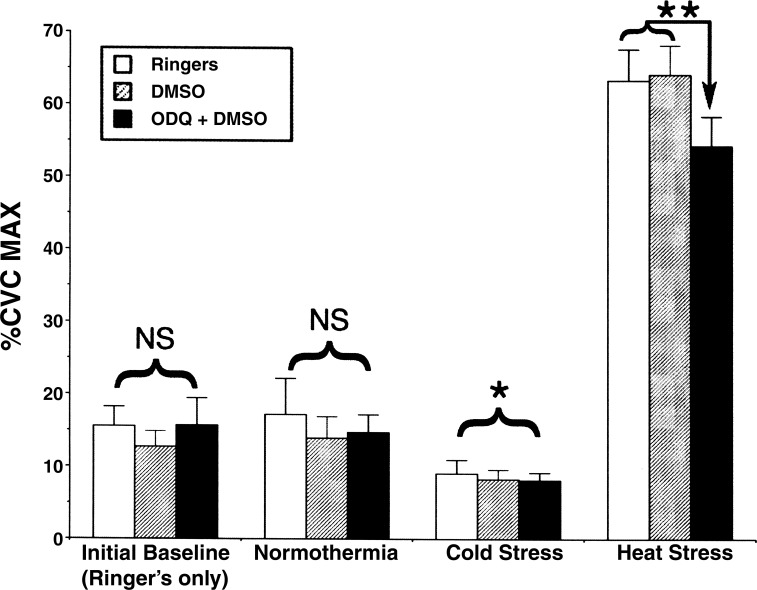
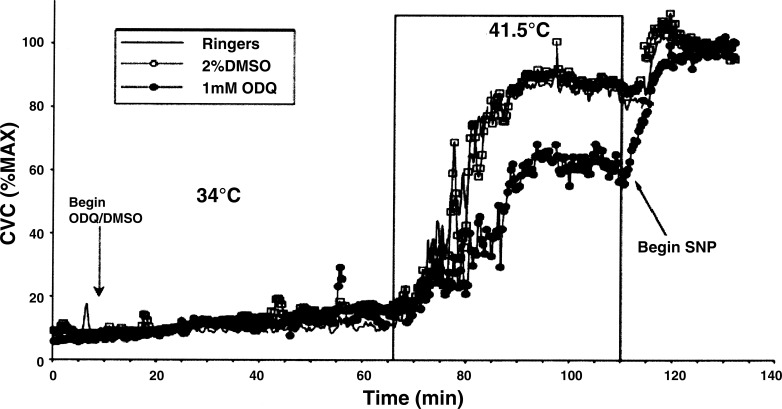
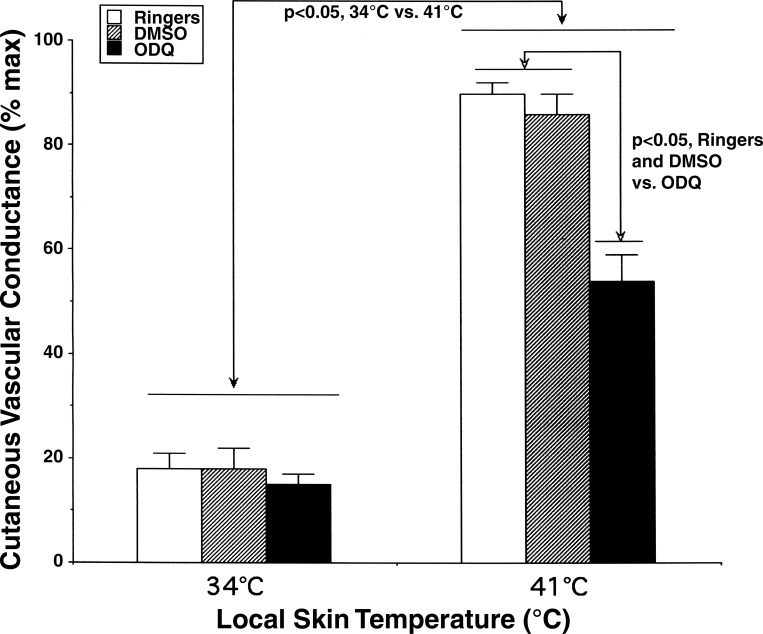
We hypothesized that nitric oxide activation of soluble guanylyl cyclase (sGC) participates in cutaneous vasodilation during whole body heat stress and local skin warming. We examined the effects of the sGC inhibitor, 1H-[1,2,4]oxadiazolo[4,3-a]quinoxalin-1-one (ODQ), on reflex skin blood flow responses to whole body heat stress and on nonreflex responses to increased local skin temperature. Blood flow was monitored by laser-Doppler flowmetry, and blood pressure by Finapres to calculate cutaneous vascular conductance (CVC). Intradermal microdialysis was used to treat one site with 1 mM ODQ in 2% DMSO and Ringer, a second site with 2% DMSO in Ringer, and a third site received Ringer. In protocol 1, after a period of normothermia, whole body heat stress was induced. In protocol 2, local heating units warmed local skin temperature from 34 to 41°C to cause local vasodilation. In protocol 1, in normothermia, CVC did not differ among sites [ODQ, 15 ± 3% maximum CVC (CVC(max)); DMSO, 14 ± 3% CVC(max); Ringer, 17 ± 6% CVC(max); P > 0.05]. During heat stress, ODQ attenuated CVC increases (ODQ, 54 ± 4% CVC(max); DMSO, 64 ± 4% CVC(max); Ringer, 63 ± 4% CVC(max); P < 0.05, ODQ vs. DMSO or Ringer). In protocol 2, at 34°C local temperature, CVC did not differ among sites (ODQ, 17 ± 2% CVC(max); DMSO, 18 ± 4% CVC(max); Ringer, 18 ± 3% CVC(max); P > 0.05). ODQ attenuated CVC increases at 41°C local temperature (ODQ, 54 ± 5% CVC(max); DMSO, 86 ± 4% CVC(max); Ringer, 90 ± 2% CVC(max); P < 0.05 ODQ vs. DMSO or Ringer). sGC participates in neurogenic active vasodilation during heat stress and in the local response to direct skin warming.
Figures
References
-
- Ahern GP, Klyachko VA, Jackson MB. cGMP and S-nitrosylation: two routes for modulation of neuronal excitability by NO. Trends Neurosci 25: 510–517, 2002. - PubMed
-
- Anderson C, Andersson T, Wardell K. Changes in skin circulation after insertion of a microdialysis probe visualized by laser-Doppler perfusion imaging. J Invest Dermatol 102: 808–811, 1994. - PubMed
-
- Aoki K, Stephens DP, Johnson JM. Diurnal variation in cutaneous vasodilator and vasoconstrictor systems during heat stress. Am J Physiol Regul Integr Comp Physiol 281: R591–R595, 2001. - PubMed
Publication types
MeSH terms
Substances
Grants and funding
LinkOut - more resources
Full Text Sources
