


Effect of calorie restriction on the free-living physical activity levels of nonobese humans: results of three randomized trials
- PMID: 21292847
- PMCID: PMC3075130
- DOI: 10.1152/japplphysiol.00846.2009
Effect of calorie restriction on the free-living physical activity levels of nonobese humans: results of three randomized trials
Abstract
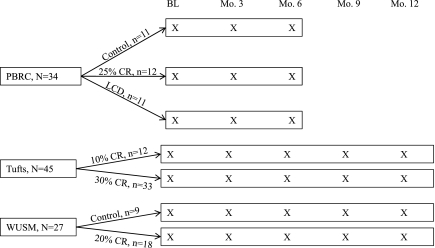
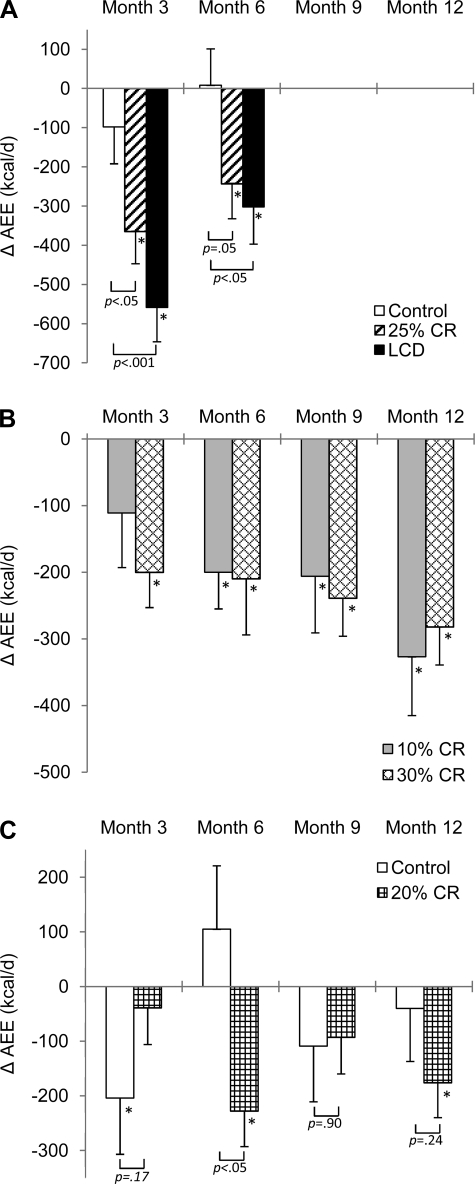
The objective of this study was to evaluate the influence of calorie restriction (CR) on free-living physical activity levels among humans. Data were from three CALERIE phase I site-specific protocols. Participants were nonobese (body mass index = 23.5-29.9 kg/m² adults randomly assigned to 25% CR, low-calorie diet (LCD, 890 kcal/day supplement diet until 15% weight loss, then weight maintenance), or control at Pennington Biomedical Research Center (PBRC); 30% or 10% CR at Tufts University; and 20% CR or control at Washington University School of Medicine (WUSM). Activity was measured at months 0, 3, and 6 (PBRC) and at months 0, 3, 6, 9, and 12 (WUSM and Tufts). Total daily energy expenditure (TEE) by doubly labeled water and resting metabolic rate (RMR) were used to compute activity energy expenditure: AEE = TEE - RMR - 0.1 * TEE. Accelerometry and 7-day recall categorized activities by intensity. At Tufts, the 10% and 30% CR groups experienced significant decreases in AEE at months 6, 9, and 12. At month 6, a larger decrease in AEE was observed in the CR than the control group at WUSM. At months 3 and 6, larger decreases in AEE were observed in the CR and LCD groups than the control group at PBRC. Accelerometry and 7-day PAR did not consistently detect changes in activity categories. CR-associated changes in AEE were variable but, generally, reduced the energy deficit, which would reduce the expected rate of weight loss. Accelerometry and recall did not consistently explain reduced AEE, suggesting that increased muscle efficiency and/or decreased fidgeting accounted for decreased AEE. Inaccuracy of accelerometry and recall also likely negatively affected sensitivity.
Figures
References
-
- Allison DB, Paultre F, Goran MI, Poehlman ET, Heymsfield SB. Statistical considerations regarding the use of ratios to adjust data. Int J Obes Relat Metab Disord 19: 644–652, 1995 - PubMed
-
- Bandini LG, Schoeller DA, Cyr HN, Dietz WH. Validity of reported energy intake in obese and nonobese adolescents. Am J Clin Nutr 52: 421–425, 1990 - PubMed
-
- Carpenter WH, Poehlman ET, O'Connell M, Goran MI. Influence of body composition and resting metabolic rate on variation in total energy expenditure: a meta-analysis. Am J Clin Nutr 61: 4–10, 1995 - PubMed
-
- Das SK, Gilhooly CH, Golden JK, Pittas AG, Fuss PJ, Cheatham RA, Tyler S, Tsay M, McCrory MA, Lichtenstein AH, Dallal GE, Dutta C, Bhapkar MV, Delany JP, Saltzman E, Roberts SB. Long-term effects of 2 energy-restricted diets differing in glycemic load on dietary adherence, body composition, and metabolism in CALERIE: a 1-y randomized controlled trial. Am J Clin Nutr 85: 1023–1030, 2007 - PubMed
Publication types
MeSH terms
Grants and funding
LinkOut - more resources
Full Text Sources
Medical
