


The effect of survival bias on case-control genetic association studies of highly lethal diseases
- PMID: 21292865
- PMCID: PMC3080449
- DOI: 10.1161/CIRCGENETICS.110.957928
The effect of survival bias on case-control genetic association studies of highly lethal diseases
Abstract
Background: Survival bias is the phenomenon by which individuals are excluded from analysis of a trait because of mortality related to the expression of that trait. In genetic association studies, variants increasing risk for disease onset as well as risk of disease-related mortality (lethality) could be difficult to detect in genetic association case-control designs, possibly leading to underestimation of a variant's effect on disease risk.
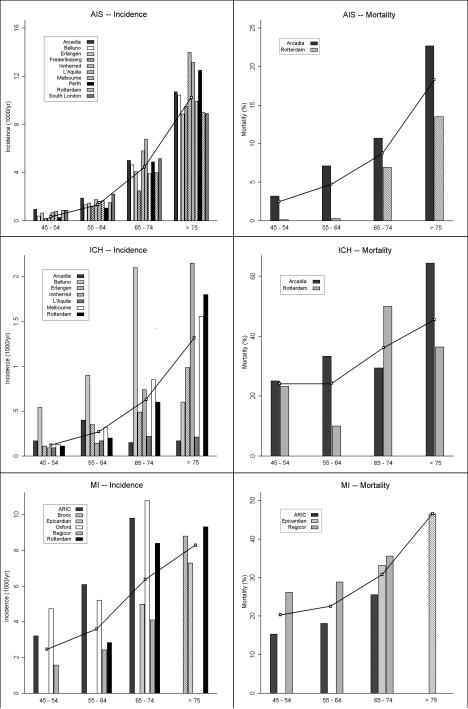
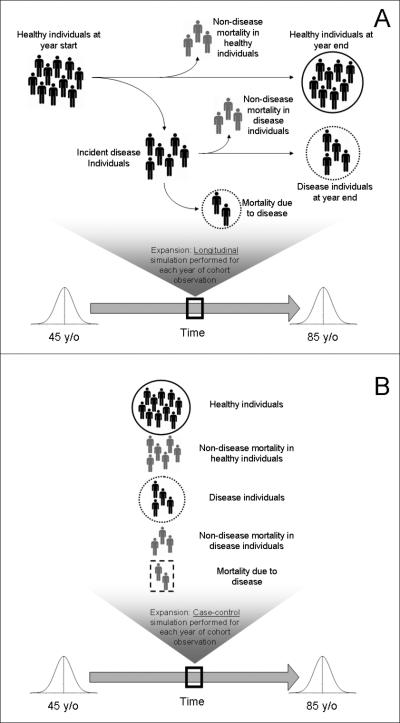
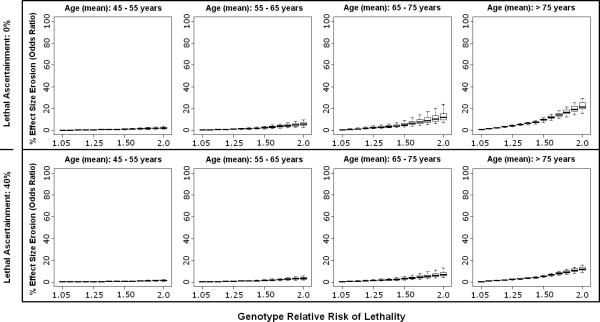
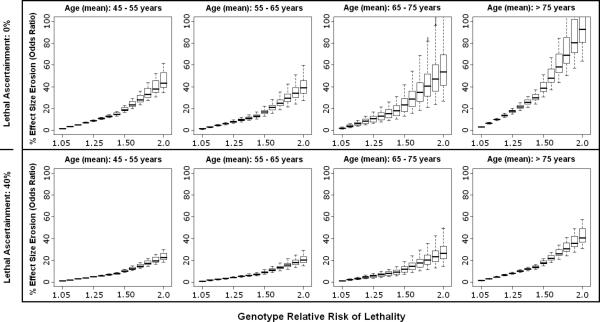
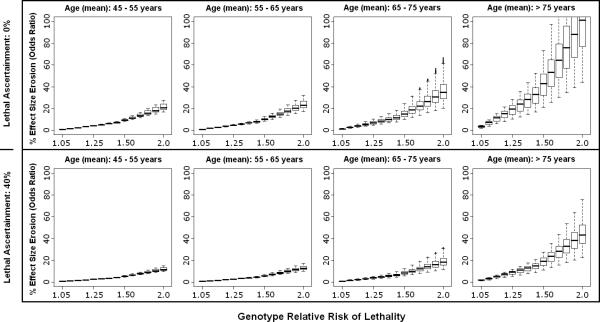
Methods and results: We modeled cohorts for 3 diseases of high lethality (intracerebral hemorrhage, ischemic stroke, and myocardial infarction) using existing longitudinal data. Based on these models, we simulated case-control genetic association studies for genetic risk factors of varying effect sizes, lethality, and minor allele frequencies. For each disease, erosion of detected effect size was larger for case-control studies of individuals of advanced age (age >75 years) and/or variants with very high event-associated lethality (genotype relative risk for event-related death >2.0). We found that survival bias results in no more than 20% effect size erosion for cohorts with mean age <75 years, even for variants that double lethality risk. Furthermore, we found that increasing effect size erosion was accompanied by depletion of minor allele frequencies in the case population, yielding a "signature" of the presence of survival bias.
Conclusions: Our simulation provides formulas to allow estimation of effect size erosion given a variant's odds ratio of disease, odds ratio of lethality, and minor allele frequencies. These formulas will add precision to power calculation and replication efforts for case-control genetic studies. Our approach requires validation using prospective data.
Figures
Comment in
-
The folly of being comforted.Circ Cardiovasc Genet. 2011 Apr;4(2):108-9. doi: 10.1161/CIRCGENETICS.111.959783. Circ Cardiovasc Genet. 2011. PMID: 21505200 No abstract available.
References
-
- Jensen H, Benn CS, Lisse IM, Rodrigues A, Andersen PK, Aaby P. Survival bias in observational studies of the impact of routine immunizations on childhood survival. Trop Med Int Health. 2007;12:5–14. - PubMed
-
- Rothman KJ, Greenland S, Lash TL. Modern Epidemiology. Third Edition Lippincott-Williams-Wilkins Publishers; Philadelphia, PA: 2008.
-
- Woodward M. Epidemiology: Study Design and Data Analysis. Second Edition CRC Press; Boca Raton, FL: 2004.
-
- Szklo M, Nieto FJ. Epidemiology: Beyond the Basics. Second Edition Aspen Publishing; Gaithersburg, MD: 2004.
Publication types
MeSH terms
Grants and funding
LinkOut - more resources
Full Text Sources
Other Literature Sources
Medical
