. 2011;33(2):157-67.
doi: 10.1159/000323972. Epub 2011 Feb 4.

Racial and ethnic differences in mortality of hemodialysis patients: role of dietary and nutritional status and inflammation

Affiliations

Racial and ethnic differences in mortality of hemodialysis patients: role of dietary and nutritional status and inflammation

Nazanin Noori et al. Am J Nephrol. 2011.

Abstract

Background: Racial/ethnic disparities prevail among hemodialysis patients. We hypothesized that significant differences exist between Black and non-Hispanic and Hispanic White hemodialysis patients in nutritional status, dietary intake and inflammation, and that they account for racial survival disparities.

Methods: In a 6-year (2001-2007) cohort of 799 hemodialysis patients, we compared diet and surrogates of nutritional-inflammatory status and their mortality-predictabilities between 279 Blacks and 520 Whites using matched and regression analyses and Cox with cubic splines.

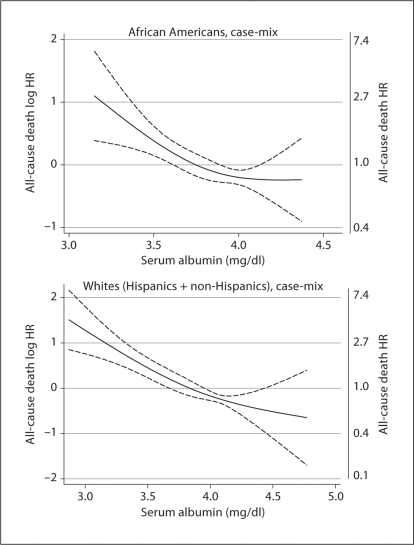
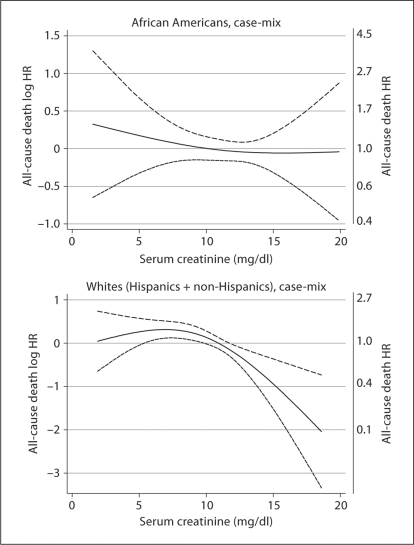
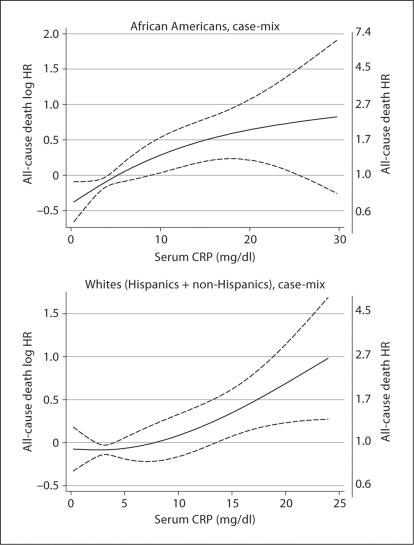
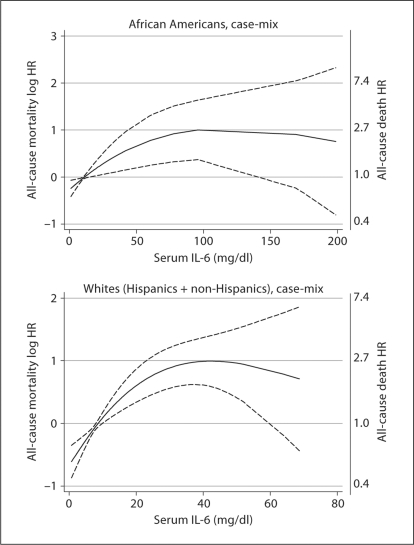
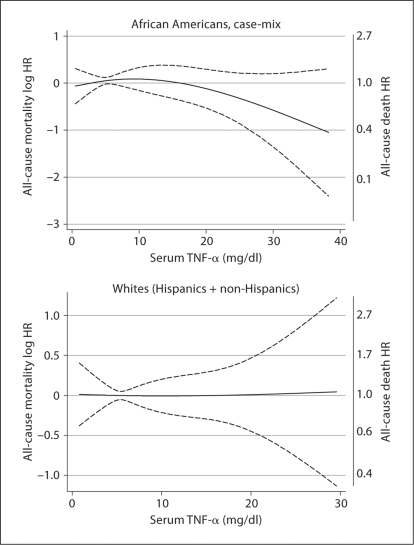
Results: In age-, gender- and diabetes-matched analyses, Blacks had higher lean body mass and serum prealbumin, creatinine and homocysteine levels than Whites. In case-mix-adjusted analyses, dietary intakes in Blacks versus Whites were higher in energy (+293 ± 119 cal/day) and fat (+18 ± 5 g/day), but lower in fiber (-2.9 ± 1.3 g/day) than Whites. In both races, higher serum albumin, prealbumin and creatinine were associated with greater survival, whereas CRP and IL-6, but not TNF-α, were associated with increased mortality. The highest (vs. lowest) quartile of IL-6 was associated with a 2.4-fold (95% CI: 1.3-3.8) and 4.1-fold (2.2-7.2) higher death risk in Blacks and Whites, respectively.

Conclusions: Significant racial disparities exist in dietary, nutritional and inflammatory measures, which may contribute to hemodialysis outcome disparities. Testing race-specific dietary and/or anti-inflammatory interventions is indicated.


Figures

Fig. 1
Fig. 1
Cubic spline models of the Cox proportional regression analyses reflecting adjusted mortality-predictability (with 95% CI) according to predialysis serum albumin in African-American (upper panel) vs. White (Hispanic and non-Hispanic, lower panel) MHD patients over 6 years. Spline models are with 2 degrees of freedom. Case-mix includes age, gender, diabetes mellitus, Charlson comorbidity index score and dialysis vintage.
Fig. 2
Fig. 2
Cubic spline models of the Cox proportional regression analyses reflecting adjusted mortality-predictability (with 95% CI) according to predialysis serum prealbumin in African-American vs. White (Hispanic and non-Hispanic) MHD patients over 6 years. Spline models are with 2 degrees of freedom. Case-mix includes age, gender, diabetes mellitus, Charlson comorbidity index score and dialysis vintage.
Fig. 3
Fig. 3
Cubic spline models of the Cox proportional regression analyses reflecting adjusted mortality-predictability (with 95% CI) according to predialysis serum creatinine in African-American vs. White (Hispanic and non-Hispanic) MHD patients over 6 years. Spline models are with 2 degrees of freedom. Case-mix includes age, gender, diabetes mellitus, Charlson comorbidity index score and dialysis vintage.
Fig. 4
Fig. 4
Cubic spline models of the Cox proportional regression analyses reflecting adjusted mortality-predictability (with 95% CI) according to predialysis serum CRP in African-American vs. White (Hispanic and non-Hispanic) MHD patients over 6 years. Spline models are with 2 degrees of freedom. Case-mix includes age, gender, diabetes mellitus, Charlson comorbidity index score and dialysis vintage.
Fig. 5
Fig. 5
Cubic spline models of the Cox proportional regression analyses reflecting adjusted mortality-predictability (with 95% CI) according to predialysis serum IL-6 in African-American vs. White (Hispanic and non-Hispanic) MHD patients over 6 years. Spline models are with 2 degrees of freedom. Case-mix includes age, gender, diabetes mellitus, Charlson comorbidity index score and dialysis vintage.
Fig. 6
Fig. 6
Cubic spline models of the Cox proportional regression analyses reflecting adjusted mortality-predictability (with 95% CI) according to predialysis serum TNF-α in African-American vs. White (Hispanic and non-Hispanic) MHD patients over 6 years. Spline models are with 2 degrees of freedom. Case-mix includes age, gender, diabetes mellitus, Charlson comorbidity index score and dialysis vintage.

References

    1. Shah SV, Feehally J. The third World Kidney Day: looking back and thinking forward. Clin J Am Soc Nephrol. 2008;3:309–311. - PMC - PubMed
    1. Coresh J, Selvin E, Stevens LA, Manzi J, Kusek JW, Eggers P, Van Lente F, Levey AS. Prevalence of chronic kidney disease in the United States. JAMA. 2007;298:2038–2047. - PubMed
    1. Kovesdy CP, Anderson JE, Derose SF, Kalantar-Zadeh K. Outcomes associated with race in males with nondialysis-dependent chronic kidney disease. Clin J Am Soc Nephrol. 2009;4:973–978. - PMC - PubMed
    1. Miller JE, Kovesdy CP, Nissenson AR, Mehrotra R, Streja E, Van Wyck D, Greenland S, Kalantar-Zadeh K. Association of hemodialysis treatment time and dose with mortality and the role of race and sex. Am J Kidney Dis. 2010;55:100–112. - PMC - PubMed
    1. Kalantar-Zadeh K, Miller JE, Kovesdy CP, Mehrotra R, Lukowsky LR, Streja E, Ricks J, Jing J, Nissenson AR, Greenland S, Norris KC. Impact of race on hyperparathyroidism, mineral disarrays, administered vitamin D mimetic, and survival in hemodialysis patients. J Bone Miner Res. 2010;25:2448–2458. - PMC - PubMed

Publication types