Review
. 2011 May;210(3-4):407-22.
doi: 10.1007/s00221-011-2568-4. Epub 2011 Feb 4.

The functional significance of velocity storage and its dependence on gravity

Affiliations
Review

The functional significance of velocity storage and its dependence on gravity

Jean Laurens et al. Exp Brain Res. 2011 May.

Abstract

Research in the vestibular field has revealed the existence of a central process, called 'velocity storage', that is activated by both visual and vestibular rotation cues and is modified by gravity, but whose functional relevance during natural motion has often been questioned. In this review, we explore spatial orientation in the context of a Bayesian model of vestibular information processing. In this framework, deficiencies/ambiguities in the peripheral vestibular sensors are compensated for by central processing to more accurately estimate rotation velocity, orientation relative to gravity, and inertial motion. First, an inverse model of semicircular canal dynamics is used to reconstruct rotation velocity by integrating canal signals over time. However, its low-frequency bandwidth is limited to avoid accumulation of noise in the integrator. A second internal model uses this reconstructed rotation velocity to compute an internal estimate of tilt and inertial acceleration. The bandwidth of this second internal model is also restricted at low frequencies to avoid noise accumulation and drift of the tilt/translation estimator over time. As a result, low-frequency translation can be erroneously misinterpreted as tilt. The time constants of these two integrators (internal models) can be conceptualized as two Bayesian priors of zero rotation velocity and zero linear acceleration, respectively. The model replicates empirical observations like 'velocity storage' and 'frequency segregation' and explains spatial orientation (e.g., 'somatogravic') illusions. Importantly, the functional significance of this network, including velocity storage, is found during short-lasting, natural head movements, rather than at low frequencies with which it has been traditionally studied.


Figures
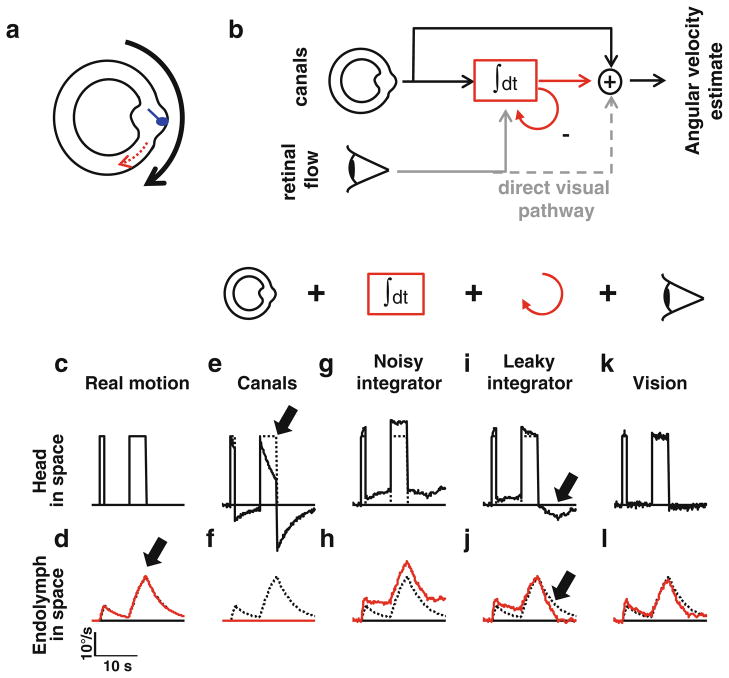
Fig. 1
Fig. 1
Perception of angular velocity. a: principle of the semicircular canals: the cupula (blue) detects the difference between head velocity (black arrow) and endolymph velocity in space (red). b: model of the central visual and vestibular processing of rotation. c, d: head and endolymph velocity in space during a sequence of rotations. el: information about head velocity and endolymph velocity provided by the canals alone (e, f), the canals and the velocity storage (gj), and the full visuo-vestibular model (k, l). Dashed black lines in (e, g, i, k) superimpose trace from (c). Dashed black lines in (f, h, j, l) superimpose trace from (d). See Fig. 4 for simulation parameters
Fig. 2
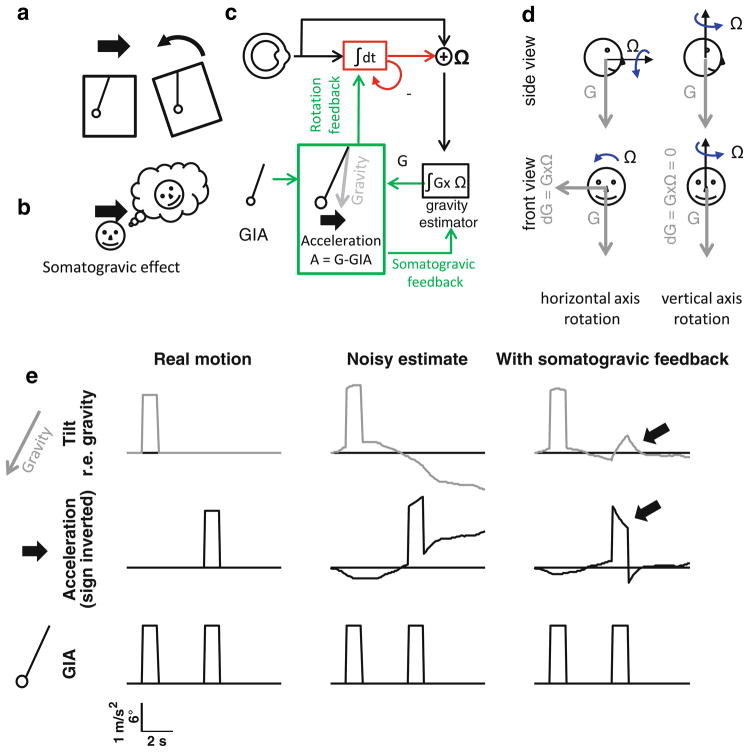
Fig. 2
Processing of inertial information. a: gravito-inertial ambiguity (the otoliths are represented as a pendulum inside of a box). b:somatogravic effect: a prolonged linear acceleration is interpreted as a tilt. c: model of canal and otolith information processing. d: Integration of angular velocity by the tilt estimator. The vector cross-product G × Ω allows computation of the rate of change of gravity (left). Note that this product is equal to zero during earth-vertical axis rotation (right). e: Motion estimates (top: tilt relative to gravity; middle: linear (inertial) acceleration; bottom: gravito-inertial acceleration (GIA)) during a tilt of the head followed by a step of inertial acceleration. The sign of the acceleration trace is inverted for clarity. Arrows illustrate soma-togravic effect. See Fig. 4 for simulation parameters
Fig. 3
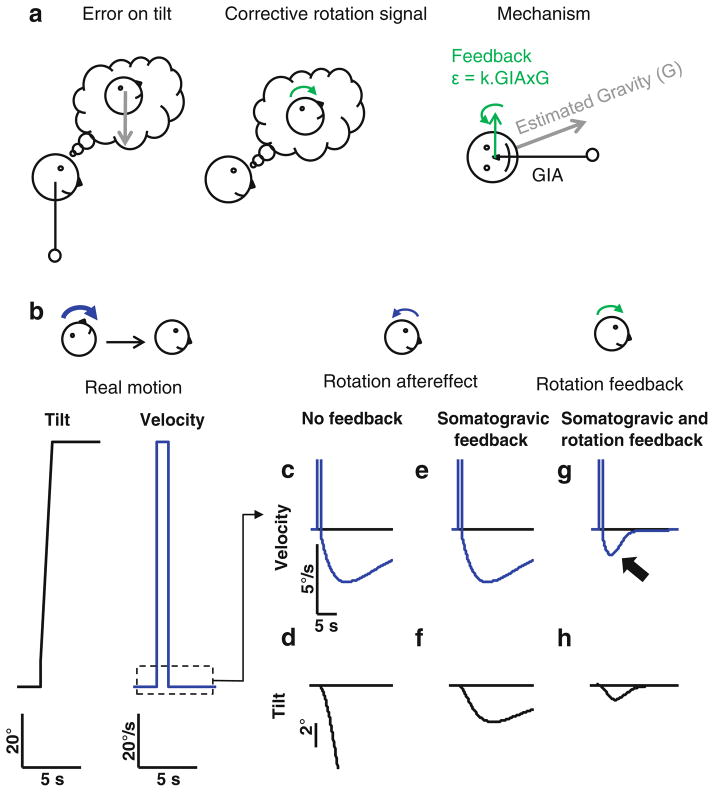
Fig. 3
Need for somatogravic and rotation feedback loops for inertial processing. a: principle of the rotation feedback signal to the velocity storage. b: example of motion inducing a canal aftereffect. ch: rotation velocity (top) and tilt estimate (bottom) caused by the canal aftereffect in the absence of any feedback (c, d), in the presence of somatogravic feedback only (e, f; note that, due to its nature, the somatogravic feedback does not affect the velocity estimate (e) but only the tilt estimate (f)), and in the presence of both somatogravic and rotation feedback loops (g, h). See Fig. 4 for simulation parameters (the noise is omitted for clarity)
Fig. 4
Fig. 4
Modeling visuo-vestibular processing. a: full representation of the model developed in the previous sections and used for all simulations; blue lines: vestibular pathways; grey lines: visual pathways; green lines: inertial pathways. The parameters used in all simulations are: kV = 0.2, ko = 0.6, τVS = 15 s, go = 2, kF = 0.38, l = 0.65. The time constant of the canals is 4 s. For the simulations of Figs. 1, 2. Gaussian noise with standard deviation of 0.1° (canals), 1° (vision) and 0.4° (velocity storage) is added every 0.1 s. b: schematic model of the principles of Bayesian inference applied to vestibular processing; black lines: deterministic model; lightning bolts: sources of noise; question marks: points of error accumulation; blue lines: influence of the zero velocity prior; green lines: influence of the zero translation prior; grey lines: incorporation of visual information
Fig. 5
Fig. 5
Simulations of off-vertical axis rotation (OVAR). a, b: angular velocity estimate during earth-vertical axis rotation (a) and OVAR (b). c: motion of the GIA (black) and the gravity estimate relative to the head during OVAR (gray), and resulting rotation feedback (green). See Fig. 4 for simulation parameters
Fig. 6
Fig. 6
Post-rotatory tilt paradigm. a: illustration of the paradigm and of the rotation indicated by the semicircular canals. b: motion of the estimated gravity caused by the rotation signal (grey arrows) and resulting rotation feedback (green). c, e: rotation estimates during the paradigm, in space-fixed (c) or head-fixed (e) coordinates. d, f: effects of the feedback signal (green arrow) in space-fixed (d) or head-fixed (f) coordinates. See Fig. 4 for simulation parameters

References

    1. Angelaki DE. Three-dimensional organization of otolith-ocular reflexes in rhesus monkeys. III. Responses to translation. J Neurophysiol. 1998;80:680–695. - PubMed
    1. Angelaki DE, Cullen KE. Vestibular system: the many facets of a multimodal sense. Annu Rev Neurosci. 2008;31:125–150. - PubMed
    1. Angelaki DE, Hess BJ. Inertial representation of angular motion in the vestibular system of rhesus monkeys. I. Vestibuloocular reflex. J Neurophysiol. 1994;71:1222–1249. - PubMed
    1. Angelaki DE, Hess BJ. Inertial representation of angular motion in the vestibular system of rhesus monkeys. II. Otolith-controlled transformation that depends on an intact cerebellar nodulus. J Neurophysiol. 1995a;73:1729–1751. - PubMed
    1. Angelaki DE, Hess BJ. Lesion of the nodulus and ventral uvula abolish steady-state off-vertical axis otolith response. J Neurophysiol. 1995b;73:1716–1720. - PubMed

Publication types