


The consequences of post-election violence on antiretroviral HIV therapy in Kenya
- PMID: 21293984
- PMCID: PMC3372410
- DOI: 10.1080/09540121.2010.525615
The consequences of post-election violence on antiretroviral HIV therapy in Kenya
Abstract
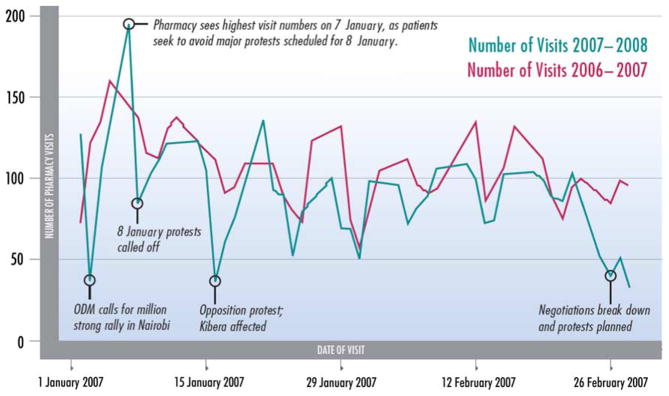
Over 1000 individuals were killed and 600,000 were displaced during post-election violence (PEV) in Kenya in 2008. Antiretroviral therapy (ART) depends on continuous access to medications which may have been interrupted due to PEV. In a mixed-methods retrospective review, treatment interruption of ART during PEV was measured among 2534 HIV-positive adults attending the Coptic Hope Center for Infectious Diseases in Nairobi, Kenya. Clients experiencing treatment interruption were compared between the PEV period (30 December 2007 to 28 February 2008) and the same time period one year earlier. Treatment interruption was defined as visiting the pharmacy ≥48 hours after antiretrovirals were calculated to have been completed. Despite clinical services remaining open throughout the PEV period, more clients (16.1%) experienced treatment interruption than during the comparison period (10.2%). Mean daily pharmacy visits were significantly lower (87 vs. 104; p < 0.006) and more variable (p = 0.03) during PEV. Among clients present at both periods (n = 1605), the odds of treatment interruption were 71% higher during PEV (95% confidence interval [CI], 34-118%). In multivariate analysis, men (odds ratio [OR], 1.37; 95% CI, 1.07-1.76) and clients traveling ≥3 hours to clinic (OR, 1.86; 95% CI, 1.28-2.71) were significantly more likely to experience treatment interruption. Clients affected by PEV were interviewed about factors associated with treatment interruption using semi-structured methods. Clients described fear, lack of transportation, and violence as contributing to treatment interruption. Widespread violence associated with the 2007 election in Kenya revealed the dependence of HIV patients on a stable civil society and infrastructure to access medications. Without the ability to maintain consistent HIV therapy, some patients face rapid treatment failure. HIV programs should have appropriate contingency plans wherever political instability may occur. Peace may be one of the most effective and most important public health interventions in Africa.
Conflict of interest statement
This study was conducted at a treatment program funded through the U.S. President’s Emergency Plan for AIDS Relief (PEPFAR). L. Pyne-Mercier, M. Chung, G. John-Stewart, B. Richardson are employed by the University of Washington, which receives PEPFAR funding. N. Kist, J. Thiga, and H. Noshy are employed by the Coptic Hope Center for Infectious Diseases, which receives PEPFAR funding through the University of Washington and was the site of the research.
Figures
References
-
- Allen K. AIDS patients hit by Kenya crisis. BBC News. 2008 Feb 15; Retrieved from http://newsvote.bbc.co.uk/mpapps/pagetools/print/news.bbc.co.uk/2/hi/afr....
-
- DART Trial Team. Fixed duration interruptions are inferior to continuous treatment in African adults starting therapy with CD4 cell counts <200 cells/ml. AIDS. 2008;22:237–247. - PubMed
-
- Department of State. Background notes: Kenya. 2008 Retrieved from http://www.state.gov/r/pa/ei/bgn/2962.htm.
MeSH terms
Substances
Grants and funding
LinkOut - more resources
Full Text Sources
Medical
