


A comparison of cooling techniques in firefighters after a live burn evolution
- PMID: 21294631
- PMCID: PMC3086381
- DOI: 10.3109/10903127.2010.545482
A comparison of cooling techniques in firefighters after a live burn evolution
Abstract
Objective: We compared the use of two active cooling devices with passive cooling in a moderate-temperature (≈ 22 °C) environment on heart rate (HR) and core temperature (T(c)) recovery when applied to firefighters following 20 minutes of fire suppression.
Methods: Firefighters (23 men, two women) performed 20 minutes of fire suppression at a live-fire evolution. Immediately following the evolution, the subjects removed their thermal protective clothing and were randomized to receive forearm immersion (FI), ice water perfused cooling vest (CV), or passive (P) cooling in an air-conditioned medical trailer for 30 minutes. Heart rate and deep gastric temperature were monitored every 5 minutes during recovery.
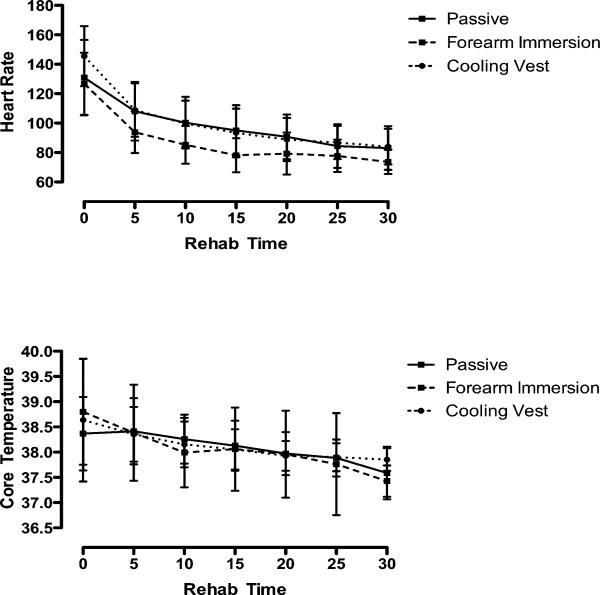
Results: A single 20-minute bout of fire suppression resulted in near-maximal mean ± standard deviation HR (175 ± 13 b min(-1), P; 172 ± 20 b·min(-1), FI; 177 ± 12 b·min(-1), CV) when compared with baseline (p < 0.001), a rapid and substantial rise in T(c) (38.2° ± 0.7°, P; 38.3° ± 0.4°, FI; 38.3° ± 0.3°, CV) compared with baseline (p < 0.001), and body mass lost from sweating of nearly 1 kilogram. Cooling rates (°C·min) differed (p = 0.036) by device, with FI (0.05 ± 0.04) providing higher rates than P (0.03 ± 0.02) or CV (0.03 ± 0.04), although differences over 30 minutes were small and recovery of body temperature was incomplete in all groups.
Conclusions: During 30 minutes of recovery following a 20-minute bout of fire suppression in a training academy setting, there is a slightly higher cooling rate for FI and no apparent benefit to CV when compared with P cooling in a moderate temperature environment.
Figures
References
-
- Gisolfi CV, Wenger CB. Temperature regulation during exercise: oldc oncepts, new ideas. Exerc Sport Sci Rev. 1984;12:339–72. - PubMed
-
- Gledhill N, Jamnik VK. Characterization of the physical demands of firefighting. Canadian Journal of Sport Sciences. 1992;17(3):207–213. - PubMed
-
- von Heimburg ED, Rasmussen AK, Medbo JI. Physiological responses of firefighters and performance predictors during a simulated rescue of hospital patients. Ergonomics. 2006;49(2):111–26. - PubMed
-
- Malley KS, et al. Effects of fire fighting uniform (modern, modified modern, and traditional) design changes on exercise duration in New York City Firefighters. J Occup Environ Med. 1999;41(12):1104–15. - PubMed
-
- National Fire Protection Association . NFPA 1584: Standard on the Rehabilitation Process for Members During Emergency Operations and Training Exercises. Quincy MA: 2007.
Publication types
MeSH terms
Grants and funding
LinkOut - more resources
Full Text Sources
Medical
Miscellaneous
