


Evaluation of four novel genetic variants affecting hemoglobin A1c levels in a population-based type 2 diabetes cohort (the HUNT2 study)
- PMID: 21294870
- PMCID: PMC3044669
- DOI: 10.1186/1471-2350-12-20
Evaluation of four novel genetic variants affecting hemoglobin A1c levels in a population-based type 2 diabetes cohort (the HUNT2 study)
Abstract
Background: Chronic hyperglycemia confers increased risk for long-term diabetes-associated complications and repeated hemoglobin A1c (HbA1c) measures are a widely used marker for glycemic control in diabetes treatment and follow-up. A recent genome-wide association study revealed four genetic loci, which were associated with HbA1c levels in adults with type 1 diabetes. We aimed to evaluate the effect of these loci on glycemic control in type 2 diabetes.
Methods: We genotyped 1,486 subjects with type 2 diabetes from a Norwegian population-based cohort (HUNT2) for single-nucleotide polymorphisms (SNPs) located near the BNC2, SORCS1, GSC and WDR72 loci. Through regression models, we examined their effects on HbA1c and non-fasting glucose levels individually and in a combined genetic score model.
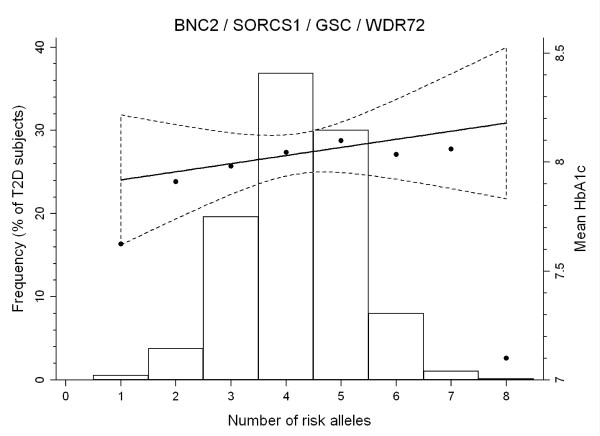
Results: No significant associations with HbA1c or glucose levels were found for the SORCS1, BNC2, GSC or WDR72 variants (all P-values > 0.05). Although the observed effects were non-significant and of much smaller magnitude than previously reported in type 1 diabetes, the SORCS1 risk variant showed a direction consistent with increased HbA1c and glucose levels, with an observed effect of 0.11% (P = 0.13) and 0.13 mmol/l (P = 0.43) increase per risk allele for HbA1c and glucose, respectively. In contrast, the WDR72 risk variant showed a borderline association with reduced HbA1c levels (β = -0.21, P = 0.06), and direction consistent with decreased glucose levels (β = -0.29, P = 0.29). The allele count model gave no evidence for a relationship between increasing number of risk alleles and increasing HbA1c levels (β = 0.04, P = 0.38).
Conclusions: The four recently reported SNPs affecting glycemic control in type 1 diabetes had no apparent effect on HbA1c in type 2 diabetes individually or by using a combined genetic score model. However, for the SORCS1 SNP, our findings do not rule out a possible relationship with HbA1c levels. Hence, further studies in other populations are needed to elucidate whether these novel sequence variants, especially rs1358030 near the SORCS1 locus, affect glycemic control in type 2 diabetes.
Figures
References
-
- Balkau B, Shipley M, Jarrett RJ, Pyorala K, Pyorala M, Forhan A, Eschwege E. High blood glucose concentration is a risk factor for mortality in middle-aged nondiabetic men. 20-year follow-up in the Whitehall Study, the Paris Prospective Study, and the Helsinki Policemen Study. Diabetes Care. 1998;21(3):360–367. doi: 10.2337/diacare.21.3.360. - DOI - PubMed
-
- Barr EL, Boyko EJ, Zimmet PZ, Wolfe R, Tonkin AM, Shaw JE. Continuous relationships between non-diabetic hyperglycaemia and both cardiovascular disease and all-cause mortality: the Australian Diabetes, Obesity, and Lifestyle (AusDiab) study. Diabetologia. 2009;52(3):415–424. doi: 10.1007/s00125-008-1246-y. - DOI - PubMed
Publication types
MeSH terms
Substances
LinkOut - more resources
Full Text Sources
Medical
Research Materials
