Review
. 2011 Feb 4;144(3):327-39.
doi: 10.1016/j.cell.2011.01.024.

Functional and mechanistic diversity of distal transcription enhancers

Affiliations
Review

Functional and mechanistic diversity of distal transcription enhancers

Michael Bulger et al. Cell. .

Erratum in

  • Cell. 2011 Mar 4;144(5):825

Abstract

Biological differences among metazoans and between cell types in a given organism arise in large part due to differences in gene expression patterns. Gene-distal enhancers are key contributors to these expression patterns, exhibiting both sequence diversity and cell type specificity. Studies of long-range interactions indicate that enhancers are often important determinants of nuclear organization, contributing to a general model for enhancer function that involves direct enhancer-promoter contact. However, mechanisms for enhancer function are emerging that do not fit solely within such a model, suggesting that enhancers as a class of DNA regulatory element may be functionally and mechanistically diverse.


Figures

Figure 1
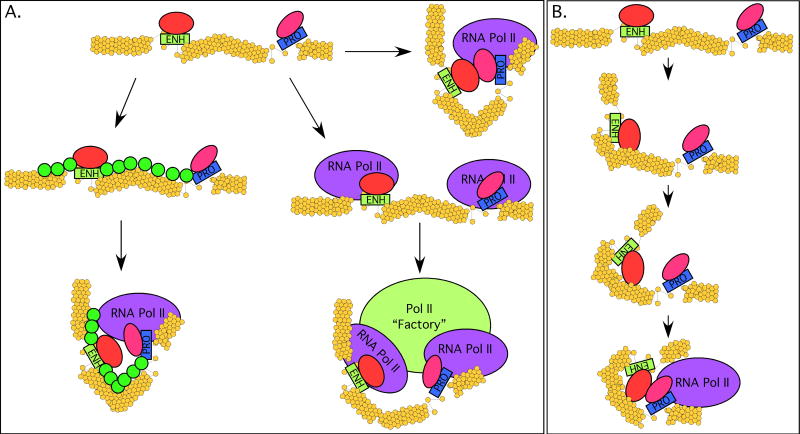
Figure 1. Enhancer Looping and Variants
(A) Simplified schematic of how enhancers might interact directly with promoters. Nucleosomes are shown as yellow circles, and the default state for chromatin is shown as a 30 nm fiber. Factors are bound to both the enhancer and promoter (red and pink ovals). These factors can potentially interact with each other. The simplest mechanism by which they might do this is via free diffusion in the nucleus (arrow 1). Enhancer-promoter interactions might be facilitated by additional factors (green circles) that bind to the intervening sequences and organize them to bring the enhancer and promoter into proximity (arrow 2). Alternatively, both enhancer and promoter can interact with RNA polymerase II, which then serves to bring the elements into proximity via association with a common RNA polymerase II transcription “factory” (arrow 3). (B) Tracking. The enhancer-bound complex (red oval) actively scans along the chromatin fiber until it encounters the promoter complex.
Figure 2
Figure 2. Alternative mechanisms of enhancer function
(A). “Placeholding”. In ES cells, the enhancer (ENH) is occupied by ES cell-specific transcription factors, but the gene promoter (PRO) is not active. In this representation, nucleosomes are designated by orange circles, and we depict the default state of chromatin as the 30 nm fiber. Upon differentiation along the lineage in which the gene is normally expressed, the ES cell-specific factors are downregulated, but new cell-specific factors occupy the enhancer in their place and mediate gene activation (bottom right). Upon differentiation into another lineage, the ES cell-specific factors are not replaced and the locus is inactivated (top right). (B) Spreading. The enhancer (ENH) is bound by a factor or factors that recruit chromatin-modifying or other activities (blue and yellow ovals), which then spread along the chromatin fiber bidirectionally until they reach a promoter. Histones may be modified throughout the region (nucleosomes shaded green), leading to the formation of a distinct chromatin “domain”. (C) Noncoding RNA. The enhancer (ENH) is bound by RNA polymerase II and transcribed. By as-yet undefined mechanisms, the noncoding RNA then mediates transcriptional activation of a neighboring, but still distal, gene promoter.
Figure 3
Figure 3. Mechanisms of distal regulatory element function in yeast and bacteria
(A) HO gene activation in yeast. The locus is diagrammed in the top panel, with the gene represented by the green box (“HO”), nucleosomes by orange circles, and binding sites for Swi5p, located >1 kb upstream of the gene, by open boxes. Swi5p enters the nucleus and binds its cognate sites in late anaphase of the cell cycle (second panel), and is required for recruitment of the SWI/SNF chromatin remodeling complex. SWI/SNF recruitment in turn leads to later recruitment, in mid- to late telophase, of the acetyltransferase-containing SAGA complex, which acetylates nucleosomes throughout the region (yellow circles), and in turn recruits additional factors (Swi4/Swi6) required for gene activation. Swi5p, however, is present only transiently and does not participate directly in these subsequent steps. (B) Mating-type silencing in S. cerevisiae. In this simplified representation, a discrete silencer element is bound by several factors (ORC, Abf1p, Rap1p) which in turn recruit a complex of SIR proteins that includes a histone deacetylase. Deacetylated nucleosomes (orange circles) are in turn recognized by the SIR complex, which can then deacetylate additional nucleosomes, resulting in a progressive spread of histone deacetylation and associated SIR complexes. Genes within the region are silenced. (C) Enhancer-binding protein interactions with σ54-dependent promoters in bacteria. An enhancer sequence (ENH) is recognized by enhancer-binding protein (EBP), and in turn the promoter (PRO) is recognized by a σ54 holoenzyme that includes RNA polymerase. This closed complex is only activated upon direct interaction between the EBP and σ54 (bottom), which can be facilitated by DNA bending mediated by integration host factor (IHF) binding between the enhancer and promoter. (D) Activation of phage T4 late genes by a tracking complex. A sliding clamp, consisting of a trimer of gp45 polypeptides, is loaded at a promoter-distal site by the gp44-gp62 complex. The gp45 trimer then tracks or slides along the DNA until it reaches the promoter, where it mediates gene activation. In this representation, RNA polymerase and additional factors (gp33 and gp55) are present at the promoter in a closed complex prior to the arrival of gp45, but this is not known; in other models the polymerase can track with gp45, for example.

References

    1. Amano T, Sagai T, Tanabe H, Mizushina Y, Nakazawa H, Shiroishi T. Chromosomal dynamics at the Shh locus: limb bud-specific differential regulation of competence and active transcription. Dev Cell. 2009;16:47–57. - PubMed
    1. Andrulis ED, Neiman AM, Zappulla DC, Sternglanz R. Perinuclear localization of chromatin facilitates transcriptional silencing. Nature. 1998;394:592–595. - PubMed
    1. Banerji J, Rusconi S, Schaffner W. Expression of a beta-globin gene is enhanced by remote SV40 DNA sequences. Cell. 1981;27:299–308. - PubMed
    1. Banerji J, Olson L, Schaffner W. A lymphocyte-specific cellular enhancer is located downstream of the joining region in immunoglobulin heavy chain genes. Cell. 1983;33:729–740. - PubMed
    1. Barski A, Cuddapah S, Cui K, Roh TY, Schones DE, Wang Z, Wei G, Chepelev I, Zhao K. High-resolution profiling of histone methylations in the human genome. Cell. 2007;129:823–837. - PubMed

Publication types

LinkOut - more resources