


Review
doi: 10.1016/j.placenta.2011.01.009.
Epub 2011 Feb 4.
Review: hCG, preeclampsia and regulatory T cells
Affiliations
- PMID: 21295851
- PMCID: PMC3061407
- DOI: 10.1016/j.placenta.2011.01.009
Item in Clipboard
Review
Review: hCG, preeclampsia and regulatory T cells
Placenta.
2011 Mar.
Abstract
Human chorionic gonadotropin (hCG) is crucial for successful pregnancy. Its many functions include angiogenesis and immune regulation. Despite years of research, the etiology of preeclampsia remains unknown. Marked by insufficient trophoblast invasion and poor spiral artery remodeling, preeclampsia has also been linked to immune dysregulation. Here we discuss the roles of hCG in the context of endovascular cross-talk between trophoblasts and endothelial cells and immune tolerance. We propose that functional and glycosylation modifications of hCG may contribute to the pathogenesis of preeclampsia.
Copyright © 2011 Elsevier Ltd. All rights reserved.
Figures
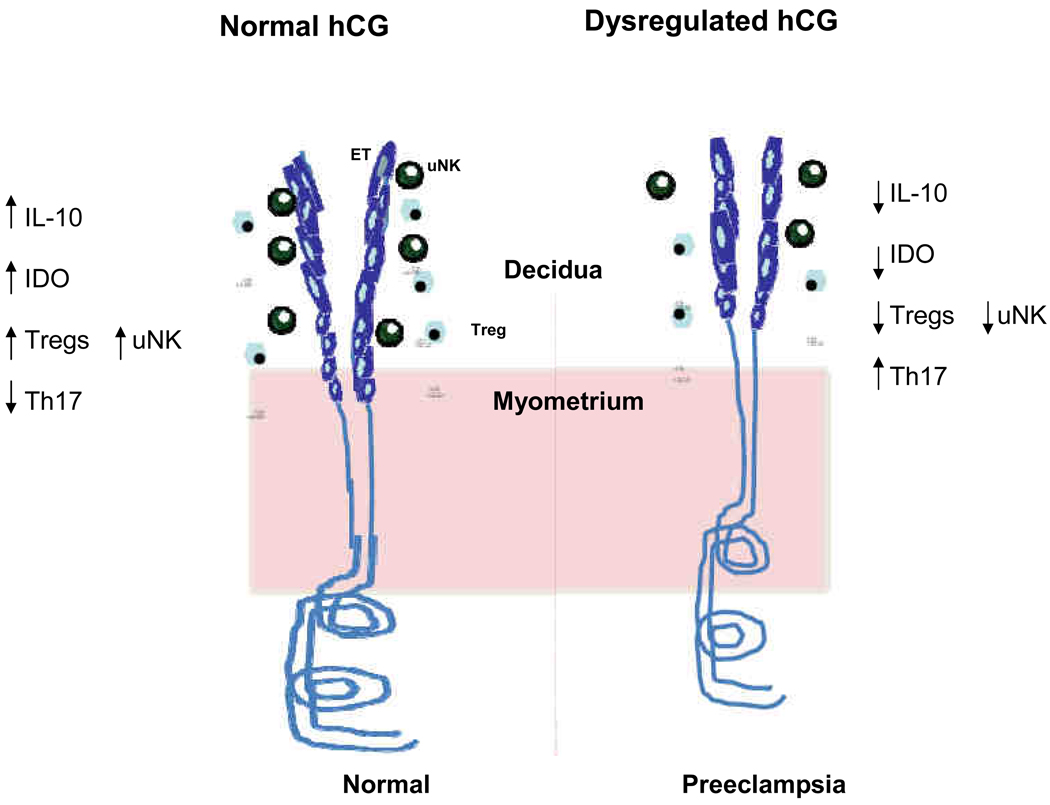
Dysregulation of hCG may lead to preeclampsia. In normal pregnancy, functional hCG, optimum expression of IL-10, and the temporal appearance of uNK and Tregs contribute to immune tolerance and angiogenesis. Dysregulated hCG due to altered structure/glycosylation may influence expression of IL-10, IDO and appearance of Tregs and uNK cells resulting in pregnancy complications such as preeclampsia. hCG: human chorionic gonadotropin, IL-10: interleukin-10, IDO: indoleamine 2,3-dioxygenase, uNK : uterine natural killer cells, Treg: regulatory T cells, ET: endovascular trophoblasts.
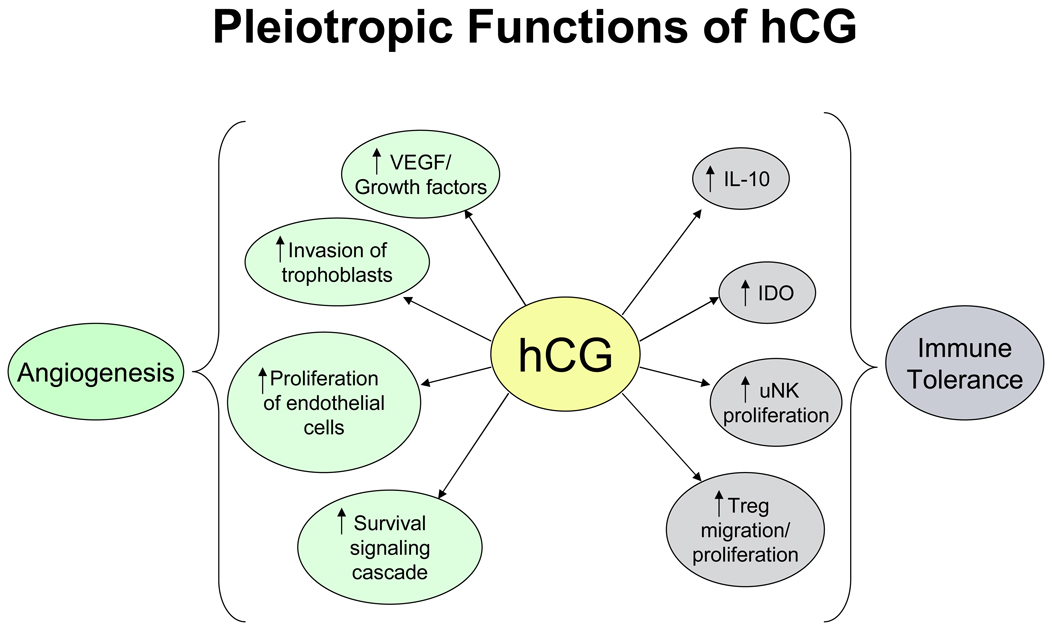
Angiogenic and immune tolerance function of hCG. hCG has many angiogenic functions such as stimulation of VEGF production, trophoblast invasion and proliferation of endothelial cells. By stimulating IL-10 and IDO expression, promoting uNK cell proliferation and Treg cell migration, hCG may play a role in immune tolerance at the maternal fetal interface. VEGF: vascular endothelial growth factor, hCG: human chorionic gonadotropin, IL-10: interleukin-10, IDO: indoleamine 2,3-dioxygenase, uNK: uterine natural killer cells, Treg: regulatory T cells.
References
-
- Meekins JW, Pijnenborg R, Hanssens M, McFadyen IR, van Asshe A. A study of placental bed spiral arteries and trophoblast invasion in normal and severe pre-eclamptic pregnancies. Br J Obstet Gynaecol. 1994;101:669–674. - PubMed
-
- Toldi G, Svec P, Vasarhelyi B, Meszaros G, Rigo J, Tulassay T, Treszi A. Decreased number of FoxP3+ regulatory T cells in preeclampsia. Acta Obstet Gynecol Scand. 2008;87:1229–1233. - PubMed
-
- Williams PJ, Bulmer JN, Searle RF, Innes BA, Robson SC. Altered decidual leucocyte populations in the placental bed in pre-eclampsia and foetal growth restriction: a comparison with late normal pregnancy. Reproduction. 2009;138:177–184. - PubMed
Publication types
MeSH terms
Substances
Grants and funding
LinkOut - more resources
Full Text Sources
