. 2011 Apr;77(7):2399-405.
doi: 10.1128/AEM.02341-10. Epub 2011 Feb 4.

Enhancing isoprene production by genetic modification of the 1-deoxy-d-xylulose-5-phosphate pathway in Bacillus subtilis

Affiliations

Enhancing isoprene production by genetic modification of the 1-deoxy-d-xylulose-5-phosphate pathway in Bacillus subtilis

Junfeng Xue et al. Appl Environ Microbiol. 2011 Apr.

Abstract

To enhance the production of isoprene, a volatile 5-carbon hydrocarbon, in the Gram-positive spore-forming rod-shaped bacterium Bacillus subtilis, 1-deoxy-d-xylulose-5-phosphate synthase (Dxs) and 1-deoxy-d-xylulose-5-phosphate reductoisomerase (Dxr) were overexpressed in B. subtilis DSM 10. For the strain that overexpresses Dxs, the yield of isoprene was increased 40% over that by the wild-type strain. In the Dxr overexpression strain, the level of isoprene production was unchanged. Overexpression of Dxr together with Dxs showed an isoprene production level similar to that of the Dxs overproduction strain. The effects of external factors, such as stress factors including heat (48°C), salt (0.3 M NaCl), ethanol (1%), and oxidative (0.005% H(2)O(2)) stress, on isoprene production were further examined. Heat, salt, and H(2)O(2) induced isoprene production; ethanol inhibited isoprene production. In addition, induction and repression effects are independent of SigB, which is the general stress-responsive alternative sigma factor of Gram-positive bacteria.


Figures
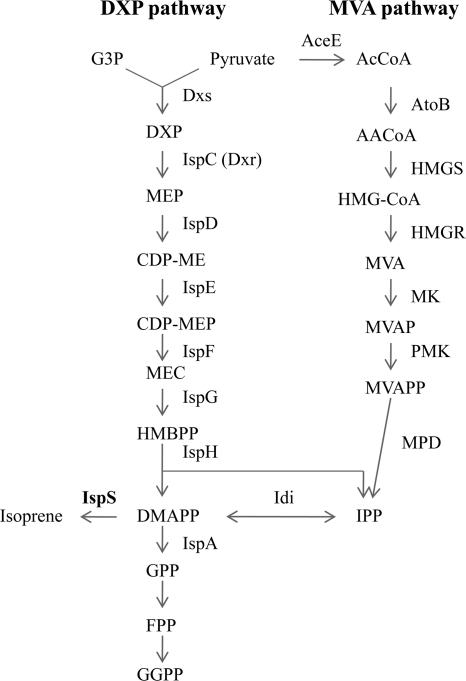
FIG. 1.
FIG. 1.
Pathways of isoprenoid biosynthesis in E. coli, B. subtilis, and Saccharomyces cerevisiae (14, 38, 39). G3P, glyceraldehyde-3-phosphate; DXP, 1-deoxy-d-xylulose 5-phosphate; MEP, 2-C-methyl-d-erythritol 4-phosphate; CDP-ME, 4-diphosphocytidyl-2-C-methylerythritol; CDP-MEP, CDP-ME 2-phosphate; MEC, 2-C-methyl-d-erythritol-2,4-cyclodiphosphate; HMBPP, (E)-4-hydroxy-3-methylbut-2-enyl-diphosphate; AcCoA, acetyl coenzyme A (acetyl-CoA); AACoA, acetoacetyl-CoA; HMG-CoA, hydroxymethylglutaryl-CoA; MVAP, mevalonate-5-phosphate; MVAPP, mevalonate-5-diphosphate; GPP, geranyl diphosphate; FPP, farnesyl diphosphate; GGPP, geranylgeranyl diphosphate; Dxs, 1-deoxy-d-xylulose-5-phosphate synthase; IspC, 1-deoxy-d-xylulose-5-phosphate reductoisomerase; IspD, 4-diphosphocytidyl-2-C-methyl-d-erythritol synthase; IspE, 4-diphosphocytidyl-2-C-methyl-d-erythritol kinase; IspF, 2-C-methyl-d-erythritol 2,4-cyclodiphosphate synthase; IspG, 1-hydroxy-2-methyl-2-(E)-butenyl 4-diphosphate synthase; IspH, 1-hydroxy-2-methyl-butenyl 4-diphosphate reductase; IspA, farnesyl diphosphate synthase; IspS, isoprene synthase; AtoB, acetoacetyl-CoA thiolase; HMGS, hydroxymethylglutaryl-CoA synthase; HMGR, hydroxymethylglutaryl-CoA reductase; MK, mevalonate kinase; PMK, phosphomevalonate kinase; MPD, mevalonate pyrophosphate decarboxylase; Idi, isopentenyl pyrophosphate isomerase.
FIG. 2.
FIG. 2.
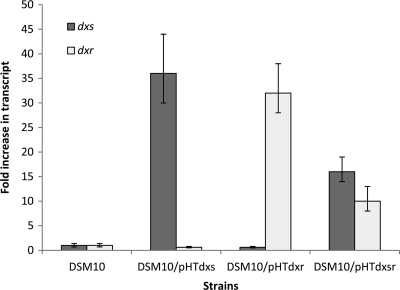
Real-time RT-PCR analysis of the relative levels of dxs and dxr mRNAs in DSM 10 and three overexpression strains. The averages of results obtained from three independent RNA preparations are shown. All transcript levels were measured in triplicate for each RNA preparation. Error bars represent standard deviations from the means.
FIG. 3.
FIG. 3.
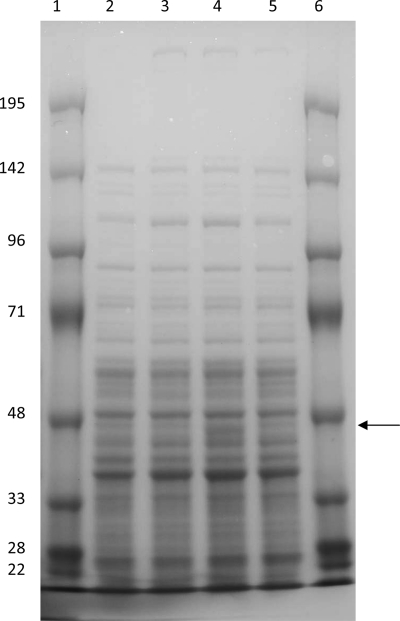
SDS-PAGE analysis of B. subtilis DSM 10, DSM 10/pHTdxs, DSM 10/pHTdxr, and DSM 10/pHTdxsr. Lanes: 1 and 6, protein markers; 2, wild type; 3, DSM 10/pHTdxs; 4, DSM 10/pHTdxr; 5, DSM 10/pHTdxsr. The arrow indicates the expected size for Dxr (43 kDa). The expected band for Dxs (70 kDa) could not be identified from SDS-PAGE.
FIG. 4.
FIG. 4.
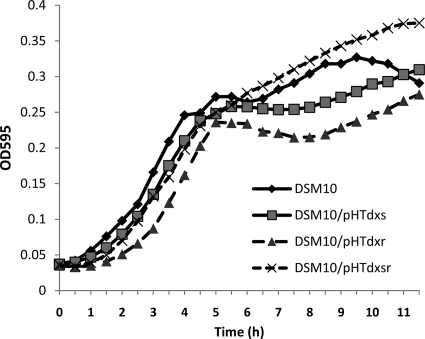
Growth curve analysis of the wild-type strain DSM 10 and overexpression strains in LB medium at 30°C. The curves indicate the average OD595 of each culture over time. Each sample was measured in triplicate.
FIG. 5.
FIG. 5.
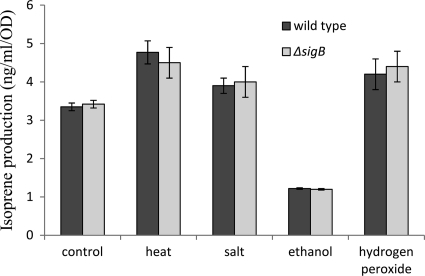
Isoprene production is induced by heat (48°C), salt (0.3 M NaCl), and oxidative stress (0.005% H2O2) and is repressed by 1% ethanol in the B. subtilis strain DSM 10 and the sigB in-frame deletion mutant. The average concentrations (ng/ml/OD600) obtained from three independent cultures are shown. Error bars represent standard deviations from the means.

References

    1. Alper, H., Y. S. Jin, J. F. Moxley, and G. Stephanopoulos. 2005. Identifying gene targets for the metabolic engineering of lycopene biosynthesis in Escherichia coli. Metab. Eng. 7:155-164. - PubMed
    1. Anthony, J. R., et al. 2009. Optimization of the mevalonate-based isoprenoid biosynthetic pathway in Escherichia coli for production of the anti-malarial drug precursor amorpha-4,11-diene. Metab. Eng. 11:13-19. - PubMed
    1. Boylan, S. A., A. R. Redfield, M. S. Brody, and C. W. Price. 1993. Stress-induced activation of the sigma B transcription factor of Bacillus subtilis. J. Bacteriol. 175:7931-7937. - PMC - PubMed
    1. Camilli, A., L. G. Tilney, and D. A. Portnoy. 1993. Dual roles of plcA in Listeria monocytogenes pathogenesis. Mol. Microbiol. 8:143-157. - PMC - PubMed
    1. Ferreira, A., C. P. O'Byrne, and K. J. Boor. 2001. Role of σB in heat, ethanol, acid, and oxidative stress resistance and during carbon starvation in Listeria monocytogenes. Appl. Environ. Microbiol. 67:4454-4457. - PMC - PubMed

Publication types

MeSH terms