


Low dose organochlorine pesticides and polychlorinated biphenyls predict obesity, dyslipidemia, and insulin resistance among people free of diabetes
- PMID: 21298090
- PMCID: PMC3027626
- DOI: 10.1371/journal.pone.0015977
Low dose organochlorine pesticides and polychlorinated biphenyls predict obesity, dyslipidemia, and insulin resistance among people free of diabetes
Abstract
Background: There is emerging evidence that background exposure to persistent organic pollutants (POPs) are important in the development of conditions predisposing to diabetes as well as of type 2 diabetes itself. We recently reported that low dose POPs predicted incident type 2 diabetes in a nested case-control study. The current study examined if low dose POPs predicted future adiposity, dyslipidemia, and insulin resistance among controls without diabetes in that study.
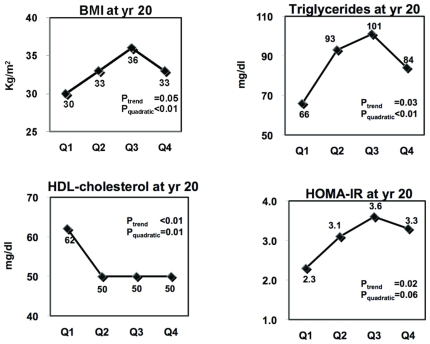
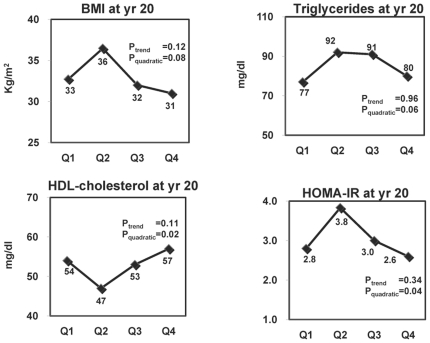
Methodology/principal findings: The 90 controls were diabetes-free during 20 years follow-up. They were a stratified random sample, enriched with overweight and obese persons. POPs measured in 1987-88 (year 2) sera included 8 organochlorine (OC) pesticides, 22 polychlorinated biphenyls (PCBs), and 1 polybrominated biphenyl (PBB). Body mass index (BMI), triglycerides, HDL-cholesterol, LDL-cholesterol, and homeostasis model assessment value for insulin resistance (HOMA-IR) were study outcomes at 2005-06 (year 20). The evolution of study outcomes during 18 years by categories of serum concentrations of POPs at year 2 was evaluated by adjusting for the baseline values of outcomes plus potential confounders. Parallel to prediction of type 2 diabetes, many statistically significant associations of POPs with dysmetabolic conditions appeared at low dose, forming inverted U-shaped dose-response relations. Among OC pesticides, p,p'-DDE most consistently predicted higher BMI, triglycerides, and HOMA-IR and lower HDL-cholesterol at year 20 after adjusting for baseline values. Oxychlordane, trans-nonachlor, and hexachlorobenzene also significantly predicted higher triglycerides. Persistent PCBs with ≥7 chlorides predicted higher BMI, triglycerides, and HOMA-IR and lower HDL-cholesterol at year 20 with similar dose-response curves.
Conclusions/significance: Simultaneous exposure to various POPs in the general population may contribute to development of obesity, dyslipidemia, and insulin resistance, common precursors of type 2 diabetes and cardiovascular diseases. Although obesity is a primary cause of these metabolic abnormalities, POPs exposure may contribute to excess adiposity and other features of dysmetabolism.
Conflict of interest statement
Figures
References
-
- Lee DH, Lee IK, Steffes M, Jacobs DR., Jr Extended analyses of the association between serum concentrations of persistent organic pollutants and diabetes. Diabetes Care. 2007;30:1596–1598. - PubMed
-
- Lee DH, Lee IK, Song K, Steffes M, Toscano W, et al. A strong dose-response relation between serum concentrations of persistent organic pollutants and diabetes: results from the National Health and Examination Survey 1999-2002. Diabetes Care. 2006;29:1638–1644. - PubMed
-
- Daston GP, Cook JC, Kavlock RJ. Uncertainties for endocrine disrupters: our view on progress. Toxicol Sci. 2003;74:245–252. - PubMed
Publication types
MeSH terms
Substances
Grants and funding
- N01 HC095095/HL/NHLBI NIH HHS/United States
- N01 HC048048/HL/NHLBI NIH HHS/United States
- R01 HL053560/HL/NHLBI NIH HHS/United States
- N01-HC-48047/HC/NHLBI NIH HHS/United States
- N01-HC-95095/HC/NHLBI NIH HHS/United States
- N01-HC-48050/HC/NHLBI NIH HHS/United States
- N01-HC-48049/HC/NHLBI NIH HHS/United States
- N01 HC048047/HL/NHLBI NIH HHS/United States
- N01 HC048050/HL/NHLBI NIH HHS/United States
- N01-HC-48048/HC/NHLBI NIH HHS/United States
- R01-HL-53560/HL/NHLBI NIH HHS/United States
- N01 HC048049/HL/NHLBI NIH HHS/United States
LinkOut - more resources
Full Text Sources
Medical
