


Optimal sampling intervals to assess long-term glycemic control using continuous glucose monitoring
- PMID: 21299401
- PMCID: PMC6468940
- DOI: 10.1089/dia.2010.0156
Optimal sampling intervals to assess long-term glycemic control using continuous glucose monitoring
Abstract
Aims and hypothesis: The optimal duration and frequency of short-term continuous glucose monitoring (CGM) to reflect long-term glycemia have not been determined. The Juvenile Diabetes Research Foundation CGM randomized trials provided a large dataset of longitudinal CGM data for this type of analysis.
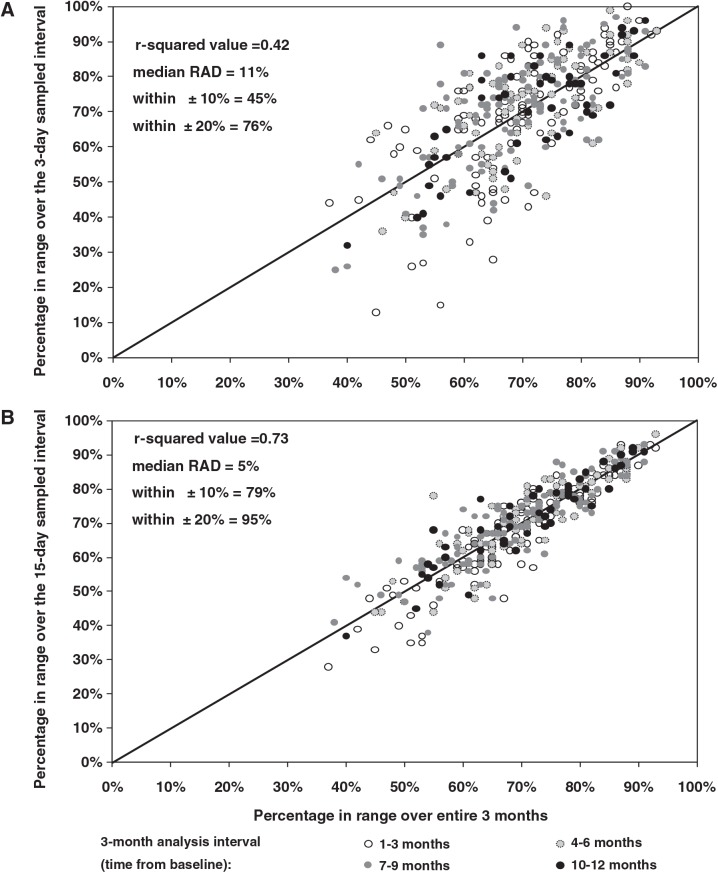
Methods: The analysis included 185 subjects who had 334 3-month intervals of CGM data meeting specific criteria. For various glucose indices, correlations (r²) were computed for the entire 3-month interval versus selected sampling periods ranging from 3 to 15 days. Other computed agreement measures included median relative absolute difference, values within ± 10% and ± 20% of full value, and median absolute difference.
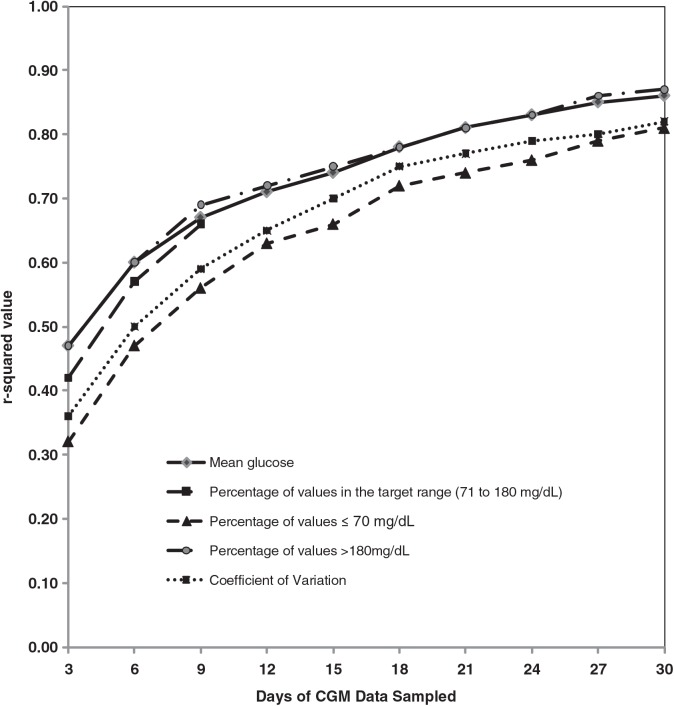
Results: As would be expected, the more days of glucose data that were sampled, the higher the correlation with the full 3 months of data. For 3 days of sampling, the r² value ranged from 0.32 to 0.47, evaluating mean glucose, percentage of values 71-180 mg/dL, percentage of values > 180 mg/dL, percentage of values ≤ 70 mg/dL, and coefficient of variation; in contrast, for 15 days of sampling, the r² values ranged from 0.66 to 0.75. The results were similar when the analysis intervals were stratified by age group (8-14, 15-24, and ≥ 25 years), by baseline hemoglobin A1c level (< 7.0% and ≥ 7.0%), and by CGM device type.
Conclusions and interpretation: Our data suggest that a 12-15-day period of monitoring every 3 months may be needed to optimally assess overall glucose control. Shorter periods of sampling can be useful, but the correlation with 3-month measures of glycemic control is lower.
Trial registration: ClinicalTrials.gov NCT00406133.
Figures
References
-
- Bugler J. An estimation of the amount of data required to measure glycemic variability. Presented at the Advanced Technologies and Treatment for Diabetes Conference; Prague, Czech Republic. 2008.
-
- Fiallo-Scharer R. Diabetes Research in Children Network Study Group: Eight-point glucose testing versus the continuous glucose monitoring system in evaluation of glycemic control in type 1 diabetes. J Clin Endocrinol Metab. 2005;90:3387–3391. - PubMed
-
- Juvenile Diabetes Research Foundation Continuous Glucose Monitoring Study Group. Tamborlane WV. Beck RW. Bode BW. Buckingham B. Chase HP. Clemons R. Fiallo-Scharer R. Fox LA. Gilliam LK. Hirsch IB. Huang ES. Kollman C. Kowalski AJ. Laffel L. Lawrence JM. Lee J. Mauras N. O'Grady M. Ruedy KJ. Tansey M. Tsalikian E. Weinzimer S. Wilson DM. Wolpert H. Wysocki T. Xing D. Continuous glucose monitoring and intensive treatment of type 1 diabetes. N Engl J Med. 2008;359:1464–1476. - PubMed
-
- Chase HP. Beck RW. Xing D. Tamborlane WV. Coffey J. Fox LA. Ives B. Keady J. Kollman C. Laffel L. Ruedy KJ. Continuous glucose monitoring in youth with type 1 diabetes: 12-month follow-up of the Juvenile Diabetes Research Foundation continuous glucose monitoring randomized trial. Diabetes Technol Ther. 2010;12:507–515. - PubMed
Publication types
MeSH terms
Substances
Associated data
Grants and funding
LinkOut - more resources
Full Text Sources
Medical
Research Materials
