. 2011 Feb;79(4):940-53.
doi: 10.1111/j.1365-2958.2010.07504.x. Epub 2010 Dec 30.

The zinc cluster transcription factor Ahr1p directs Mcm1p regulation of Candida albicans adhesion

Affiliations

The zinc cluster transcription factor Ahr1p directs Mcm1p regulation of Candida albicans adhesion

Christopher Askew et al. Mol Microbiol. 2011 Feb.

Abstract

Biofilm development by Candida albicans requires cell adhesion for the initial establishment of the biofilm and the continued stability after hyphal development occurs; however, the regulation of the process has not been fully established. Using chromatin immunoprecipitation coupled to microarray analysis (ChIP-chip) we have characterized a regulon containing the Mcm1p factor that is required for the initial surface adhesion during biofilm formation. In the yeast Saccharomyces cerevisiae several Mcm1p regulons have been characterized in which regulatory specificity is achieved through cofactors binding a sequence adjacent to the Mcm1p binding site. This new Mcm1p regulon in C. albicans also requires a cofactor, which we identify as the transcription factor Ahr1p. However, in contrast to the other yeast regulons, Ahr1p alone binds the target promoters, which include several key adhesion genes, and recruits Mcm1p to these sites. Through transcription profiling and qPCR analysis, we demonstrate that this Ahr1p-Mcm1p complex directly activates these adhesion genes. When the regulatory circuit was disrupted by deleting AHR1, the strain displayed reduced adherence to a polystyrene surface. We also demonstrate a role for the regulon in hyphal growth and in virulence. Our work thus establishes a new mechanism of Mcm1p-directed regulation distinct from those observed for other Mcm1p co-regulators.


Figures

Fig. 1
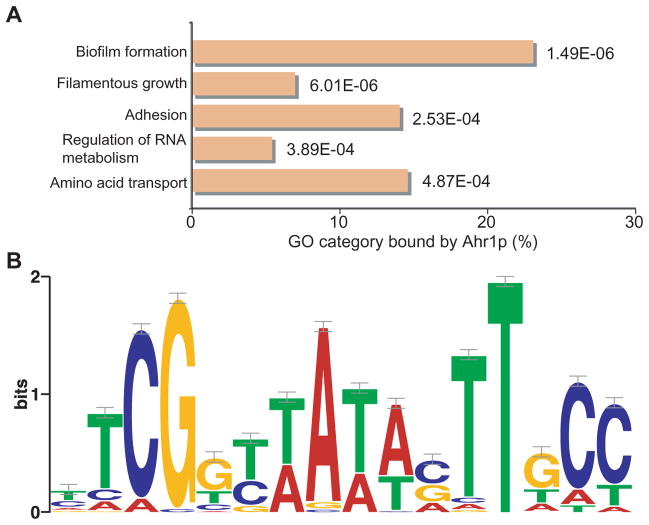
Fig. 1. Ahr1p binds many promoter targets involved in biofilm formation and recognizes a typical zinc cluster motif
A. ChIP-chip of Ahr1p was performed and the 182 gene targets with a peak intensity greater than twofold were analysed for GO enrichment. GO categories with P < 0.0005 are displayed with the P-value indicated. Only the general categories of adhesion and filamentous growth are shown although more specific categories related to these processes were enriched but were omitted because of redundancy. B. Consensus motif representing the binding site of Ahr1p based on the top peak intensity targets (> 5-fold enrichment). The sequence surrounding each peak point (covering five probes, 300 bp) was sent to MEME (http://meme.sdsc.edu/meme4_5_0/intro.html) and the most significant motif is reported.
Fig. 2
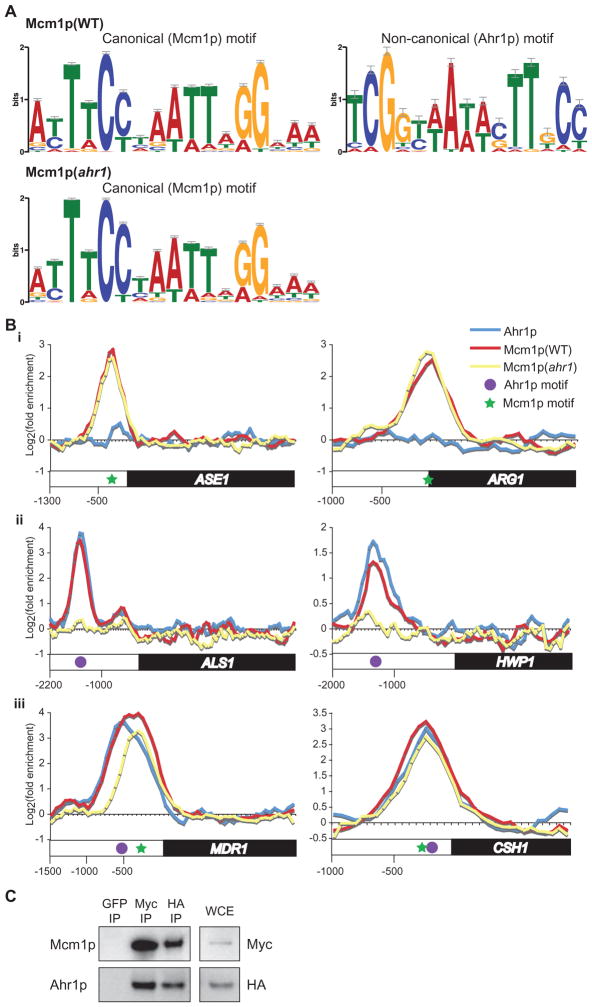
Fig. 2. Ahr1p directs Mcm1p binding to the non-canonical motif
A. Consensus motifs representing the binding sites of Mcm1p in a wild-type strain and an ahr1 deletion strain based on ChIP-chip. The sequence surrounding (covering five probes, 300 bp) the top peak intensity targets (> 5-fold enrichment) was sent to MEME (http://meme.sdsc.edu/meme4_5_0/intro.html) and the most significant high-complexity motifs are reported. B. ChIP-chip binding curves representing Ahr1p, Mcm1p(WT) and Mcm1p(ahr1) binding for type 1 (i), type 2 (ii) and type 3 (iii) Mcm1p targets. Data points for the curves were plotted at each probe position of 60 bp intervals. Values were determined by taking the mean fold enrichment of each probe and the surrounding four probes. C. Immunoprecipitations with an Ahr1p HA-tagged and Mcm1p Myc-tagged strain were performed with cells grown in YPD media at 30°C. The top labels refer to the antibody used in the immunoprecipitation and the labels on the right refer to the primary antibody used to probe the membrane. The GFP antibody was used as a negative control and WCE represents the whole cell extract.
Fig. 3
Fig. 3
The Ahr1p–Mcm1p complex activates ALS1, ALS4 and HWP1 under adhesion-promoting growth conditions. RNA was extracted after 2 h of adhesion to a polystyrene surface and mRNA expression of selected adhesion genes was determined by qPCR for the ahr1 strain (CAS12) compared with the wild-type strain (CAS19). ‘NC’ indicates no change in gene expression. ALS3 and ALS9 were included as comparison references as neither Ahr1p nor Mcm1p bound their promoters and their expression was unchanged in the ahr1 transcription profile.
Fig. 4
Fig. 4
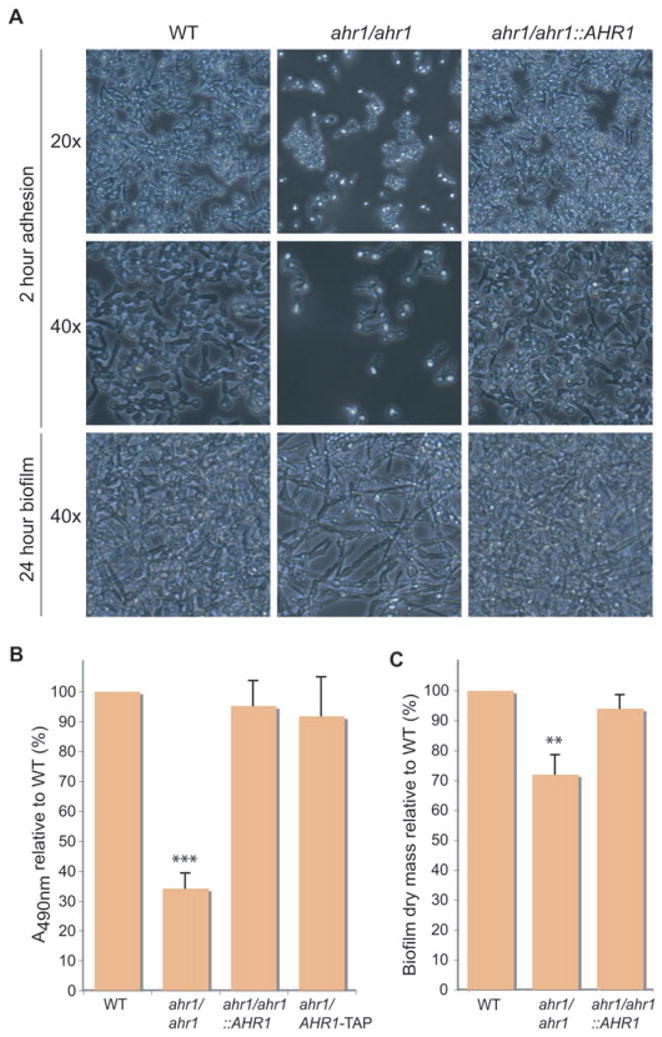
Disrupting the Ahr1p–Mcm1p complex affects adherence to polystyrene and reduces biofilm density. Strains used were WT (CAS19), ahr1/ahr1 (CAS12), ahr1/ahr1::AHR1 (CAS13) and ahr1/AHR1-TAP (CAS15). A. Overnight cultures were resuspended in RPMI media at OD600 = 1 and 100 μl was added to each well in a 96-well plate. After 2 h of rocking incubation at 37°C, the non-adherent cells were removed, the wells were washed with PBS, and pictures were taken at 20× (top panel) and 40× (middle panel) magnification. Fresh RPMI media was added, the plate was incubated with rocking for 24 h at 37°C to allow for biofilm development, and pictures were then taken at 40× magnification (bottom panel). B. An XTT assay was performed after the 2 h adhesion step. Absorbencies were reported relative to the WT strain. The symbol ‘***’ indicates a significant difference (P < 0.0001, t-test) compared with both wild-type and complemented strains. C. Biofilm dry masses were determined after 24 h of development. Masses were reported relative to the WT strain. The symbol ‘**’ indicates a significant difference (P < 0.01, t-test) compared with both wild-type and complemented strains.
Fig. 5
Fig. 5
The Ahr1p–Mcm1p complex controls the yeast–hyphal switch. Cells were serially diluted and a representative dilution is shown. Strains used were WT (CAS19), ahr1/ahr1 (CAS12) and ahr1/ahr1::AHR1 (CAS13). Pictures were taken after 4 days for M199 pH 8 and after 2 days for the other conditions. Although the ahr1/ahr1::AHR1 strain did not revert the phenotype for YPD and M199 pH 8 at 37°C, three independently constructed heterozygous strains (CAS25) showed the same phenotype as the complemented strain (data not shown), indicating that AHR1 shows haplo-insufficiency under some hyphal growth conditions.
Fig. 6
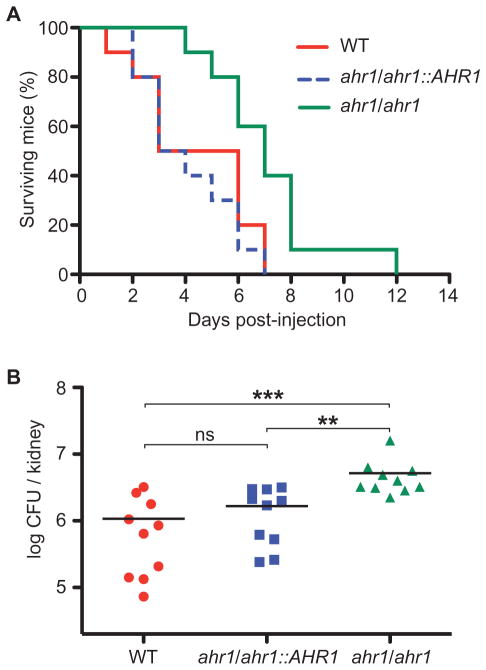
Fig. 6. An ahr1 strain displays attenuated virulence in a C57BL/6J mouse model
A. Survival curves of mice infected with WT (SN95), ahr1/ahr1 (CaEE534) and ahr1/ahr1::AHR1 (CaEE573) strains. Mice were monitored daily according to approved protocols. B. Comparison of the kidney fungal load of mice infected with WT (SN95), ahr1/ahr1 (CaEE534) and ahr1/ahr1::AHR1 (CaEE573) strains. Kidney fungal burdens were assessed at the time of sacrifice when mice were determined to be moribund. Mutant-infected mice survived longer and accumulated a statistically significantly higher fungal burden compared with both WT and revertant-infected mice as indicated (***P < 0.001; **P < 0.01; ns P > 0.05).

References

    1. Askew C, Sellam A, Epp E, Hogues H, Mullick A, Nantel A, Whiteway M. Transcriptional regulation of carbohydrate metabolism in the human pathogen Candida albicans. PLoS Pathog. 2009;5:e1000612. - PMC - PubMed
    1. Borneman AR, Gianoulis TA, Zhang ZD, Yu H, Rozowsky J, Seringhaus MR, et al. Divergence of transcription factor binding sites across related yeast species. Science. 2007;317:815–819. - PubMed
    1. Braun BR, van Het Hoog M, d’Enfert C, Martchenko M, Dungan J, Kuo A, et al. A human-curated annotation of the Candida albicans genome. PLoS Genet. 2005;1:36–57. - PMC - PubMed
    1. Butler G, Rasmussen MD, Lin MF, Santos MA, Sakthikumar S, Munro CA, et al. Evolution of pathogenicity and sexual reproduction in eight Candida genomes. Nature. 2009;459:657–662. - PMC - PubMed
    1. Chandra J, Mukherjee PK, Leidich SD, Faddoul FF, Hoyer LL, Douglas LJ, Ghannoum MA. Antifungal resistance of candidal biofilms formed on denture acrylic in vitro. J Dent Res. 2001;80:903–908. - PubMed

Publication types

MeSH terms

Associated data