


Who listens to our advice? A secondary analysis of data from a clinical trial testing an intervention designed to decrease delay in seeking treatment for acute coronary syndrome
- PMID: 21300515
- PMCID: PMC3097294
- DOI: 10.1016/j.pec.2011.01.016
Who listens to our advice? A secondary analysis of data from a clinical trial testing an intervention designed to decrease delay in seeking treatment for acute coronary syndrome
Abstract
Objective: Prolonged prehospital delay in persons experiencing acute coronary syndrome (ACS) remains a problem. Understanding which patients respond best to particular interventions designed to decrease delay time would provide mechanistic insights into the process by which interventions work.
Methods: In the PROMOTION trial, 3522 at-risk patients were enrolled from 5 sites in the United States (56.4%), Australia and New Zealand; 490 (N=272 intervention, N=218 control) had an acute event within 2 years. Focusing on these 490, we (1) identified predictors of a rapid response to symptoms, (2) identified intervention group subjects with a change in these predictors over 3 months of follow-up, and (3) compared intervention group participants with and without the favorable response pattern. Hypothesized predictors of rapid response were increased perceived control and decreased anxiety. Knowledge, attitudes, and beliefs were hypothesized to differ between responders and non-responders.
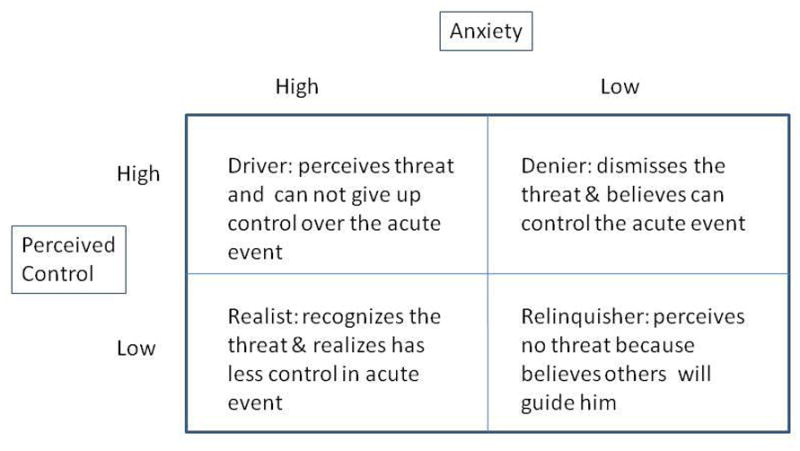
Results: Contrary to hypothesis, responders had low anxiety and low perceived control. Only 73 (26.8%) subjects showed this pattern 3 months following the intervention. No differences in ACS knowledge, attitudes, or beliefs were found.
Conclusion: The results of this study challenge existing beliefs.
Practice implications: New intervention approaches that focus on a realistic decrease in anxiety and perceived control are needed.
Copyright © 2011 Elsevier Ireland Ltd. All rights reserved.
Figures
References
-
- Goldberg RJ, Steg PG, Sadiq I, Granger CB, Jackson EA, Budaj A, et al. Extent of, and factors associated with, delay to hospital presentation in patients with acute coronary disease (the GRACE registry) Am J Cardiol. 2002 Apr 1;89(7):791–6. - PubMed
-
- Moser DK, Kimble LP, Alberts MJ, Alonzo A, Croft JB, Dracup K, et al. Reducing delay in seeking treatment by patients with acute coronary syndrome and stroke: a scientific statement from the American Heart Association Council on cardiovascular nursing and stroke council. Circulation. 2006 Jul 11;114(2):168–82. - PubMed
-
- Luepker RV, Raczynski JM, Osganian S, Goldberg RJ, Finnegan JR, Jr, Hedges JR, et al. Effect of a community intervention on patient delay and emergency medical service use in acute coronary heart disease: The Rapid Early Action for Coronary Treatment (REACT) Trial. JAMA. 2000 Jul 5;284(1):60–7. - PubMed
-
- Dracup K, McKinley S, Riegel B, Mieschke H, Doering LV, Moser DK. A nursing intervention to reduce prehospital delay in acute coronary syndrome: a randomized clinical trial. J Cardiovasc Nurs. 2006 May–Jun;21(3):186–93. - PubMed
Publication types
MeSH terms
Grants and funding
LinkOut - more resources
Full Text Sources
