Randomized Controlled Trial
doi: 10.1136/bmj.d40.
Strategy for intention to treat analysis in randomised trials with missing outcome data
Affiliations
- PMID: 21300711
- PMCID: PMC3230114
- DOI: 10.1136/bmj.d40
Item in Clipboard
Randomized Controlled Trial
Strategy for intention to treat analysis in randomised trials with missing outcome data
BMJ.
.
Abstract
Loss to follow-up is often hard to avoid in randomised trials. This article suggests a framework for intention to treat analysis that depends on making plausible assumptions about the missing data and including all participants in sensitivity analyses
Conflict of interest statement
Competing interests All authors have completed the unified competing interest form at
Figures
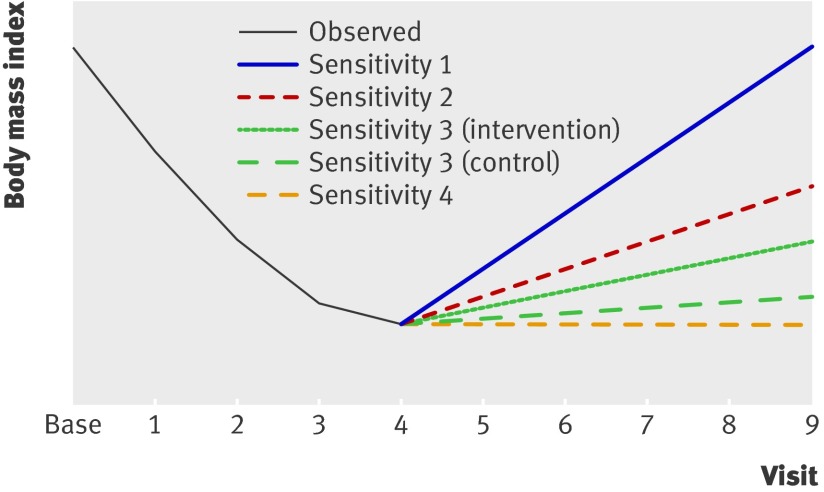
Fig 1 Possible ways to impute outcome measures at visit 9 for a hypothetical participant in the obesity trial who drops out after visit 4: main analysis (last value brought forward) and three sensitivity analyses (1 assumes participants lost to follow-up return to baseline weight; 2 assumes 50% of weight regained, and 3 assumes intervention group regains a greater proportion of weight than controls)
References
-
- Peduzzi P, Wittes J, Detre K. Analysis as randomised and the problem of non-adherence: an example from the Veterans Affairs randomized trial of coronary artery bypass surgery. Stat Med 1993;12:1185-95. - PubMed
-
- Committee for Proprietary Medicinal Products. Points to consider on missing data. 2001. www.emea.europa.eu/pdfs/human/ewp/177699EN.pdf.
-
- Doody R, Gavrilova S, Sano M, Thomas R, Aisen P, Bachurin S, et al. Effect of dimebon on cognition, activities of daily living, behaviour, and global function in patients with mild-to-moderate Alzheimer’s disease: a randomised, double-blind, placebo-controlled study. Lancet 2008;372:207-15. - PubMed
Publication types
MeSH terms
Grants and funding
LinkOut - more resources
Full Text Sources
Medical