


doi: 10.1128/AAC.01549-10.
Epub 2011 Feb 7.
Vibrio cholerae triggers SOS and mutagenesis in response to a wide range of antibiotics: a route towards multiresistance
Affiliations
- PMID: 21300836
- PMCID: PMC3088271
- DOI: 10.1128/AAC.01549-10
Item in Clipboard
Vibrio cholerae triggers SOS and mutagenesis in response to a wide range of antibiotics: a route towards multiresistance
Antimicrob Agents Chemother.
2011 May.
Abstract
Antibiotic resistance development has been linked to the bacterial SOS stress response. In Escherichia coli, fluoroquinolones are known to induce SOS, whereas other antibiotics, such as aminoglycosides, tetracycline, and chloramphenicol, do not. Here we address whether various antibiotics induce SOS in Vibrio cholerae. Reporter green fluorescent protein (GFP) fusions were used to measure the response of SOS-regulated promoters to subinhibitory concentrations of antibiotics. We show that unlike the situation with E. coli, all these antibiotics induce SOS in V. cholerae.
Figures
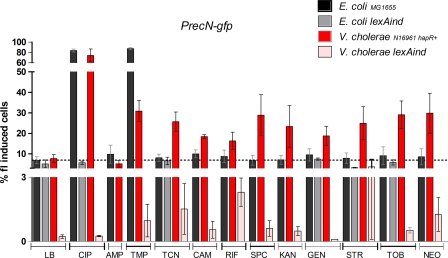
SOS induction by subinhibitory concentrations of antibiotics in E. coli and V. cholerae. Bacteria were grown overnight in MH supplemented with sub-MICs of specified antibiotics as follows (final concentrations [μg ml−1] of drug for organism [E. coli, V. cholerae]): ciprofloxacin (CIP), 0.05, 0.005; ampicillin (AMP) and rifampin (RIF), 0.05, 0.01; trimethoprim (TMP), 0.05, 0.005; tetracycline (TCN), 0.15, 0.015; chloramphenicol (CAM), 0.15, 0.005; spectinomycin (SPC), kanamycin (KAN), and streptomycin (STR), 0.2, 0.05; gentamicin (GEN), tobramycin (TOB), and neomycin (NEO), 0.1, 0.01. The samples were washed in PBS, and the fluorescence was measured using the FACSCalibur device (1). The percentage of fluorescent cells is represented on the y axis. Each measurement was reproduced at least four times. In order to test whether the means of two groups were different, we first tested the equality of their variance with a Fisher test. When the variances of two groups were found to be significantly different, an unequal-variance t test was performed. Otherwise, a simple t test was performed. The chosen significance threshold was 0.05 for all tests.
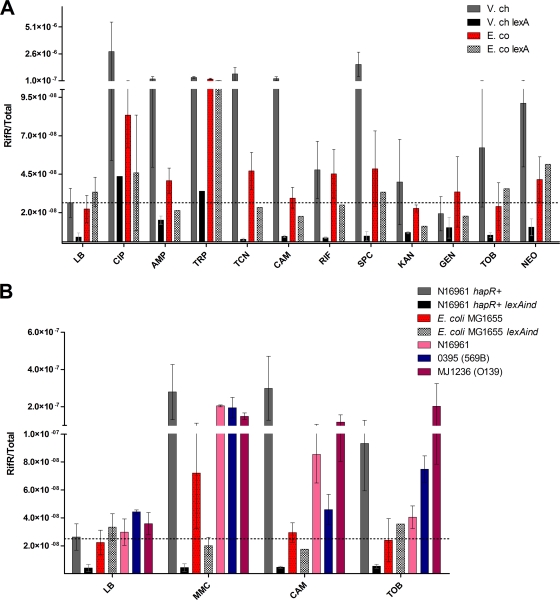
Spontaneous mutation frequency after treatment with subinhibitory concentrations of antibiotics. Bacteria were grown as described in Fig. 1. Appropriate dilutions were plated on Luria broth, and 1 ml of culture was centrifuged and plated on 100-μg/ml rifampin plates. The mutation frequency, corresponding to the rifampin-resistant CFU count over the total number of CFU, was measured and represented on the y axis for each antibiotic. (A) E. coli MG1655 and V. cholerae N16961 hapR+. (B) Comparison of various V. cholerae strains.
References
Publication types
MeSH terms
Substances
LinkOut - more resources
Full Text Sources
Medical
