. 2011 Feb 22;108(8):3401-5.
doi: 10.1073/pnas.1008840108. Epub 2011 Feb 7.

Brief predator sound exposure elicits behavioral and neuronal long-term sensitization in the olfactory system of an insect

Affiliations

Brief predator sound exposure elicits behavioral and neuronal long-term sensitization in the olfactory system of an insect

Sylvia Anton et al. Proc Natl Acad Sci U S A. .

Abstract

Modulation of sensitivity to sensory cues by experience is essential for animals to adapt to a changing environment. Sensitization and adaptation to signals of the same modality as a function of experience have been shown in many cases, and some of the neurobiological mechanisms underlying these processes have been described. However, the influence of sensory signals on the sensitivity of a different modality is largely unknown. In males of the noctuid moth, Spodoptera littoralis, the sensitivity to the female-produced sex pheromone increases 24 h after a brief preexposure with pheromone at the behavioral and central nervous level. Here we show that this effect is not confined to the same sensory modality: the sensitivity of olfactory neurons can also be modulated by exposure to a different sensory stimulus, i.e., a pulsed stimulus mimicking echolocating sounds from attacking insectivorous bats. We tested responses of preexposed male moths in a walking bioassay and recorded from neurons in the primary olfactory center, the antennal lobe. We show that brief exposure to a bat call, but not to a behaviorally irrelevant tone, increases the behavioral sensitivity of male moths to sex pheromone 24 h later in the same way as exposure to the sex pheromone itself. The observed behavioral modification is accompanied by an increase in the sensitivity of olfactory neurons in the antennal lobe. Our data provide thus evidence for cross-modal experience-dependent plasticity not only on the behavioral level, but also on the central nervous level, in an insect.


Conflict of interest statement

The authors declare no conflict of interest.

Figures
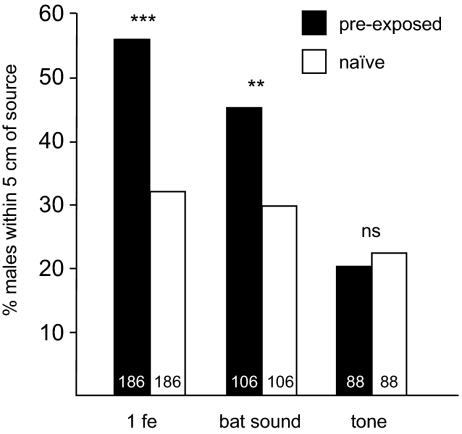
Fig. 1.
Fig. 1.
The percentage of S. littoralis males approaching within 5 cm from an odor source of 0.03 fe of sex pheromone gland extract in a walking bioassay. The response of males preexposed to 1 fe, bat sound, or a tone was compared with the response of naive males. Statistical analysis by a χ2 test for independence was done (**P < 0.01, ***P < 0.001). Numbers in bars indicate numbers of tested males. The higher n value for 1 fe is a result of this treatment being used as a control in parallel with each other treatment.
Fig. 2.
Fig. 2.
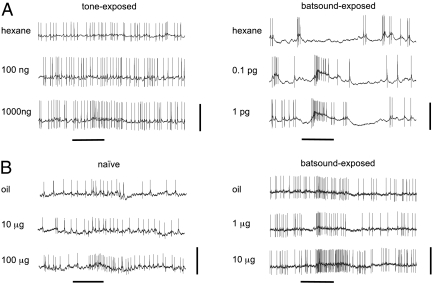
Responses of AL neurons in male S. littoralis to the main pheromone component, ZE-9,11–14:OAc and its solvent hexane (A) and to the plant odor linalool and its solvent mineral oil (B). The odor stimulus reaches the antenna at approximately 250 ms. (A) Typical recordings from MGC neurons in a tone-exposed male (Left) with responses only to high pheromone doses (1,000 ng) and in a bat sound-exposed male (Right) with responses to very low pheromone doses (0.1 pg). (B) Typical recordings from OG neurons in a naive male (Left), responding to high doses of linalool (100 μg), and in a bat sound-exposed male (Right), responding to lower doses of linalool (1 μg). The horizontal black bar underneath the traces indicates stimulation duration (500 ms). (Scale bars: 20 mV in A, 10 mV in B.)
Fig. 3.
Fig. 3.
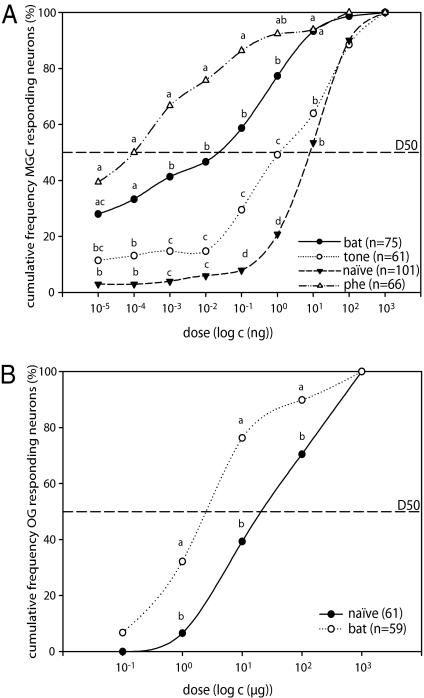
Cumulative frequency curves of response thresholds of AL neurons in S. littoralis males. (A) Cumulative response threshold distribution of MGC neurons to the main pheromone component, EZ-9,11–14:OAc. Mainly neurons with a high threshold were found in naive and tone-exposed males, whereas lower threshold neurons were found in males that had been preexposed to pheromone or bat sound. The D50 is indicated as a dashed line. Neurons in pheromone- and bat-exposed males reached the D50 at lower doses than in tone-exposed and naive males. (Bat, neurons in bat sound-exposed males; tone, neurons in tone-exposed males; phe, neurons in pheromone-exposed males.) (B) Cumulative response threshold distribution of OG neurons to flower odors. For each neuron the lowest threshold for the best-tuned compound out of the three tested odors (linalool, geraniol, and heptanal) was determined. Neurons in bat-exposed males had lower thresholds than neurons in control males. Statistical differences among treatments were assessed for each individual dose by means of a G-test for independence and pairwise post-hoc comparisons. Numbers in brackets indicate numbers of tested neurons. Different letters denote statistical differences (α′ = 0.008).

References

    1. Grubb MS, Thompson ID. The influence of early experience on the development of sensory systems. Curr Opin Neurobiol. 2004;14:503–512. - PubMed
    1. Arenas A, Giurfa M, Farina WM, Sandoz JC. Early olfactory experience modifies neural activity in the antennal lobe of a social insect at the adult stage. Eur J Neurosci. 2009;30:1498–1508. - PubMed
    1. Iyengar A, Chakraborty TS, Goswami SP, Wu CF, Siddiqi O. Post-eclosion odor experience modifies olfactory receptor neuron coding in Drosophila. Proc Natl Acad Sci USA. 2010;107:9855–9860. - PMC - PubMed
    1. Kay LM, Laurent G. Odor- and context-dependent modulation of mitral cell activity in behaving rats. Nat Neurosci. 1999;2:1003–1009. - PubMed
    1. Crair MC, Gillespie DC, Stryker MP. The role of visual experience in the development of columns in cat visual cortex. Science. 1998;279:566–570. - PMC - PubMed

Publication types

Substances