Characterization of the differential response of endothelial cells exposed to normal and elevated laminar shear stress
- PMID: 21302282
- PMCID: PMC3412226
- DOI: 10.1002/jcp.22629
Characterization of the differential response of endothelial cells exposed to normal and elevated laminar shear stress
Abstract
Most acute coronary events occur in the upstream region of stenotic atherosclerotic plaques that experience laminar shear stress (LSS) elevated above normal physiological levels. Many studies have described the atheroprotective effect on endothelial behavior of normal physiological LSS (approximately 15 dynes/cm(2)) compared to static or oscillatory shear stress (OSS), but it is unknown whether the levels of elevated shear stress imposed by a stenotic plaque would preserve, enhance or reverse this effect. Therefore we used transcriptomics and related functional analyses to compare human endothelial cells exposed to laminar shear stress of 15 (LSS15-normal) or 75 dynes/cm(2) (LSS75-elevated). LSS75 upregulated expression of 145 and downregulated expression of 158 genes more than twofold relative to LSS15. Modulation of the metallothioneins (MT1-G, -M, -X) and NADPH oxidase subunits (NOX2, NOX4, NOX5, and p67phox) accompanied suppression of reactive oxygen species production at LSS75. Shear induced changes in dual specificity phosphatases (DUSPs 1, 5, 8, and 16 increasing and DUSPs 6 and 23 decreasing) were observed as well as reduced ERK1/2 but increased p38 MAP kinase phosphorylation. Amongst vasoactive substances, endothelin-1 expression decreased whereas vasoactive intestinal peptide (VIP) and prostacyclin expression increased, despite which intracellular cAMP levels were reduced. Promoter analysis by rVISTA identified a significant over representation of ATF and Nrf2 transcription factor binding sites in genes upregulated by LSS75 compared to LSS15. In summary, LSS75 induced a specific change in behavior, modifying gene expression, reducing ROS levels, altering MAP kinase signaling and reducing cAMP levels, opening multiple avenues for future study.
Copyright © 2011 Wiley-Liss, Inc.
Figures
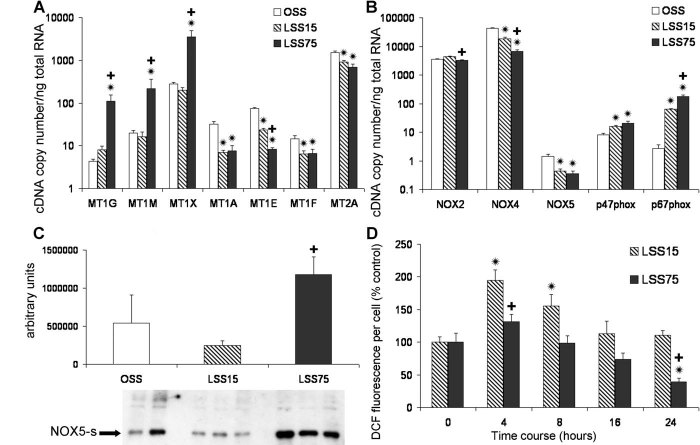
 P < 0.05 compared to OSS;
  P < 0.05 compared to LSS15 (n = 6–9). C: Western blot assessment of NOX5 protein expression in HUVEC exposed to different shear stress regimens, LSS75 significantly higher than LSS15 (n = 3, P < 0.05). D: Time course of shear stress-dependent ROS production measured by DCF fluorescence. LSS75 P < 0.05 compared to OSS.
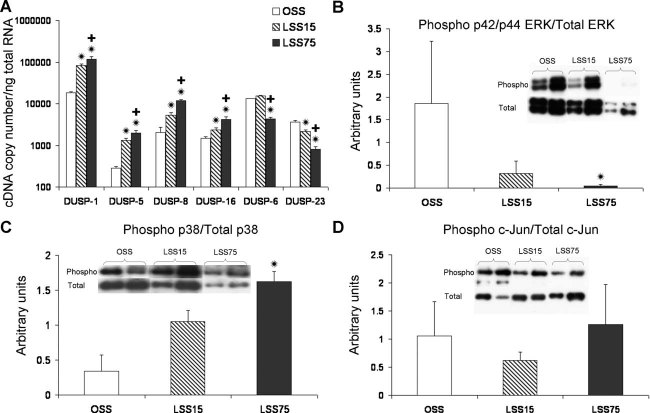 P < 0.05 compared to OSS;
P < 0.05 compared to LSS15 (n = 6–9). B–D: Western blot assessment of the ratio of phosphorylated to total ERK1/2, p38 and c-Jun (n = 4, arbitrary units). LSS75 P < 0.05 compared to OSS.
P < 0.05 compared to OSS;
P < 0.05 compared to LSS15 (n = 6–9). B–D: Western blot assessment of the ratio of phosphorylated to total ERK1/2, p38 and c-Jun (n = 4, arbitrary units). LSS75 P < 0.05 compared to OSS.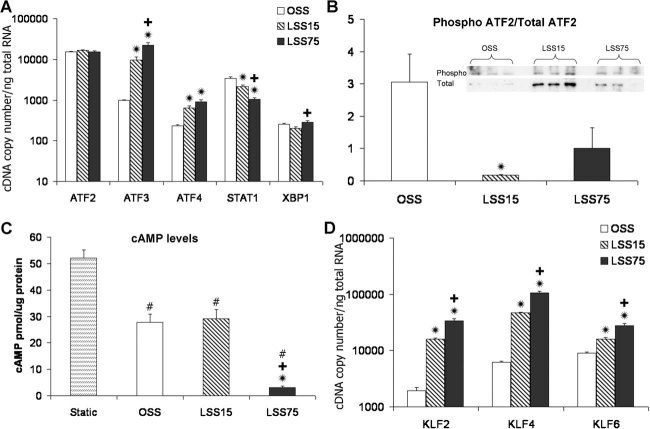 P < 0.05 compared to OSS;
P < 0.05 compared to LSS15 (n = 6–9). B: Western blot assessment of the ratio of phosphorylated ATF2 to total ATF2, LSS15 significantly lower than OSS (n = 3, P < 0.01). C: cAMP levels in HUVEC #P < 0.01 compared to static;
P < 0.01 compared to OSS;
P < 0.01 compared to LSS15. Static cultures had significantly higher cAMP levels compared to all sheared samples, LSS75 showed significant ∼9-fold reduction in intracellular cAMP levels 16 h after commencement of shear (n = 3, P < 0.01). D: Changes in gene expression assayed by qPCR,
P < 0.05 compared to OSS;
P < 0.05 compared to LSS15 (n = 6–9).
P < 0.05 compared to OSS;
P < 0.05 compared to LSS15 (n = 6–9). B: Western blot assessment of the ratio of phosphorylated ATF2 to total ATF2, LSS15 significantly lower than OSS (n = 3, P < 0.01). C: cAMP levels in HUVEC #P < 0.01 compared to static;
P < 0.01 compared to OSS;
P < 0.01 compared to LSS15. Static cultures had significantly higher cAMP levels compared to all sheared samples, LSS75 showed significant ∼9-fold reduction in intracellular cAMP levels 16 h after commencement of shear (n = 3, P < 0.01). D: Changes in gene expression assayed by qPCR,
P < 0.05 compared to OSS;
P < 0.05 compared to LSS15 (n = 6–9).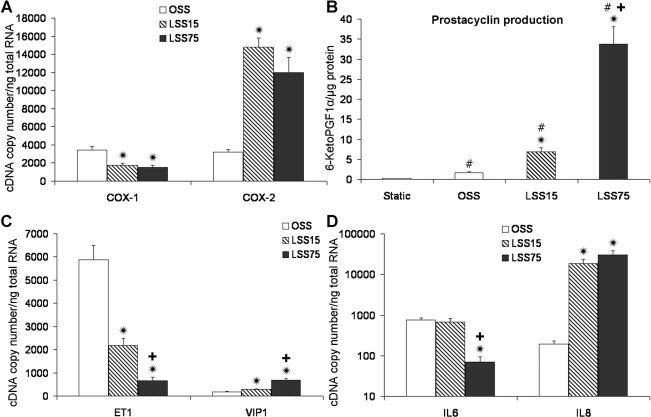 P < 0.05 compared to OSS;
P < 0.05 compared to LSS15 (n = 6–9). B: Quantification of 6-keto PGF1α production (the stable metabolite produced from prostacyclin-PGI2 breakdown) in HUVEC 16 h after commencement of shear, #P < 0.01 compared to static;
P < 0.01 compared to OSS;
P < 0.01 compared to LSS15 (n = 3).
P < 0.05 compared to OSS;
P < 0.05 compared to LSS15 (n = 6–9). B: Quantification of 6-keto PGF1α production (the stable metabolite produced from prostacyclin-PGI2 breakdown) in HUVEC 16 h after commencement of shear, #P < 0.01 compared to static;
P < 0.01 compared to OSS;
P < 0.01 compared to LSS15 (n = 3).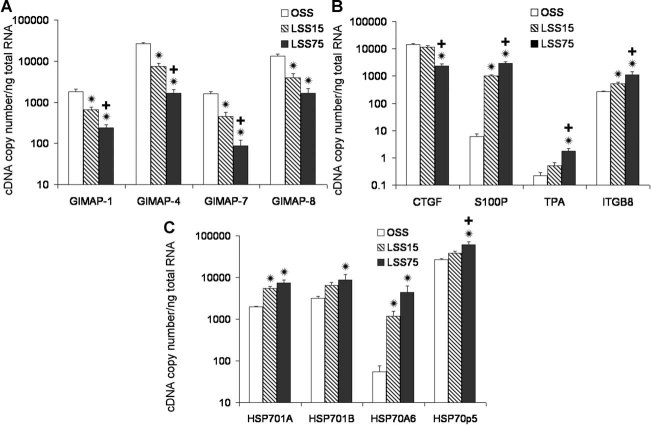 P < 0.05 compared to OSS;
P < 0.05 compared to LSS15 (n = 6–9).
P < 0.05 compared to OSS;
P < 0.05 compared to LSS15 (n = 6–9).References
-
- Afonyushkin T, Oskolkova OV, Philippova M, Resink TJ, Erne P, Binder BR, Bochkov VN. Oxidized phospholipids regulate expression of ATF4 and VEGF in endothelial cells via NRF2-dependent mechanism: Novel point of convergence between electrophilic and unfolded protein stress pathways. Arterioscler Thromb Vasc Biol. 2010;30:1007–1013. - PubMed
-
- Arumugam T, Simeone DM, Schmidt AM, Logsdon CD. S100P stimulates cell proliferation and survival via receptor for activated glycation end products (RAGE) J Biol Chem. 2004;279:5059–5065. - PubMed
-
- Atkins GB, Jain MK. Role of kruppel-like transcription factors in endothelial biology. Circ Res. 2007;100:1686–1695. - PubMed
-
- Boon RA, Leyen TA, Fontijn RD, Fledderus JO, Baggen JMC, Volger OL, van Nieuw Amerongen GP, Horrevoets AJG. KLF2-induced actin shear fibers control both alignment to flow and JNK signaling in vascular endothelium. Blood. 2010;115:2533–2542. - PubMed
Publication types
MeSH terms
Substances
Grants and funding
LinkOut - more resources
Full Text Sources
Molecular Biology Databases
Miscellaneous