. 2011 Feb 8;13(1):R18.
doi: 10.1186/ar3242.

Dysregulated expression of MIG/CXCL9, IP-10/CXCL10 and CXCL16 and their receptors in systemic sclerosis

Affiliations

Dysregulated expression of MIG/CXCL9, IP-10/CXCL10 and CXCL16 and their receptors in systemic sclerosis

Bradley J Rabquer et al. Arthritis Res Ther. .

Abstract

Introduction: Systemic sclerosis (SSc) is characterized by fibrosis and microvascular abnormalities including dysregulated angiogenesis. Chemokines, in addition to their chemoattractant properties, have the ability to modulate angiogenesis. Chemokines lacking the enzyme-linked receptor (ELR) motif, such as monokine induced by interferon-γ (IFN-γ) (MIG/CXCL9) and IFN-inducible protein 10 (IP-10/CXCL10), inhibit angiogenesis by binding CXCR3. In addition, CXCL16 promotes angiogenesis by binding its unique receptor CXCR6. In this study, we determined the expression of these chemokines and receptors in SSc skin and serum.

Methods: Immunohistology and enzyme-linked immunosorbent assays (ELISAs) were used to determine chemokine and chemokine receptor expression in the skin and serum, respectively, of SSc and normal patients. Endothelial cells (ECs) were isolated from SSc skin biopsies and chemokine and chemokine receptor expression was determined by quantitative PCR and immunofluorescence staining.

Results: Antiangiogenic IP-10/CXCL10 and MIG/CXCL9 were elevated in SSc serum and highly expressed in SSc skin. However, CXCR3, the receptor for these chemokines, was decreased on ECs in SSc vs. normal skin. CXCL16 was elevated in SSc serum and increased in SSc patients with early disease, pulmonary arterial hypertension, and those that died during the 36 months of the study. In addition, its receptor CXCR6 was overexpressed on ECs in SSc skin. At the mRNA and protein levels, CXCR3 was decreased while CXCR6 was increased on SSc ECs vs. human microvascular endothelial cells (HMVECs).

Conclusions: These results show that while the expression of MIG/CXCL9 and IP-10/CXCL10 are elevated in SSc serum, the expression of CXCR3 is downregulated on SSc dermal ECs. In contrast, CXCL16 and CXCR6 are elevated in SSc serum and on SSc dermal ECs, respectively. In all, these findings suggest angiogenic chemokine receptor expression is likely regulated in an effort to promote angiogenesis in SSc skin.


Figures
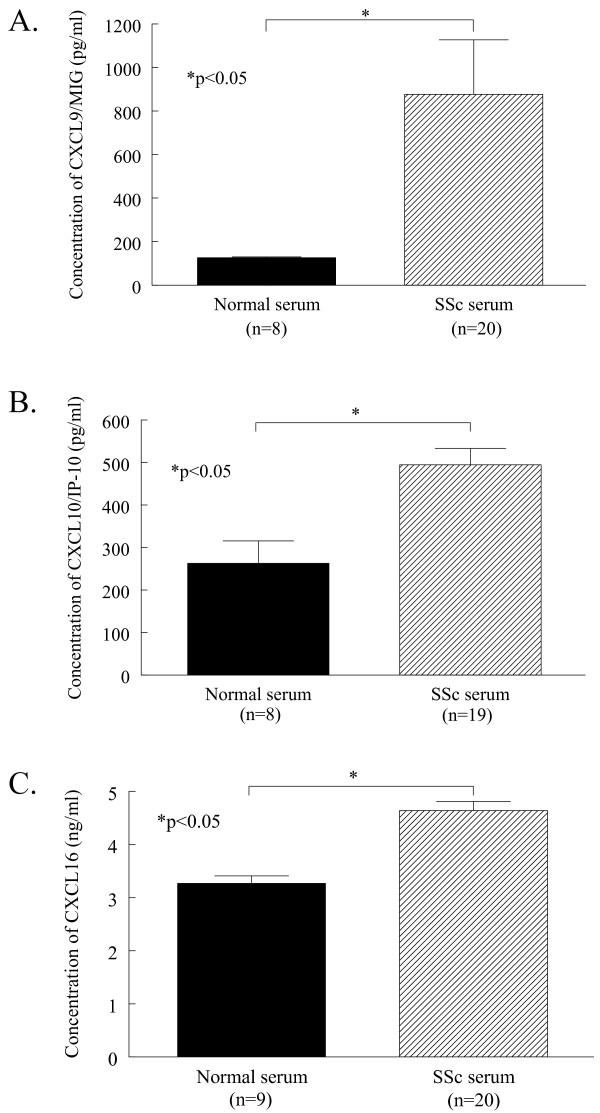
Figure 1
Figure 1
MIG/CXCL9, IP-10/CXCL10, and CXCL16 are overexpressed in SSc serum. The amounts of MIG/CXCL9 (A), IP-10/CXCL10 (B), and CXCL16 (C) were determined in normal and SSc serum by ELISA. Means are given with SEM. Differences were determined using the Student's t-test and P-values less than 0.05 were significant. n = number of patients.
Figure 2
Figure 2
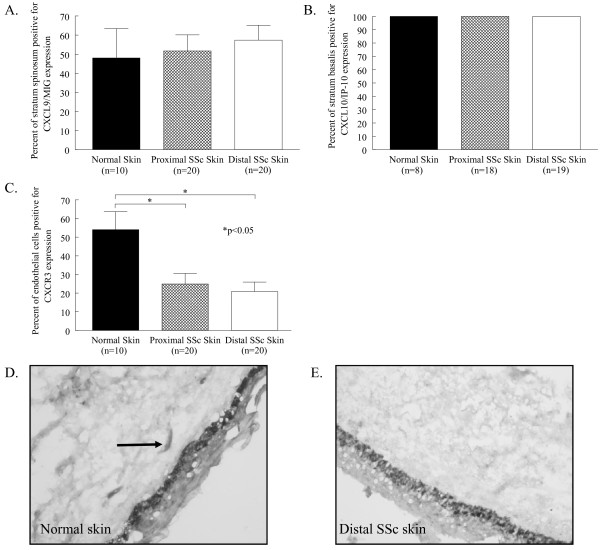
MIG/CXCL9 and IP-10/CXCL10 are highly expressed, but CXCR3 is decreased, in SSc and normal skin. Frozen sections of proximal and distal SSc and normal skin were stained for MIG/CXCL9, IP-10/CXCL10, or CXCR3. (A), MIG/CXCL9 was highly expressed in the stratum spinosum of normal (48%), proximal SSc (52%), and distal SSc (57%) skin. (B), IP-10/CXCL10 was uniformly expressed in the stratum basalis of normal, proximal SSc, and distal SSc skin at 100%. (C), CXCR3 was significantly decreased on ECs in proximal SSc (25%) and distal SSc skin (21%) compared to normal skin (54%). Representative photos of CXCR3 immunohistological staining in normal (D) and distal SSc skin (E) are shown. Arrows indicate positive staining. Means are given with the SEM. n = the number of patients. P < 0.05 was considered significant.
Figure 3
Figure 3
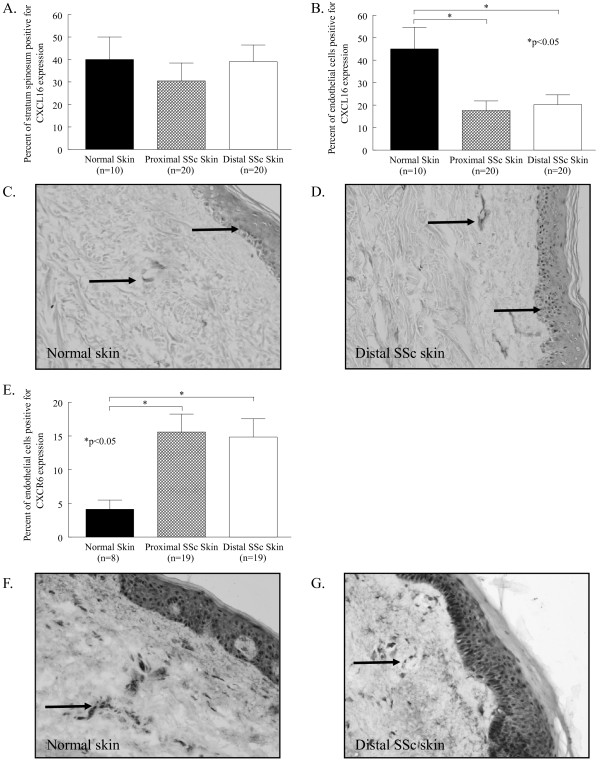
CXCL16 and CXCR6 are highly expressed in SSc compared to normal skin. Frozen sections of proximal and distal SSc and normal skin were stained for CXCL16 or CXCR6. (A), CXCL16 was highly expressed in the stratum spinosum of normal (40%), proximal SSc (30%), and distal SSc (39%) skin. (B), CXCL16 was significantly decreased on ECs in proximal SSc (18%) and distal SSc skin (20%) compared to normal skin (45%). Representative photos of CXCL16 immunohistological staining in normal (C) and distal SSc skin (D) are shown. (E), CXCR6 was significantly increased on ECs in proximal SSc (16%) and distal SSc skin (15%) compared to normal skin (4%). Representative photos of CXCR6 immunohistological staining in normal (F) and distal SSc skin (G) are shown. Arrows indicate positive staining. Means are given with the SEM. n = the number of patients. P < 0.05 was considered significant.
Figure 4
Figure 4
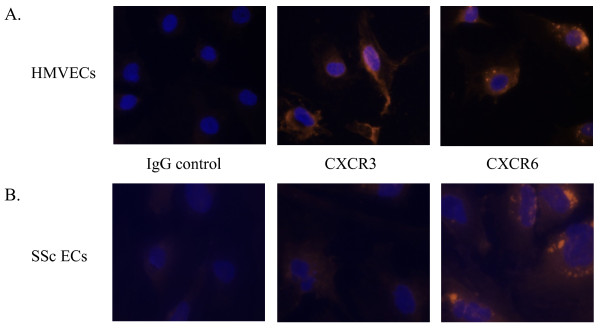
CXCR3 expression is decreased while CXCR6 expression is unchanged on SSc ECs compared to HMVECs. HMVECs (A) and SSc ECs (B) were cultured on gelatin-coated chambers and immunofluorescence stained. Staining with specific antibodies against CXCR3, CXCR6, or irrelevant IgG control is shown. Nuclei were counter stained with DAPI. Staining was detected using a fluorescence microscope and images were taken at 400×.

References

    1. Gabrielli A, Avvedimento EV, Krieg T. Scleroderma. N Engl J Med. 2009;360:1989–2003. doi: 10.1056/NEJMra0806188. - DOI - PubMed
    1. Distler JH, Gay S, Distler O. Angiogenesis and vasculogenesis in systemic sclerosis. Rheumatology (Oxford) 2006;45:iii26–27. doi: 10.1093/rheumatology/kel295. - DOI - PubMed
    1. Szekanecz Z, Gaspar L, Koch AE. Angiogenesis in rheumatoid arthritis. Front Biosci. 2005;10:1739–1753. doi: 10.2741/1657. - DOI - PubMed
    1. Koch AE, Polverini PJ, Kunkel SL, Harlow LA, DiPietro LA, Elner VM, Elner SG, Strieter RM. Interleukin-8 as a macrophage-derived mediator of angiogenesis. Science. 1992;258:1798–1801. doi: 10.1126/science.1281554. - DOI - PubMed
    1. Strieter RM, Polverini PJ, Kunkel SL, Arenberg DA, Burdick MD, Kasper J, Dzuiba J, Van Damme J, Walz A, Marriott D. The functional role of the ELR motif in CXC chemokine-mediated angiogenesis. J Biol Chem. 1995;270:27348–27357. doi: 10.1074/jbc.270.45.27348. - DOI - PubMed

Publication types

MeSH terms