


Cerebral formation of free radicals during hypoxia does not cause structural damage and is associated with a reduction in mitochondrial PO2; evidence of O2-sensing in humans?
- PMID: 21304557
- PMCID: PMC3070986
- DOI: 10.1038/jcbfm.2011.2
Cerebral formation of free radicals during hypoxia does not cause structural damage and is associated with a reduction in mitochondrial PO2; evidence of O2-sensing in humans?
Abstract
Cellular hypoxia triggers a homeostatic increase in mitochondrial free radical signaling. In this study, blood was obtained from the radial artery and jugular venous bulb in 10 men during normoxia and 9 hours hypoxia (12.9% O(2)). Mitochondrial oxygen tension (p(O(2))(mit)) was derived from cerebral blood flow and blood gases. The ascorbate radical (A(•-)) was detected by electron paramagnetic resonance spectroscopy and neuron-specific enolase (NSE), a biomarker of neuronal injury, by enzyme-linked immunosorbent assay. Hypoxia increased the cerebral output of A(•-) in proportion to the reduction in p(O(2))(mit), but did not affect NSE exchange. These findings suggest that neuro-oxidative stress may constitute an adaptive response.
Figures
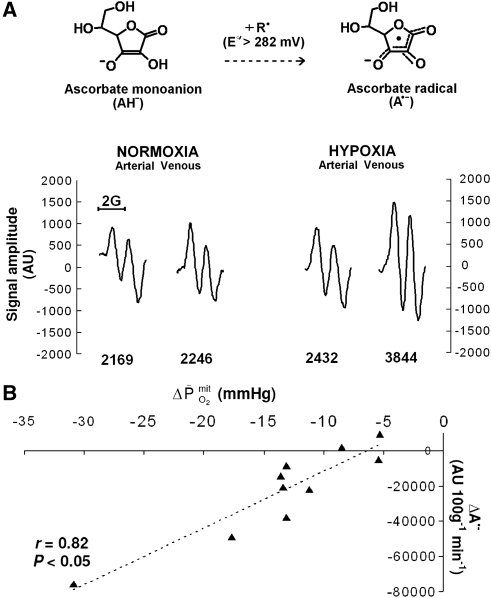
 ) and increase in the cerebral output of ascorbate radicals (A•−).
References
-
- Bailey DM, Roukens R, Knauth M, Kallenberg K, Christ S, Mohr A, Genius J, Storch-Hagenlocher B, Meisel F, McEneny J, Young IS, Steiner T, Hess K, Bartsch P. Free radical-mediated damage to barrier function is not associated with altered brain morphology in high-altitude headache. J Cereb Blood Flow Metab. 2006;26:99–111. - PubMed
-
- Bailey DM, Evans KA, James PE, McEneny J, Young IS, Fall L, Gutowski M, Kewley E, McCord JM, Moller K, Ainslie PN. Altered free radical metabolism in acute mountain sickness: implications for dynamic cerebral autoregulation and blood-brain barrier function. J Physiol. 2009b;587:73–85. - PMC - PubMed
-
- Bailey DM, Taudorf S, Berg RMG, Jensen LT, Lundby C, Evans KA, James PE, Pedersen BK, Moller K. Transcerebral exchange kinetics of nitrite and calcitonin gene-related peptide in acute mountain sickness: evidence against trigeminovascular activation. Stroke. 2009c;40:2205–2208. - PubMed
-
- Bailey DM, Taudorf S, Berg RMG, Lundby C, McEneny J, Young IS, Evans KA, James PE, Shore A, Hullin DA, McCord JM, Pedersen BK, Moller K. Increased cerebral output of free radicals during hypoxia: implications for acute mountain sickness. Am J Physiol Regul, Integr Comp Physiol. 2009d;297:R1283–R1292. - PubMed
Publication types
MeSH terms
Substances
LinkOut - more resources
Full Text Sources
