. 2011 Jan 28;6(1):e16509.
doi: 10.1371/journal.pone.0016509.

MicroRNAs profiling in murine models of acute and chronic asthma: a relationship with mRNAs targets

Affiliations

MicroRNAs profiling in murine models of acute and chronic asthma: a relationship with mRNAs targets

Nancy Garbacki et al. PLoS One. .

Abstract

Background: miRNAs are now recognized as key regulator elements in gene expression. Although they have been associated with a number of human diseases, their implication in acute and chronic asthma and their association with lung remodelling have never been thoroughly investigated.

Methodology/principal findings: In order to establish a miRNAs expression profile in lung tissue, mice were sensitized and challenged with ovalbumin mimicking acute, intermediate and chronic human asthma. Levels of lung miRNAs were profiled by microarray and in silico analyses were performed to identify potential mRNA targets and to point out signalling pathways and biological processes regulated by miRNA-dependent mechanisms. Fifty-eight, 66 and 75 miRNAs were found to be significantly modulated at short-, intermediate- and long-term challenge, respectively. Inverse correlation with the expression of potential mRNA targets identified mmu-miR-146b, -223, -29b, -29c, -483, -574-5p, -672 and -690 as the best candidates for an active implication in asthma pathogenesis. A functional validation assay was performed by cotransfecting in human lung fibroblasts (WI26) synthetic miRNAs and engineered expression constructs containing the coding sequence of luciferase upstream of the 3'UTR of various potential mRNA targets. The bioinformatics analysis identified miRNA-linked regulation of several signalling pathways, as matrix metalloproteinases, inflammatory response and TGF-β signalling, and biological processes, including apoptosis and inflammation.

Conclusions/significance: This study highlights that specific miRNAs are likely to be involved in asthma disease and could represent a valuable resource both for biological makers identification and for unveiling mechanisms underlying the pathogenesis of asthma.


Conflict of interest statement

Competing Interests: The authors have declared that no competing interests exist.

Figures

Figure 1
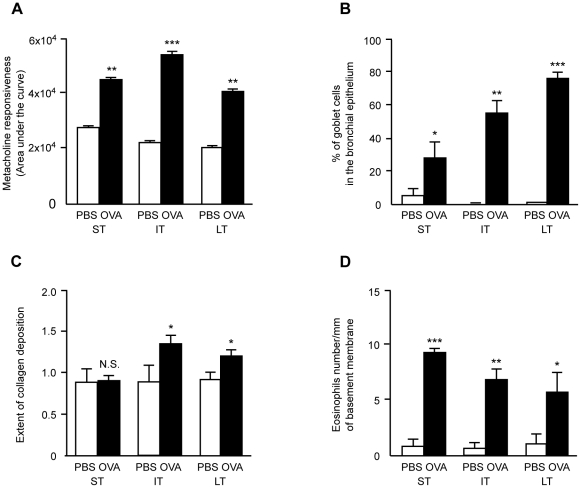
Figure 1. Assessment of airway inflammation, sensitization and hyperresponsiveness.
Assessment of airway responsiveness to metacholine (Panel A), of glandular hyperplasia as percentage of goblet cells per total epithelial cells (Panel B), of peribronchial collagen deposition (Panel C) and of eosinophils accumulation (Panel D) in randomly selected bronchi in PBS and OVA-treated groups of mice at short-term (ST), intermediate-term (IT) and long-term (LT) sensitization and exposure protocols. Mean scores were measured as described in . Results are expressed as means ± SE and the comparison between groups was performed using Mann-Whitney U test (* p-value <0.05; ** p-value <0.005; *** p-value <0.001; N.S.: not significant).
Figure 2
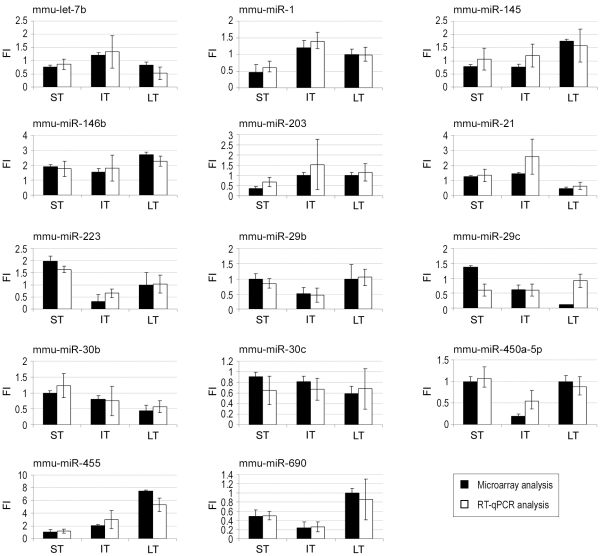
Figure 2. Validation of microarray data by real-time RT-qPCR.
Comparison of miRNA level regulation as determined by microarray hybridization (several probes per target) performed on pooled total RNA and by RT-qPCR performed on total RNA of each individual mice. Results are expressed as means ± SD. The value “1” is arbitrarily given when no change is observed. ST, IT, LT: short, intermediate and long-term treatments, respectively. FI: fold induction.
Figure 3
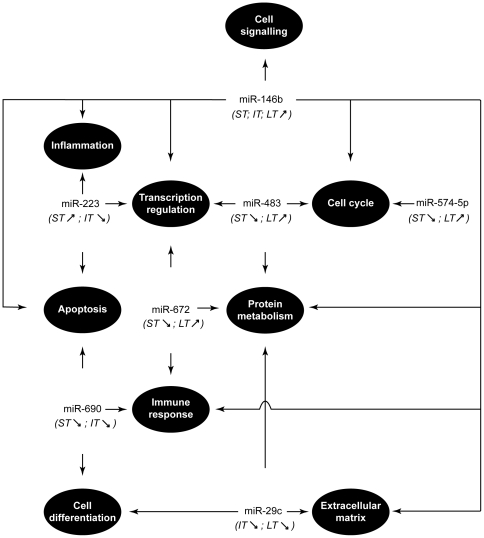
Figure 3. Potential regulation performed by miRNAs during the development of allergen-induced asthma.
This in silico prediction is based on significant inverse correlation between mRNA and miRNA modulation of expression as detailed in tables 4 and 5. ST, IT, LT: short, intermediate and long-term treatments, respectively. The observed up- (<$>\raster="rg1"<$>) and down- (<$>\raster="rg2"<$>) regulations of the expression of the selected miRNAs are reported.
Figure 4
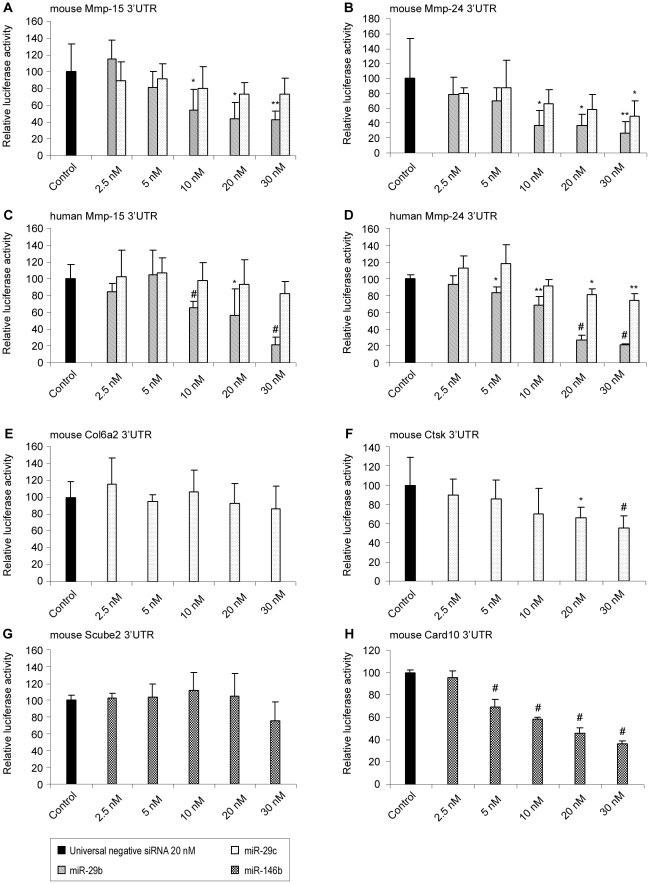
Figure 4. Dose-response analysis of the effect of miR-29b, -29c and -146b on their predicted target in lung cells.
Transient transfection analysis for luciferase reporter expression with mouse Mmp-15 3′UTR in the presence of miR-29b and -29c (Panel A); mouse Mmp-24 3′UTR in the presence and absence of miR-29b and -29c (Panel B); human Mmp-15 3′UTR in the presence of miR-29b and -29c (Panel C); human Mmp-24 3′UTR in the presence of miR-29b and -29c (Panel D); mouse Col6a2 3′UTR in the presence of miR-29c (Panel E); mouse Ctsk 3′UTR in the presence of miR-29c (Panel F); mouse Scube2 3′UTR in the presence of miR-146b (Panel G); mouse Card10 3′UTR in the presence of miR-146b (Panel H). Universal negative siRNA was used at 20 nM as non-functional small RNA control. For each expression vector, the specific effect of the miRNA on luciferase activity was expressed as compared to the activity measured in the control condition, arbitrarily set at “100”. Results are expressed as mean ± SD. (* p-value <0.05; ** p-value <0.001; # p-value <0.005).
Figure 5
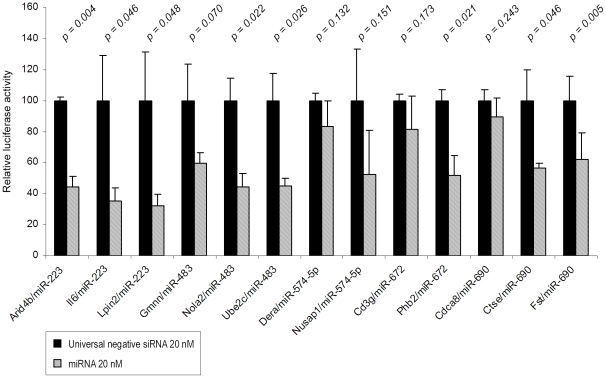
Figure 5. Analysis of 13 miRNAs-predicted target murine genes in vitro.
Transient transfection analysis for luciferase reporter expression with Arid4b, Il-6 or Lpin2 3′UTR in the presence of miR-223; with Gmnn, Nola2 or Ube2c 3′UTR in the presence of miR-483; with Dera or Nusap1 3′UTR in the presence of miR-574-5p; with Cd3g or Phb2 3′UTR in the presence of miR-672; and with Fst, Ctse or Cdca8 3′UTR in the presence of miR-690. Universal negative siRNA were used at 20 nM as non-functional small RNA control. For each expression vector, the specific effect of the miRNA on luciferase activity was expressed as compared to the activity measured in the control condition, arbitrarily set at “100”. Results are expressed as mean ± SD. Each p-value is indicated in the graph.
Figure 6
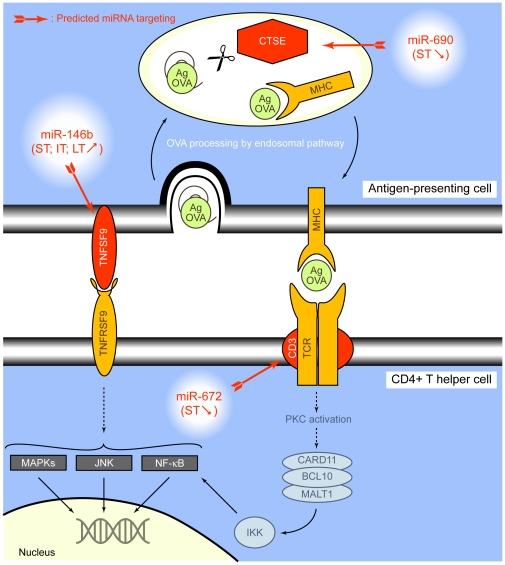
Figure 6. Potential influence of miRNAs on immune response induced by OVA.
In antigen presenting cells, MHC complexes are maturated in endosomes by lysosomal reductases while CTSE processes antigen (Ag), i.e. OVA. Finally, the MHC/antigenic peptide complex translocates to the plasma membrane and is presented to the TCR/CD3 complex on CD4+ T helper cell surface. Activation of TCR/CD3 induces the activation of NF-κB through PKC activation and CARD11/BCL10/MALT1 complex recruitment. MiRNA modulation could occur through mmu-miR-690, -672 and -146b. Cross-linking of costimulatory receptors on the T helper cell with corresponding ligands, such as TNFRSF9 with TNFSF9, also induces NF-κB and regulators (MAPKs, JNK) of the activity of multiple transcription factors. Production of TNFSF9 could be under the control of mmu-miR-146b, thus regulating the T helper cells properties. ST, IT, LT: short, intermediate and long-term treatments, respectively. The observed up- (<$>\raster="rg1"<$>) and down- (<$>\raster="rg2"<$>) regulations of the expression of some specific miRNAs are reported.
Figure 7
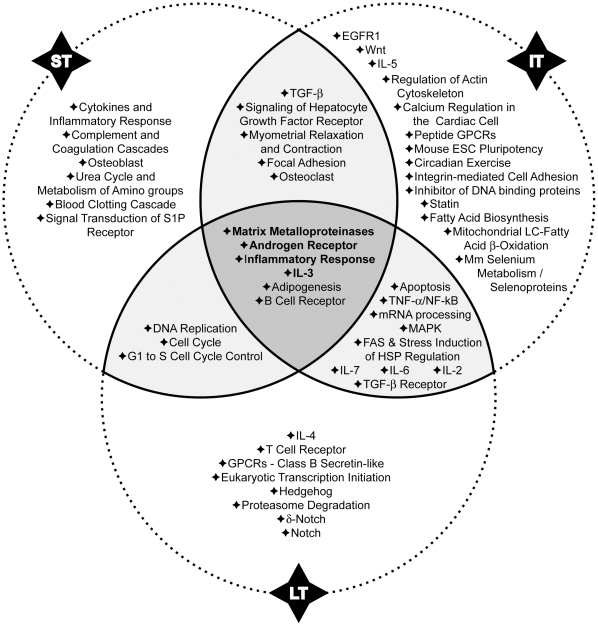
Figure 7. Regulatory pathways regulated by miRNAs as determined by the MicroCosm Targets algorithm.
Fifty-one pathways were identified at one time-point at least. While 28 pathways appeared to be modulated at only one stage of the disease (ST, IT or LT), 17 were regulated at 2 different time-points and 6 during the entire course of the disease. Stouffer's method was used to identify significant enrichment for pathways annotations among predicted targets of modulated miRNA in the model. ST, IT, LT: short, intermediate and long-term treatments, respectively.
Figure 8
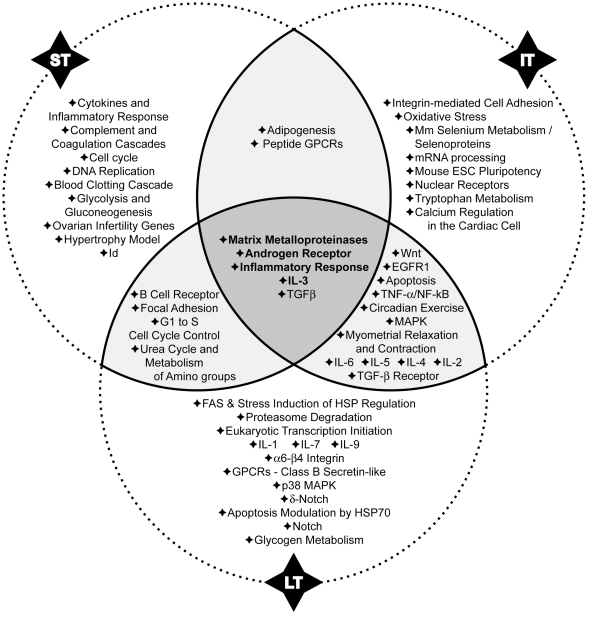
Figure 8. Regulatory pathways regulated by miRNAs as determined by the TargetScan algorithm.
Fifty-three pathways were identified at one time-point at least. While 30 pathways appeared to be modulated at only one stage of the disease (ST, IT or LT), 18 were regulated at 2 different time-points and 5 during the entire study. Stouffer's method was used to identify significant enrichment for pathways annotations among predicted targets of modulated miRNA in the model. ST, IT, LT: short, intermediate and long-term treatments, respectively.
Figure 9
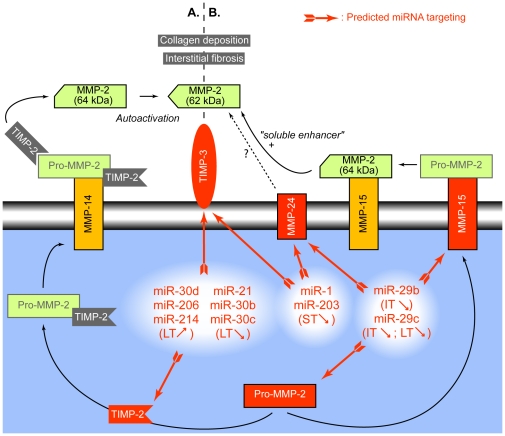
Figure 9. miRNAs and MMP-2 activation.
Panel A represents MMP-14 (MT1-MMP)-dependent activation pathway for MMP-2. TIMP-2 activates pro-MMP-2 by forming a complex that interacts with the MMP-14/TIMP-2 complex at the cell membrane. Activation of pro-MMP-2 occurs in a two step process: cleavage within the MMP-2 prodomain followed by an autocatalytic cleavage which results in the active 62 kD form. Panel B represents the presumed MMP-15 (MT2-MMP) and MMP-24 (MT5-MMP)-dependent activation pathway for MMP-2. Activation of pro-MMP-2 occurs in a two step process: cleavage within the MMP-2 prodomain in the absence of TIMP-2 followed by a second cleavage, enhanced by an unidentified secreted soluble protein which results in the active 62 kD form. The mechanism by which MMP-24 releases active MMP-2 is currently unknown. The intensive activation of MMP-2 contributes to collagen deposition and interstitial fibrosis. An excess of TIMP-2 and the extracellular matrix-anchored TIMP-3 contribute, respectively, to the degradation of pro-MMP-2 and to the inhibition of MMP-2. ST, IT, LT: short, intermediate and long-term treatments, respectively. The observed up- (<$>\raster="rg1"<$>) and down- (<$>\raster="rg2"<$>) regulations of the expression of some specific miRNA are reported.
Figure 10
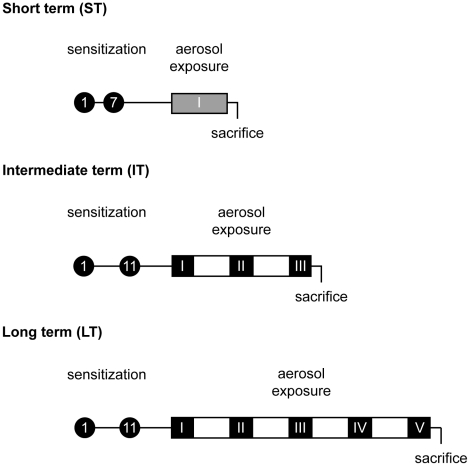
Figure 10. Experimental protocol.
Sensitization and short-term (ST), intermediate-term (IT) and long-term (LT) PBS/ovalbumin (OVA) exposure protocols. BALB/c male mice were sensitized on days 1 and 7 (ST) or 11 (IT and LT) by intraperitoneal injection of 10 µg OVA. At day 22, mice were subsequently exposed to PBS or OVA 1% aerosol for 30 min per day. For ST, aerosol challenge was performed for 7 consecutive days (grey box). For IT or LT, aerosol challenges were performed three or five times (black boxes) according to a pattern of 5-day inhalation (black boxes) followed by a 9-day time off (white boxes). Mice were sacrificed the day after last aerosol challenge.

References

    1. Lange P, Parner J, Vestbo J, Schnohr P, Jensen G. A 15-year follow-up study of ventilatory function in adults with asthma. N Engl J Med. 1998;339:1194–1200. - PubMed
    1. Pascual RM, Peters SP. Airway remodeling contributes to the progressive loss of lung function in asthma: an overview. J Allergy Clin Immunol. 2005;116:477–486; quiz 487. - PubMed
    1. Hirst SJ, Martin JG, Bonacci JV, Chan V, Fixman ED, et al. Proliferative aspects of airway smooth muscle. J Allergy Clin Immunol. 2004;114:S2–17. - PubMed
    1. Di Valentin E, Crahay C, Garbacki N, Hennuy B, Gueders M, et al. New asthma biomarkers: lessons from murine models of acute and chronic asthma. Am J Physiol Lung Cell Mol Physiol. 2009;296:L185–197. - PubMed
    1. Pennings JL, Kimman TG, Janssen R. Identification of a common gene expression response in different lung inflammatory diseases in rodents and macaques. PLoS ONE. 2008;3:e2596. - PMC - PubMed

Publication types