


Hypoxia activates the notch signaling pathway in cells of the intervertebral disc: implications in degenerative disc disease
- PMID: 21305512
- PMCID: PMC3613279
- DOI: 10.1002/art.30246
Hypoxia activates the notch signaling pathway in cells of the intervertebral disc: implications in degenerative disc disease
Abstract
Objective: To investigate whether hypoxia regulates Notch signaling, and whether Notch plays a role in intervertebral disc cell proliferation.
Methods: Reverse transcription-polymerase chain reaction and Western blotting were used to measure expression of Notch signaling components in intervertebral disc tissue from mature rats and from human discs. Transfections were performed to determine the effects of hypoxia and Notch on target gene activity.
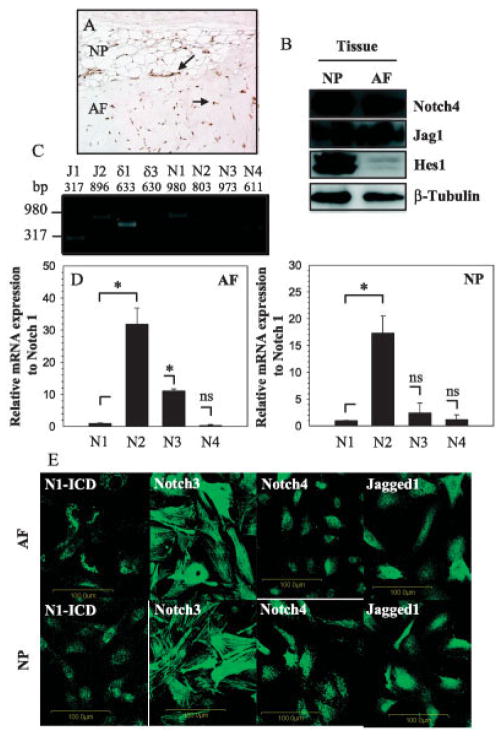
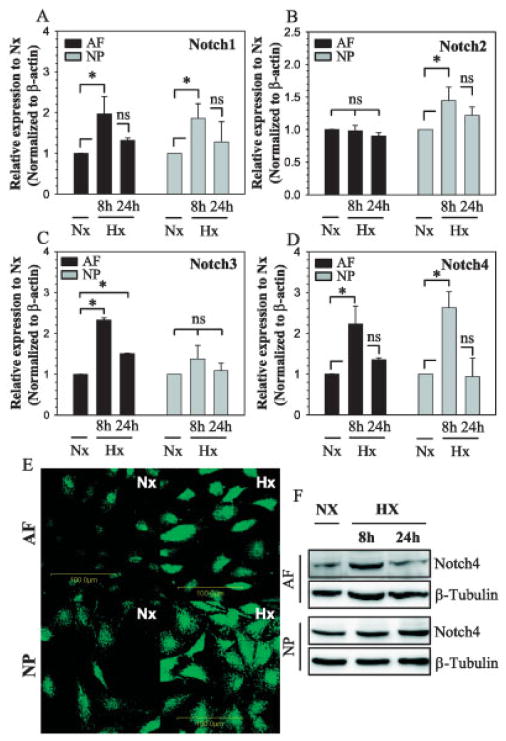
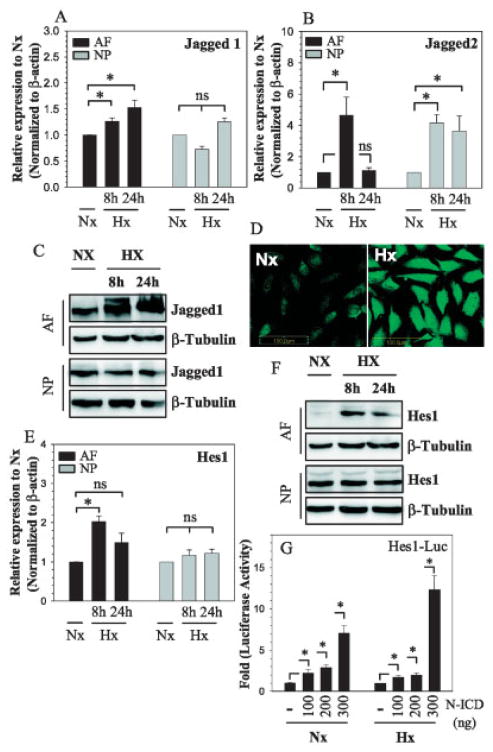
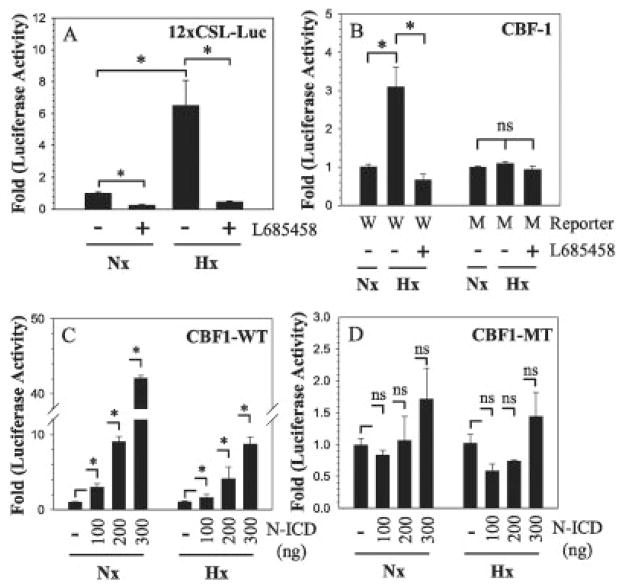
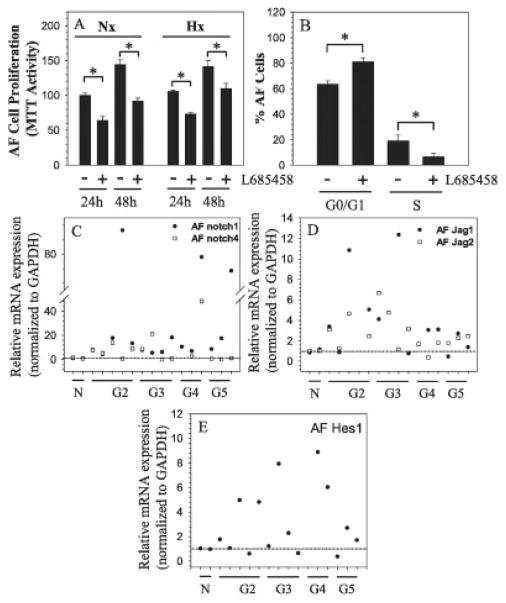
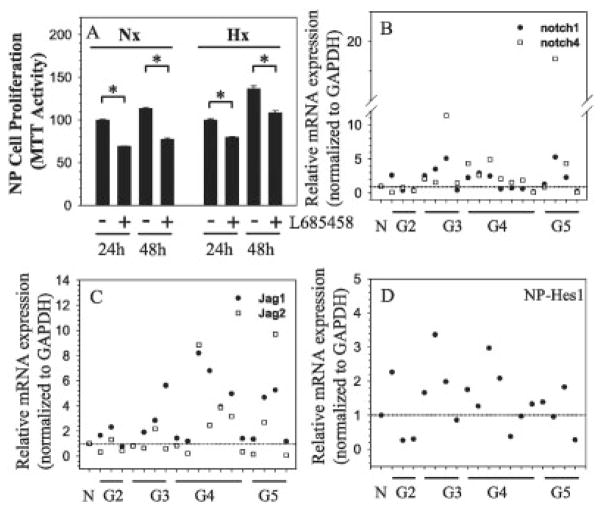
Results: Cells of the nucleus pulposus and annulus fibrosus of rat disc tissue expressed components of the Notch signaling pathway. Expression of Notch-2 was higher than that of the other Notch receptors in both the nucleus pulposus and annulus fibrosus. In both tissues, hypoxia increased Notch1 and Notch4 messenger RNA (mRNA) expression. In the annulus fibrosus, mRNA expression of the Notch ligand Jagged1 was induced by hypoxia, while Jagged2 mRNA expression was highly sensitive to hypoxia in both tissues. A Notch signaling inhibitor, L685458, blocked hypoxic induction of the activity of the Notch-responsive luciferase reporters 12xCSL and CBF1. Expression of the Notch target gene Hes1 was induced by hypoxia, while coexpression with the Notch-intracellular domain increased Hes1 promoter activity. Moreover, inhibition of Notch signaling blocked disc cell proliferation. Analysis of human disc tissue showed that there was increased expression of Notch signaling proteins in degenerated discs.
Conclusion: In intervertebral disc cells, hypoxia promotes expression of Notch signaling proteins. Notch signaling is an important process in the maintenance of disc cell proliferation, and thus offers a therapeutic target for the restoration of cell numbers during degenerative disc disease.
Copyright © 2011 by the American College of Rheumatology.
Figures
Comment in
-
New evidence of the role of the hypoxia-regulated pathway in nucleus pulposus cell survival: comment on the article by Hiyama et al.Arthritis Rheum. 2012 Mar;64(3):940-1; author reply 941-2. doi: 10.1002/art.33480. Arthritis Rheum. 2012. PMID: 22095167 No abstract available.
References
-
- Gruber HE, Ashraf N, Kilburn J, Williams C, Norton HJ, Gordon BE, et al. Vertebral endplate architecture and vascularization: application of micro-computerized tomography, a vascular tracer, and immunocytochemistry in analyses of disc degeneration in the aging sand rat. Spine. 2005;30:2593–600. - PubMed
-
- Hassler O. The human intervertebral disc: a micro-angiographical study on its vascular supply at various ages. Acta Orthop Scand. 1969;40:765–72. - PubMed
-
- Rudert M, Tillmann B. Lymph and blood supply of the human intervertebral disc: cadaver study of correlations to discitis. Acta Orthop Scand. 1993;64:37–40. - PubMed
-
- Bartels EM, Fairbank JC, Winlove CP, Urban JP. Oxygen and lactate concentrations measured in vivo in the intervertebral discs of patients with scoliosis and back pain. Spine. 1998;23:1–7. - PubMed
Publication types
MeSH terms
Substances
Grants and funding
LinkOut - more resources
Full Text Sources
Other Literature Sources
Research Materials
Miscellaneous
