Review
. 2011 Sep;108(4):627-36.
doi: 10.1093/aob/mcr015. Epub 2011 Feb 8.

Pollen tube growth and guidance: roles of small, secreted proteins

Affiliations
Review

Pollen tube growth and guidance: roles of small, secreted proteins

Keun Chae et al. Ann Bot. 2011 Sep.

Abstract

Background: Pollination is a crucial step in angiosperm (flowering plant) reproduction. Highly orchestrated pollen-pistil interactions and signalling events enable plant species to avoid inbreeding and outcrossing as a species-specific barrier. In compatible pollination, pollen tubes carrying two sperm cells grow through the pistil transmitting tract and are precisely guided to the ovules, discharging the sperm cells to the embryo sac for fertilization.

Scope: In Lilium longiflorum pollination, growing pollen tubes utilize two critical mechanisms, adhesion and chemotropism, for directional growth to the ovules. Among several molecular factors discovered in the past decade, two small, secreted cysteine-rich proteins have been shown to play major roles in pollen tube adhesion and reorientation bioassays: stigma/style cysteine-rich adhesin (SCA, approx. 9·3 kDa) and chemocyanin (approx. 9·8 kDa). SCA, a lipid transfer protein (LTP) secreted from the stylar transmitting tract epidermis, functions in lily pollen tube tip growth as well as in forming the adhesive pectin matrix at the growing pollen tube wall back from the tip. Lily chemocyanin is a plantacyanin family member and acts as a directional cue for reorienting pollen tubes. Recent consecutive studies revealed that Arabidopsis thaliana homologues for SCA and chemocyanin play pivotal roles in tip polarity and directionality of pollen tube growth, respectively. This review outlines the biological roles of various secreted proteins in angiosperm pollination, focusing on plant LTPs and chemocyanin.


Figures
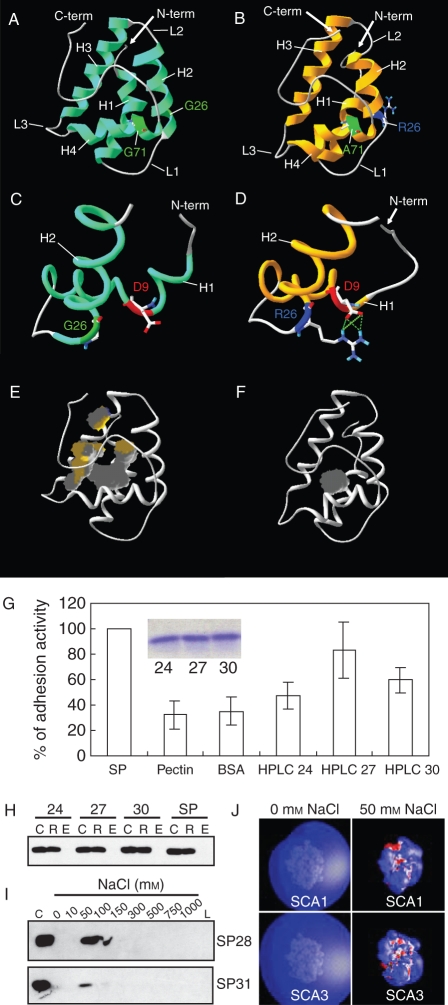
Fig. 1.
Fig. 1.
Two lily SCA isoforms that have identical pectin binding ability show different levels of pollen tube adhesion activity in vitro, with correlating structural differences. (A–F) Three-dimensional structures of SCA1 and SCA3 were generated by homology/MD modelling using the crystal structure of maize LTP (Shin et al., 1995) as the template. Both SCA1 (A) and SCA3 (B) have the typical plant LTP-like structure: a globular shape of the orthogonal four-helix bundle architecture, four disulfide bonds, an internal hydrophobic and solvent-inaccessible cavity, and a long C-terminal tail. H1–H4 indicate helices 1–4, respectively. L1–L3 represent loops 1–3. G26 in SCA1 does not interact with D9 (C). R26 in SCA3 is shown to have strong hydrogen bonding and salt bridge interactions with D9 (D). SCA1 (E) has a larger internal hydrophobic cavity (grey), compared with SCA3 (F). (G) In vitro adhesion assays using HPLC-purified SCA isoforms. SP, pectin matrix prepared with SCA-enriched size-column fractions prior to the HPLC purification as a positive control of adhesion activity; Pectin, pectin matrix alone without any protein (a negative control); BSA, pectin matrix with bovine serum albumin (BSA) replacing SCA (a negative control); HPLC 24–30, pectin matrices containing the HPLC-purified SCA proteins from size-column fractions 24 (SCA2-enriched), 27 (SCA1-enriched) and 30 (SCA3-enriched), respectively. The insert shows equal amounts of proteins (5 µg) from each fraction, applied to the bioassay. (H) In vitro pectin-binding assay. SP, positive protein control prior to HPLC purification; C, a 10 µL aliquot of protein–pectin mixtures as the loading control; R, retentate from the 100 kDa cut-off spin-column containing proteins bound to pectins; E, eluate containing proteins washed off by 1 m NaCl. (I) Ionic strengths of SCAs needed to be detached from the pectin matrix. SP28 and SP31, size-column fractions 28 (SCA1-enriched) and 31 (SCA3-enriched), respectively; C, the loading control; 0–1000 mm NaCl, eluates containing proteins that were serially washed off using a gradient of ionic strengths; L, retentate containing proteins that were left over in the spin-column after the final elution using 1 m NaCl. (J) Electrostatic potentials for homology/MD structures of SCAs. Isopotential contour plots at ±1 kBT e−1 for both SCA1 and SCA3 were generated using GRASP at 0 and 50 mm ionic strengths. Blue indicates a positive and red a negative electrostatic potential. This research was originally published in Journal of Biological Chemistry (Chae et al., 2007). Copyright the American Society for Biochemistry and Molecular Biology.
Fig. 2.
Fig. 2.
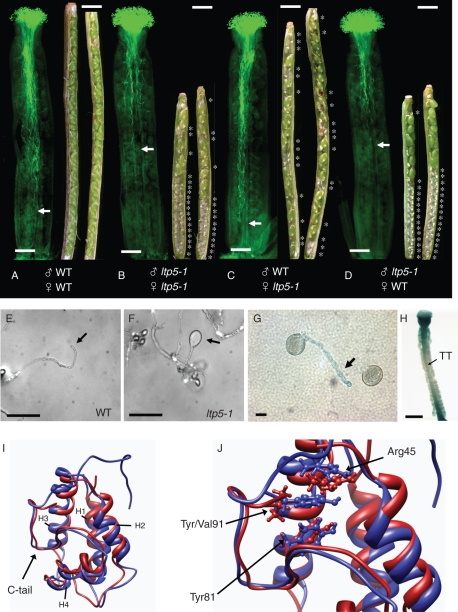
A gain-of-function mutant for Arabidopsis LTP5, an SCA-like LTP, shows defects in polar pollen tube tip growth and pistil function for seed formation. (A–D) In vivo reciprocal cross-pollination of ltp5-1 to wild-type plants. Flowers at stage 12 (Smyth et al., 1990) were emasculated a day before each cross-pollination (n = 15 per cross). At 12 h after pollination, 6–7 pistils were fixed, and pollen tube growth was examined by aniline blue staining. The remaining pollinated pistils ripened into mature siliques in 8 d. Siliques were then dissected for examination of fertilized ovules. Scale bars = 200 mm. Arrows indicate the pollen tube front in the pistil. Asterisks designate unfertilized ovules in the silique. Scale bars = 1 mm. (E, F) Pollen from mature flowers was grown on solid germination medium in vitro for 6 h at room temperature. Arrows indicate pollen tube tips. Scale bars = 100 mm. (G, H) GUS (β-glucuronidase) assay of an LTP5pro:GUS flower. (G) A weak level of gene expression (arrow) was identified in pollen tubes grown on the solid medium in vitro for 6 h. Scale bars = 10 mm. (H) A dissected pistil showed a low level of gene expression in the pistil TT (arrow). Scale bar = 400 mm. (I) Superposition of ribbon representations of the structures of LTP5 and ltp5-1. The structures were generated using homology modelling and 1 ns molecular dynamics simulations. The additional, predominantly hydrophobic, C-terminal tail of ltp5-1 is shown to cap one side of the protein, which is known to be an entrance for a putative ligand to the internal hydrophobic cavity in maize LTP (Han et al., 2001). Red, LTP5; blue, ltp5-1; H1–H4, helix 1–4. (J) A focused view of the superposition of (I) is shown, with residues of interest (Arg45, Tyr81, Val91 and Tyr91) depicted in ball and stick representations. Replacement of Val91 in LTP5 with Tyr91 in ltp5-1 results in stabilizing π-cation interactions with Arg45 and π-stacking interactions with Tyr81. The colouring scheme is the same as in (I). This research was originally published in The Plant Cell (www.plantcell.org) (Chae et al., 2009). Copyright American Society of Plant Biologists.
Fig. 3.
Fig. 3.
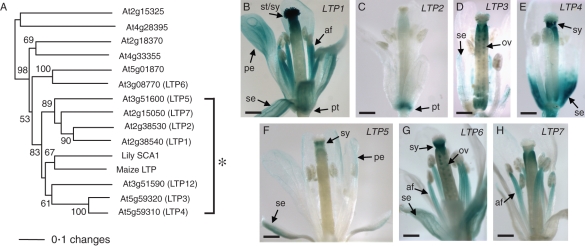
The SCA-like LTP group in Arabidopsis thaliana. (A) Phylogenetic relationships of SCA and SCA-like LTPs in Arabidopsis. The asterisk indicates lily SCA, maize LTP and seven closely related Arabidopsis SCA-like LTPs. The values on the branches indicate the number of bootstrap replicates supporting the branch. Only bootstrap replication values >50 are shown. This research was originally published in The Plant Cell (www.plantcell.org) (Chae et al., 2009). Copyright American Society of Plant Biologists. (B–H) GUS analysis for gene expression patterns of SCA-like Arabidopsis LTP genes in mature floral tissues. This research was originally published in Journal of Experimental Botany (Chae et al., 2010). Copyright the Society of Experimental Biology.
Fig. 4.
Fig. 4.
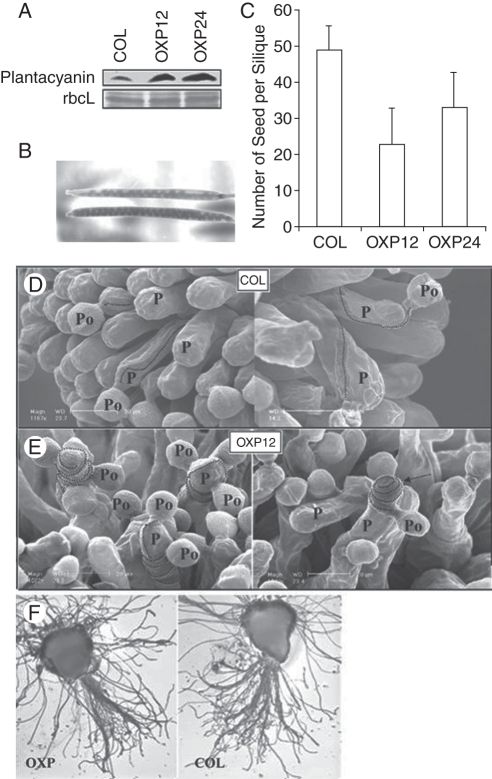
Plantacyanin over-expression lines were used to examine the effect of increased levels of Arabidopsis plantacyanin in the stigma on pollination with wild-type (COL) pollen. Plantacyanin protein levels in the pistils (A) at flower stage 12–13 of OXPs (homozygous T2 generation) are much higher than those of the wild type (COL), as revealed by protein blots. The protein loading control used was Ponceau S staining of the Rubisco large subunit. (B, C) Over-expression pistils pollinated with wild-type pollen produce siliques with fewer seeds than the wild type (COL). The numbers of T2 homozygous pistils hand pollinated after emasculation of flowers are COL (n = 5), OXP12 (n = 21) and OXP24 (n = 23). Values are means ±s.d. (D) Scanning electron microscope images of wild-type pollen on wild-type stigma (two images). Dotted lines trace the path of the pollen tube after it penetrates the papilla cell wall. P, papilla cell, Po, pollen grain. (E) Wild-type pollen on over-expression stigmas showed aberrant tube growth after penetration of the papilla cell wall. Pollen tubes make many turns around the papilla cell in the over-expression stigmas (OXP12; left). One pollen tube shown (OXP12; right) grew away from the style and ended up at the papilla cell tip (arrow). In a semi-in vivo analysis (F), the over-expression stigma (left) and the wild-type stigma (right) were pollinated with wild-type pollen and cultured on an Arabidopsis pollen growth medium. Pollen tubes that penetrate the stigma/style were quantified. No significant difference in number was found between the transgenic and control samples. Scale bars = 20 µm. This research was originally published in Plant Physiology (www.plantphysiol.org) (Dong et al., 2005). Copyright American Society of Plant Biologists.

References

    1. Arondel V, Vergnolle C, Cantrel C, Kader JC. Lipid transfer proteins are encoded by a small multigene family in Arabidopsis thaliana. Plant Science. 2000;157:1–12. - PubMed
    1. Bernhard WR, Thoma S, Botella J, Somerville CR. Isolation of a cDNA clone for spinach lipid transfer protein and evidence that the protein is synthesized by the secretory pathway. Plant Physiology. 1991;95:164–170. - PMC - PubMed
    1. von Besser K, Frank AC, Johnson MA, Preuss D. Arabidopsis HAP2 (GCS1) is a sperm-specific gene required for pollen tube guidance and fertilization. Development. 2006;133:4761–4769. - PubMed
    1. Bosch M, Franklin-Tong VE. Self-incompatibility in Papaver: signalling to trigger PCD in incompatible pollen. Journal of Experimental Botany. 2008;59:481–490. - PubMed
    1. Bosch M, Hepler PK. Pectin methylesterases and pectin dynamics in pollen tubes. The Plant Cell. 2005;17:3219–3226. - PMC - PubMed

Publication types

MeSH terms