


Compartmentalization increases food-web persistence
- PMID: 21307311
- PMCID: PMC3048152
- DOI: 10.1073/pnas.1014353108
Compartmentalization increases food-web persistence
Abstract
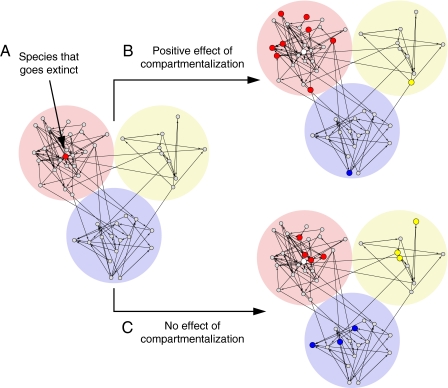
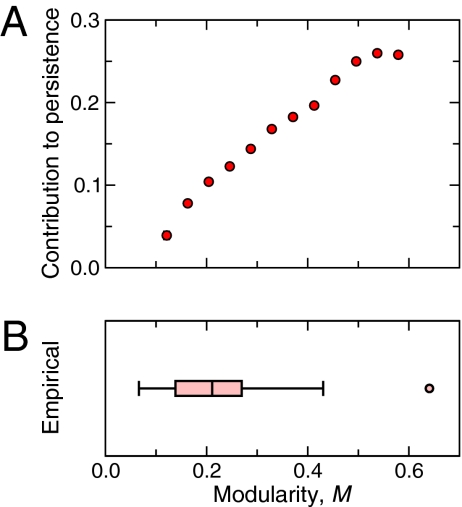
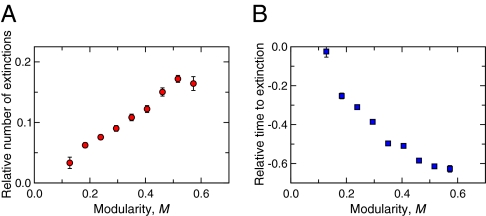
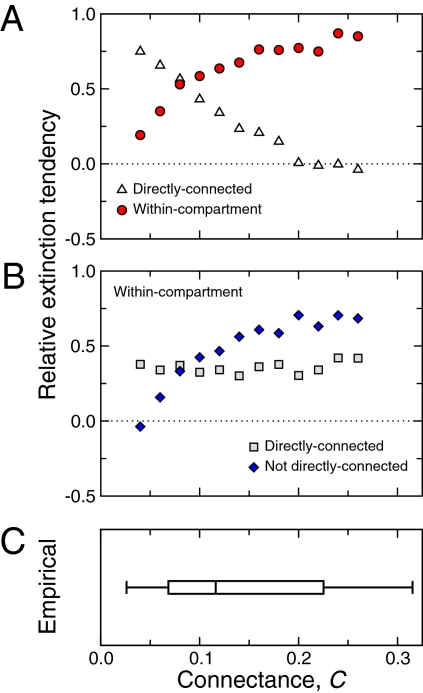
It has recently been noted that empirical food webs are significantly compartmentalized; that is, subsets of species exist that interact more frequently among themselves than with other species in the community. Although the dynamic implications of compartmentalization have been debated for at least four decades, a general answer has remained elusive. Here, we unambiguously demonstrate that compartmentalization acts to increase the persistence of multitrophic food webs. We then identify the mechanisms behind this result. Compartments in food webs act directly to buffer the propagation of extinctions throughout the community and augment the long-term persistence of its constituent species. This contribution to persistence is greater the more complex the food web, which helps to reconcile the simultaneous complexity and stability of natural communities.
Conflict of interest statement
The authors declare no conflict of interest.
Figures
References
-
- Elton CS. Ecology of Invasions by Animals and Plants. London: Chapman & Hall; 1958.
-
- Hutchinson GE. Homage to Santa Rosalia or why are there so many kinds of animals? Am Nat. 1959;93:145–159.
-
- May RM. Will a large complex system be stable? Nature. 1972;238:413–414. - PubMed
-
- May RM. Stability and Complexity in Model Ecosystems. Princeton: Princeton Univ Press; 1973. - PubMed
-
- Yodzis P. The stability of real ecosystems. Nature. 1981;289:674–676.
Publication types
MeSH terms
LinkOut - more resources
Full Text Sources
