


The association between dietary sodium intake, ESRD, and all-cause mortality in patients with type 1 diabetes
- PMID: 21307382
- PMCID: PMC3064042
- DOI: 10.2337/dc10-1722
The association between dietary sodium intake, ESRD, and all-cause mortality in patients with type 1 diabetes
Abstract
Objective: Many guidelines recommend reduced consumption of salt in patients with type 1 diabetes, but it is unclear whether dietary sodium intake is associated with mortality and end-stage renal disease (ESRD).
Research design and methods: In a nationwide multicenter study (the FinnDiane Study) between 1998 and 2002, 2,807 enrolled adults with type 1 diabetes without ESRD were prospectively followed. Baseline urinary sodium excretion was estimated on a 24-h urine collection. The predictors of all-cause mortality and ESRD were determined by Cox regression and competing risk modeling, respectively.
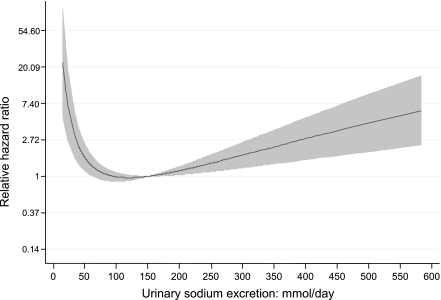
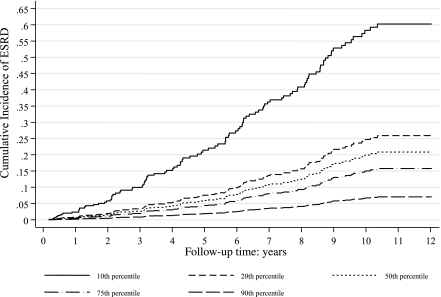
Results: The median follow-up for survival analyses was 10 years, during which 217 deaths were recorded (7.7%). Urinary sodium excretion was nonlinearly associated with all-cause mortality, such that individuals with the highest daily urinary sodium excretion, as well as the lowest excretion, had reduced survival. This association was independent age, sex, duration of diabetes, the presence and severity of chronic kidney disease (CKD) (estimated glomerular filtration rate [eGFR] and log albumin excretion rate), the presence of established cardiovascular disease, and systolic blood pressure. During follow-up, 126 patients developed ESRD (4.5%). Urinary sodium excretion was inversely associated with the cumulative incidence of ESRD, such that individuals with the lowest sodium excretion had the highest cumulative incidence of ESRD.
Conclusions: In patients with type 1 diabetes, sodium was independently associated with all-cause mortality and ESRD. Although we have not demonstrated causality, these findings support the calls for caution before applying salt restriction universally. Clinical trials must be performed in diabetic patients to formally test the utility/risk of sodium restriction in this setting.
Figures
References
-
- Graham I, Atar D, Borch-Johnsen K, et al. European Society of Cardiology (ESC) European Association for Cardiovascular Prevention and Rehabilitation (EACPR) Council on Cardiovascular Nursing. European Association for Study of Diabetes (EASD) International Diabetes Federation Europe (IDF-Europe) European Stroke Initiative (EUSI) Society of Behavioural Medicine (ISBM) European Society of Hypertension (ESH) WONCA Europe (European Society of General Practice/Family Medicine) European Heart Network (EHN) European Atherosclerosis Society (EAS) European guidelines on cardiovascular disease prevention in clinical practice: full text. Fourth Joint Task Force of the European Society of Cardiology and other societies on cardiovascular disease prevention in clinical practice (constituted by representatives of nine societies and by invited experts). Eur J Cardiovasc Prev Rehabil 2007;14(Suppl. 2):S1–S113 10.1097/01.hjr.0000277983.23934.c9 - DOI - PubMed
Publication types
MeSH terms
Substances
LinkOut - more resources
Full Text Sources
Medical
Research Materials
Miscellaneous
