


Duty hour recommendations and implications for meeting the ACGME core competencies: views of residency directors
- PMID: 21307391
- PMCID: PMC3046937
- DOI: 10.4065/mcp.2010.0635
Duty hour recommendations and implications for meeting the ACGME core competencies: views of residency directors
Abstract
Objective: To describe the views of residency program directors regarding the effect of the 2010 duty hour recommendations on the 6 core competencies of graduate medical education.
Methods: US residency program directors in internal medicine, pediatrics, and general surgery were e-mailed a survey from July 8 through July 20, 2010, after the 2010 Accreditation Council for Graduate Medical Education (ACGME) duty hour recommendations were published. Directors were asked to rate the implications of the new recommendations for the 6 ACGME core competencies as well as for continuity of inpatient care and resident fatigue.
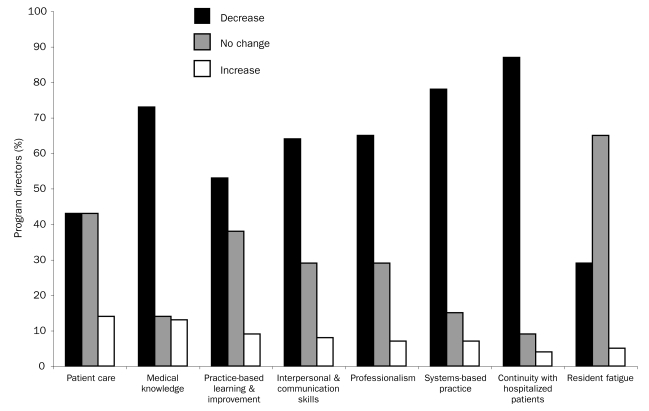
Results: Of 719 eligible program directors, 464 (65%) responded. Most program directors believe that the new ACGME recommendations will decrease residents' continuity with hospitalized patients (404/464 [87%]) and will not change (303/464 [65%]) or will increase (26/464 [6%]) resident fatigue. Additionally, most program directors (249-363/464 [53%-78%]) believe that the new duty hour restrictions will decrease residents' ability to develop competency in 5 of the 6 core areas. Surgery directors were more likely than internal medicine directors to believe that the ACGME recommendations will decrease residents' competency in patient care (odds ratio [OR], 3.9; 95% confidence interval [CI], 2.5-6.3), medical knowledge (OR, 1.9; 95% CI, 1.2-3.2), practice-based learning and improvement (OR, 2.7; 95% CI, 1.7-4.4), interpersonal and communication skills (OR, 1.9; 95% CI, 1.2-3.0), and professionalism (OR, 2.5; 95% CI, 1.5-4.0).
Conclusion: Residency program directors' reactions to ACGME duty hour recommendations demonstrate a marked degree of concern about educating a competent generation of future physicians in the face of increasing duty hour standards and regulation.
Figures
Comment in
-
Duty hours: where do we go from here?Mayo Clin Proc. 2011 Mar;86(3):176-8. doi: 10.4065/mcp.2011.0086. Mayo Clin Proc. 2011. PMID: 21364108 Free PMC article. No abstract available.
-
The times, they are a-changing: maybe we need to change too.Mayo Clin Proc. 2011 Mar;86(3):179-80. doi: 10.4065/mcp.2011.0079. Mayo Clin Proc. 2011. PMID: 21364109 Free PMC article. No abstract available.
-
Think broad, act lean: implications of residency training and duty hour changes on health care costs.Mayo Clin Proc. 2011 Jul;86(7):703-5; author reply 706-8. doi: 10.4065/mcp.2011.0179. Mayo Clin Proc. 2011. PMID: 21719625 Free PMC article. No abstract available.
-
2010 duty hour standards: seeing beyond the numeric limits.Mayo Clin Proc. 2011 Jul;86(7):703; author reply 706-8. doi: 10.4065/mcp.2011.0163. Mayo Clin Proc. 2011. PMID: 21719626 Free PMC article. No abstract available.
-
Inconclusive findings on effects of duty hour reduction.Mayo Clin Proc. 2011 Jul;86(7):705-6; author reply 706-8. doi: 10.4065/mcp.2011.0222. Mayo Clin Proc. 2011. PMID: 21719627 Free PMC article. No abstract available.
References
-
- Fletcher KE, Davis SQ, Underwood W, Mangrulkar RS, McMahon LF, Jr, Saint S. Systematic review: effects of resident work hours on patient safety. Ann Intern Med. 2004;141(11)851-857 - PubMed
-
- Fletcher KE, Underwood W, III, Davis SQ, Mangrulkar RS, McMahon LF, Jr, Saint S. Effects of work hour reduction on residents' lives: a systematic review. JAMA. 2005;294(9)1088-1100 - PubMed
-
- Barrack RL, Miller LS, Sotile WM, Sotile MO, Rubash HE. Effect of duty hour standards on burnout among orthopaedic surgery residents. Clin Orthop Relat Res. 2006;449:134-137 - PubMed
-
- Gopal R, Glasheen JJ, Miyoshi TJ, Prochazka AV. Burnout and internal medicine resident work-hour restrictions. Arch Intern Med. 2005;165(22)2595-2600 - PubMed
Publication types
MeSH terms
Grants and funding
LinkOut - more resources
Full Text Sources
