


Acoelomorph flatworms are deuterostomes related to Xenoturbella
- PMID: 21307940
- PMCID: PMC4025995
- DOI: 10.1038/nature09676
Acoelomorph flatworms are deuterostomes related to Xenoturbella
Abstract
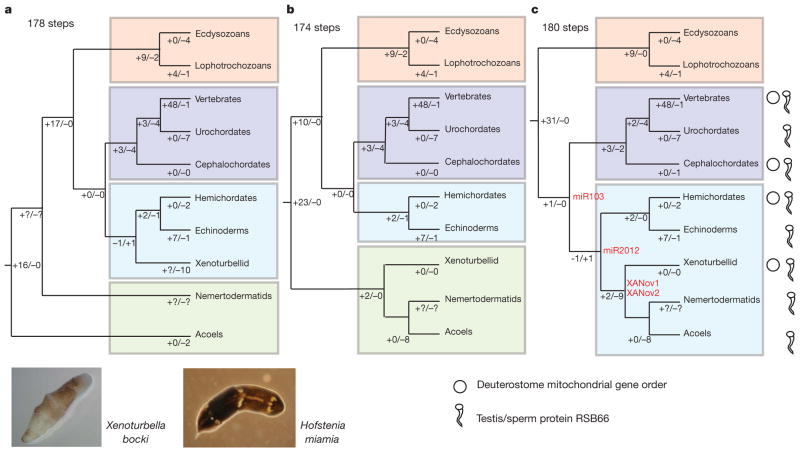
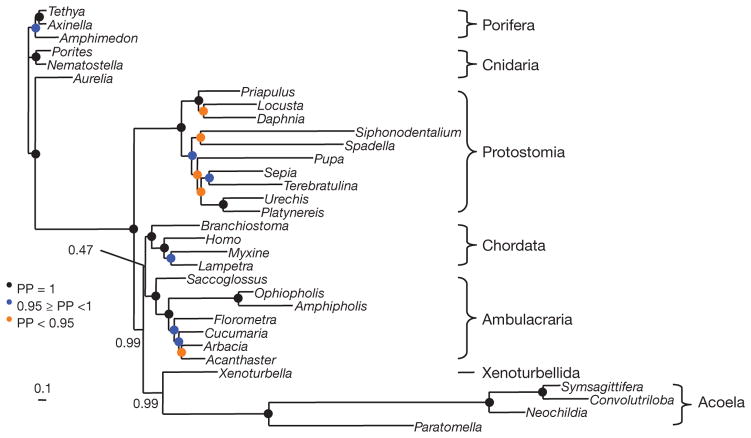
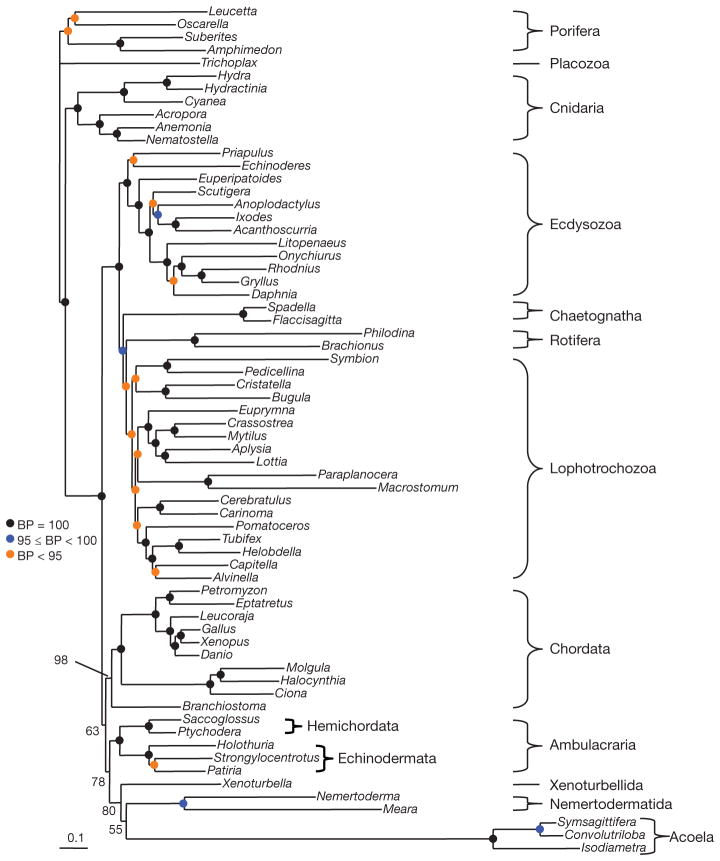
Xenoturbellida and Acoelomorpha are marine worms with contentious ancestry. Both were originally associated with the flatworms (Platyhelminthes), but molecular data have revised their phylogenetic positions, generally linking Xenoturbellida to the deuterostomes and positioning the Acoelomorpha as the most basally branching bilaterian group(s). Recent phylogenomic data suggested that Xenoturbellida and Acoelomorpha are sister taxa and together constitute an early branch of Bilateria. Here we assemble three independent data sets-mitochondrial genes, a phylogenomic data set of 38,330 amino-acid positions and new microRNA (miRNA) complements-and show that the position of Acoelomorpha is strongly affected by a long-branch attraction (LBA) artefact. When we minimize LBA we find consistent support for a position of both acoelomorphs and Xenoturbella within the deuterostomes. The most likely phylogeny links Xenoturbella and Acoelomorpha in a clade we call Xenacoelomorpha. The Xenacoelomorpha is the sister group of the Ambulacraria (hemichordates and echinoderms). We show that analyses of miRNA complements have been affected by character loss in the acoels and that both groups possess one miRNA and the gene Rsb66 otherwise specific to deuterostomes. In addition, Xenoturbella shares one miRNA with the ambulacrarians, and two with the acoels. This phylogeny makes sense of the shared characteristics of Xenoturbellida and Acoelomorpha, such as ciliary ultrastructure and diffuse nervous system, and implies the loss of various deuterostome characters in the Xenacoelomorpha including coelomic cavities, through gut and gill slits.
Figures
References
-
- Bourlat S, et al. Deuterostome phylogeny reveals monophyletic chordates and the new phylum Xenoturbellida. Nature. 2006;444:85–88. - PubMed
-
- Bourlat S, Nielsen C, Lockyer A, Littlewood DTJ, Telford MJ. Xenoturbella is a deuterostome that eats molluscs. Nature. 2003;424:925–928. - PubMed
-
- Sempere LF, Cole CN, McPeek MA, Peterson KJ. The phylogenetic distribution of metazoan microRNAs: insights into evolutionary complexity and constraint. J Exp Zool B. 2006;306:575–588. - PubMed
Publication types
MeSH terms
Substances
Grants and funding
LinkOut - more resources
Full Text Sources
Miscellaneous
