


Phonology and vocal behavior in toddlers with autism spectrum disorders
- PMID: 21308998
- PMCID: PMC3110574
- DOI: 10.1002/aur.183
Phonology and vocal behavior in toddlers with autism spectrum disorders
Abstract
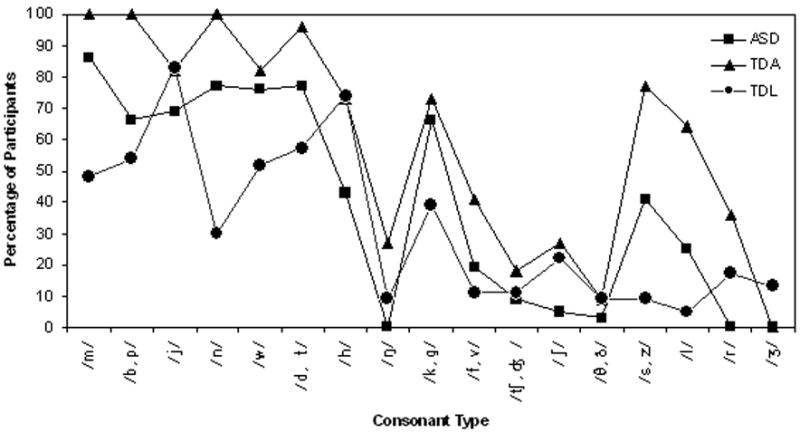
The purpose of this study is to examine the phonological and other vocal productions of children, 18-36 months, with autism spectrum disorder (ASD) and to compare these productions to those of age-matched and language-matched controls. Speech samples were obtained from 30 toddlers with ASD, 11 age-matched toddlers and 23 language-matched toddlers during either parent-child or clinician-child play sessions. Samples were coded for a variety of speech-like and nonspeech vocalization productions. Toddlers with ASD produced speech-like vocalizations similar to those of language-matched peers, but produced significantly more atypical nonspeech vocalizations when compared to both control groups. Toddlers with ASD show speech-like sound production that is linked to their language level, in a manner similar to that seen in typical development. The main area of difference in vocal development in this population is in the production of atypical vocalizations. Findings suggest that toddlers with ASDs do not tune into the language model of their environment. Failure to attend to the ambient language environment negatively impacts the ability to acquire spoken language.
Copyright © 2011, International Society for Autism Research, Wiley Periodicals, Inc.
Figures
References
-
- American Psychiatric Association . Diagnostic and Statistical Manual of Mental Disorders (text revision) Washington, DC: Author; 2000.
-
- Bartak L, Rutter M, Cox A. A comparative study of infantile autism and specific developmental receptive language disorder: The children. British Journal of Psychiatry. 1975;126:127–145. - PubMed
-
- Bartolucci G, Pierce S, Streiner D, Tolkin-Eppel P. Phonological investigation of verbal autistic and mentally retarded subjects. Journal of Autism and Childhood Schizophrenia. 1976;6:303–315. - PubMed
-
- Chakrabarti S, Fombonne E. Pervasive developmental disorders in preschool children. Journal of the American Medical Association. 2001;285:3093–3099. - PubMed
-
- Charman T, Baird G. Practitioner review: Diagnosis of autism spectrum disorders in 2- and 3-year-old children. Journal of Child Psychology and Psychiatry. 2002;43:289–305. - PubMed
Publication types
MeSH terms
Grants and funding
LinkOut - more resources
Full Text Sources
