


Nickel-catalyzed Negishi cross-coupling reactions of secondary alkylzinc halides and aryl iodides
- PMID: 21309529
- PMCID: PMC6474776
- DOI: 10.1021/ol200098d
Nickel-catalyzed Negishi cross-coupling reactions of secondary alkylzinc halides and aryl iodides
Abstract
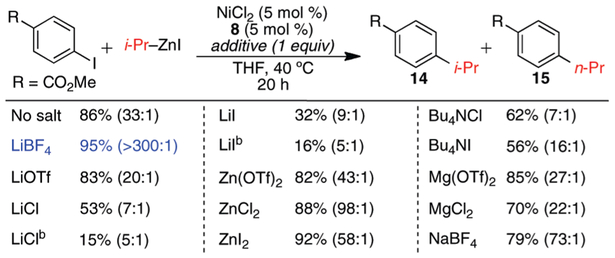
A general Ni-catalyzed process for the cross-coupling of secondary alkylzinc halides and aryl/heteroaryl iodides has been developed. This is the first process to overcome the isomerization and β-hydride elimination problems that are associated with the use of secondary nucleophiles, and that have limited the analogous Pd-catalyzed systems. The impact of salt additives was also investigated. It was found that the presence of LiBF(4) dramatically improves both isomeric retention and yield for challenging substrates.
Figures
References
-
- Metal-Catalyzed Cross-Coupling Reactions; de Meijere A, Diederich F, Eds., Wiley-VCH: New York, 2004.
- Rudolph A; Lautens M Angew. Chem., Int. Ed 2009, 48, 2656 and references cited therein. Vechorkin O; Hu X Angew. Chem., Int. Ed 2009, 48, 2937 and references cited therein..
-
-
Original pioneering study:
- Tamao K; Kiso Y; Sumitani K; Kumada M J. Am. Chem. Soc 1972, 94, 9268.
-
-
-
For recent examples of secondary nucleophiles in Pd catalysis, see:
- Campos KR; Klapars A; Walsman JH; Dormer PG; Chen C J. Am. Chem. Soc 2006, 128, 3538. - PubMed
- Luo X; Zhang H; Duan H; Liu Q; Zhu L; Zhang T; Lei A Org. Lett 2007, 9, 4571. - PubMed
- Dreher SD; Dormer PG; Sandrock DL; Molander GA J. Am. Chem. Soc 2008, 130, 9257. - PMC - PubMed
- Han C; Buchwald SL J. Am. Chem. Soc 2009, 131, 7532. - PMC - PubMed
- Thaler T; Haag B; Gavryushin A; Schober K; Hartman E; Gschwing RM; Zipse H; Mayer P; Knochel P Nat. Chem 2010, 2, 125. - PubMed
- Nakao Y; Takeda M; Matsumoto T; Hiyama T Angew. Chem., Int. Ed 2010, 45, 4447. - PubMed
- Sandrock DL; Jean-Gerard L; Chen C-Y; Dreher SD; Molander GA J. Am. Chem. Soc 2010, 132, 17108 For recent examples of secondary nucleophiles in Ni catalysis, see: - PMC - PubMed
- Melzig L; Gavryushin A; Knochel Org. Lett 2007, 9, 5529. - PubMed
- Smith SW; Fu GC Angew.Chem., Int. Ed 2008, 47, 9334. - PMC - PubMed
- Phapale VB; Guisan-Ceinos M; Bunuel E; Cardenas DJ Chem.—Eur. J 2009, 15, 12681. - PubMed
-
-
-
The presence of an ortho-substituent or an electron-withdrawing group on the electrophilic component of Pd-catalyzed cross-coupling reactions has been shown to accelerate reductive elimination. See:
- Crabtree RH The Organometallic Chemistry of the Transition Metals, 3rd ed.; John Wiley and Sons: New York, 2001.
- Torraca KE; Huang X; Parrish CA; Buchwald SL J. Am. Chem. Soc 2001, 123, 10770. - PubMed
- Culkin DA; Hartwig JF Organometallics 2004, 23, 3398.
-
-
-
While a Ni(0)–Ni(II) catalytic cycle cannot be conclusively ruled out, structural and computational studies support a Ni(I)–Ni(III) catalytic cycle for such Ni-catalyzed reactions when bi- and tridentate nitrogen are employed as the supporting ligand. See ref .
- Anderson TJ; Jones GD; Vicic DA J. Am. Chem. Soc 2004, 126, 8100. - PubMed
- Jones GD; Martin JL; McFarland C; Allen OR; Hall RE; Haley AD; Brandon RJ; Konovalova T; Desrochers PJ; Pulay P; Vicic DA J. Am. Chem. Soc 2006, 128, 13175. - PubMed
-
Grants and funding
LinkOut - more resources
Full Text Sources
Other Literature Sources
