


Hereditary angioedema: beyond international consensus - circa December 2010 - The Canadian Society of Allergy and Clinical Immunology Dr. David McCourtie Lecture
- PMID: 21310025
- PMCID: PMC3048557
- DOI: 10.1186/1710-1492-7-1
Hereditary angioedema: beyond international consensus - circa December 2010 - The Canadian Society of Allergy and Clinical Immunology Dr. David McCourtie Lecture
Abstract
Background: The 2010 International Consensus Algorithm for the Diagnosis, Therapy and Management of Hereditary Angioedema was published earlier this year in this Journal (Bowen et al. Allergy, Asthma & Clinical Immunology 2010, 6:24 - http://www.aacijournal.com/content/6/1/24). Since that publication, there have been multiple phase III clinical trials published on either prophylaxis or therapy of hereditary angioedema and some of these products have changed approval status in various countries. This manuscript was prepared to review and update the management of hereditary angioedema.
Objective: To review approaches for the diagnosis and management of hereditary angioedema (HAE) circa December 2010 and present thoughts on moving from HAE management from international evidence-based consensus to facilitate more local health unit considerations balancing costs, efficacies of treatments, and risk benefits. Thoughts will reflect Canadian and international experiences.
Methods: PubMed searches including hereditary angioedema and diagnosis, therapy, management and consensus were reviewed as well as press releases from various pharmaceutical companies to early December 2010.
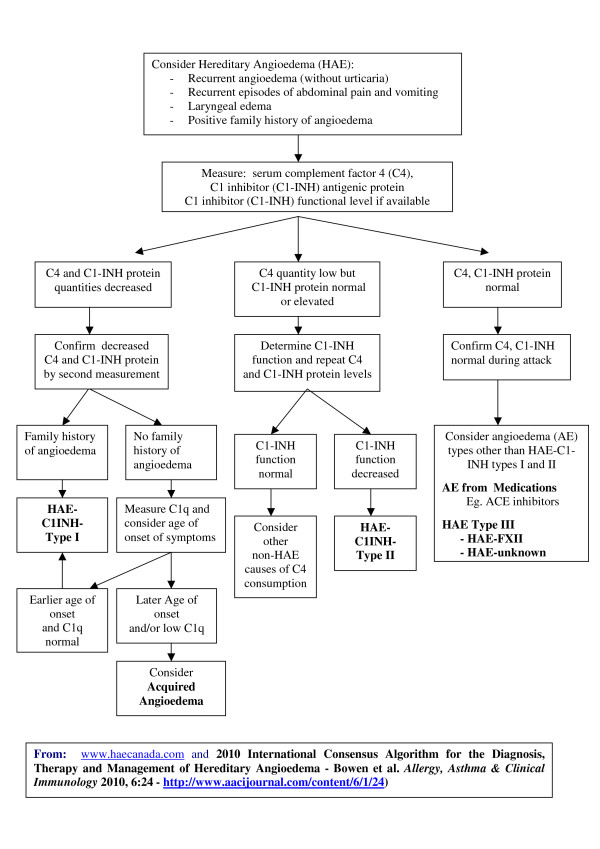
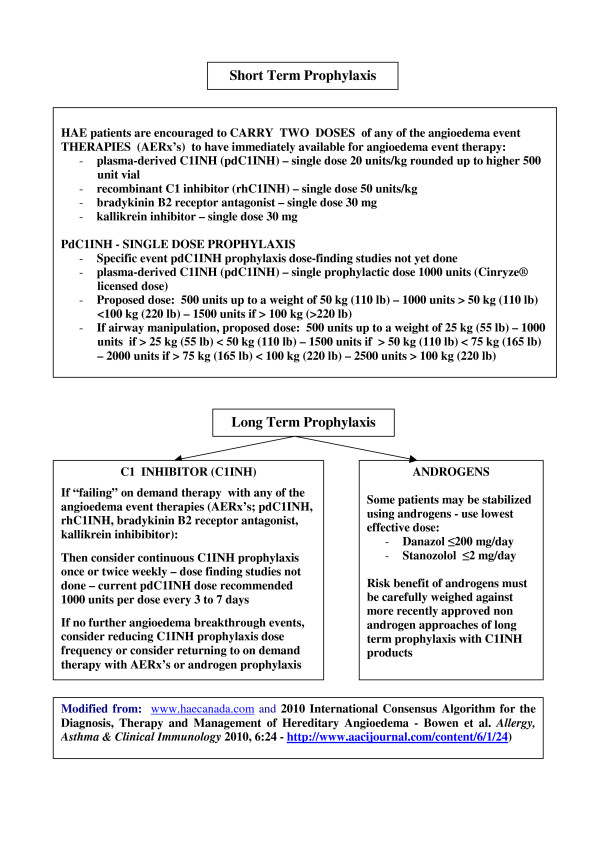
Results: The 2010 International Consensus Algorithms for the Diagnosis, Therapy and Management of Hereditary Angioedema is reviewed in light of the newly published phase III Clinical trials for prevention and therapy of HAE. Management approaches and models are discussed.
Conclusions: Consensus approach and double-blind placebo controlled trials are only interim guides to a complex disorder such as HAE and should be replaced as soon as possible with large phase IV clinical trials, meta analyses, data base registry validation of approaches including quality of life and cost benefit analyses, safety, and head-to-head clinical trials investigating superiority or non-inferiority comparisons of available approaches. Since not all therapeutic products are available in all jurisdictions and since health care delivery approaches and philosophy vary between countries, each health care delivery sector will likely devise their own algorithms based on local practicalities for implementing evidence-based guidelines and standards for HAE disease management. Quality-of-life and cost affordability benefit conclusions will likely vary between countries and health care units. Data base registries for rare disorders like HAE should be used to detect early adverse events for new therapies and to facilitate phase IV clinical trials and encourage superiority and non-inferiority comparisons of HAE management approaches.
Figures
References
-
- Bowen T, Cicardi M, Farkas H, Bork K, Longhurst HJ, Zuraw B, Aygoeren-Pürsün E, Craig T, Binkley K, Hebert J, Ritchie B, Bouillet L, Betschel S, Cogar D, Dean J, Devaraj R, Hamed A, Kamra P, Keith PK, Lacuesta G, Leith E, Lyons H, Mace S, Mako B, Neurath D, Poon MC, Rivard GE, Schellenberg R, Rowan D, Rowe A, Stark D, Sur S, Tsai E, Warrington R, Waserman S, Ameratunga R, Bernstein J, Björkander J, Brosz K, Brosz J, Bygum A, Caballero T, Frank M, Fust G, Harmat G, Kanani A, Kreuz W, Levi M, Li H, Martinez-Saguer I, Moldovan D, Nagy I, Nielsen EW, Nordenfelt P, Reshef A, Rusicke E, Smith-Foltz S, Späth P, Varga L, Xiang ZY. 2010 International consensus algorithm for the diagnosis, therapy and management of hereditary angioedema. Allergy Asthma Clin Immunol. 2010;6:24. doi: 10.1186/1710-1492-6-24. - DOI - PMC - PubMed
-
- Zuraw BL, Busse PJ, White M, Jacobs J, Lumry W, Baker J, Craig T, Grant JA, Hurewitz D, Bielory L, Cartwright WE, Koleilat M, Ryan W, Schaefer O, Manning M, Patel P, Bernstein JA, Friedman RA, Wilkinson R, Tanner D, Kohler G, Gunther G, Levy R, McClellan J, Redhead J, Guss D, Heyman E, Blumenstein BA, Kalfus I, Frank MM. Nanofiltered C1 inhibitor concentrate for treatment of hereditary angioedema. N Engl J Med. 2010;363:513–22. doi: 10.1056/NEJMoa0805538. - DOI - PubMed
-
- Zuraw B, Cicardi M, Levy RJ, Nuijens JH, Relan A, Visscher S, Haase G, Kaufman L, Hack CE. Recombinant human C1-inhibitor for the treatment of acute angioedema attacks in patients with hereditary angioedema. J Allergy Clin Immunol. 2010;126:821–827. doi: 10.1016/j.jaci.2010.07.021. e14. - DOI - PubMed
-
- Cicardi M, Banerji A, Bracho F, Malbrán A, Rosenkranz B, Riedl M, Bork K, Lumry W, Aberer W, Bier H, Bas M, Greve J, Hoffmann TK, Farkas H, Reshef A, Ritchie B, Yang W, Grabbe J, Kivity S, Kreuz W, Levy RJ, Luger T, Obtulowicz K, Schmid-Grendelmeier P, Bull C, Sitkauskiene B, Smith WB, Toubi E, Werner S, Anné S, Björkander J, Bouillet L, Cillari E, Hurewitz D, Jacobson KW, Katelaris CH, Maurer M, Merk H, Bernstein JA, Feighery C, Floccard B, Gleich G, Hébert J, Kaatz M, Keith P, Kirkpatrick CH, Langton D, Martin L, Pichler C, Resnick D, Wombolt D, Fernández Romero DS, Zanichelli A, Arcoleo F, Knolle J, Kravec I, Dong L, Zimmermann J, Rosen K, Fan WT. Icatibant, a new bradykinin-receptor antagonist, in hereditary angioedema. N Engl J Med. 2010;363:532–41. doi: 10.1056/NEJMoa0906393. Erratum in: N Engl J Med. 2010, 363:1486. - DOI - PMC - PubMed
LinkOut - more resources
Full Text Sources
Other Literature Sources
