


Prenatal fatty acid status and child adiposity at age 3 y: results from a US pregnancy cohort
- PMID: 21310834
- PMCID: PMC3057547
- DOI: 10.3945/ajcn.110.005801
Prenatal fatty acid status and child adiposity at age 3 y: results from a US pregnancy cohort
Abstract
Background: Exposure to polyunsaturated fatty acids (PUFAs) in early life may influence adiposity development.
Objective: We examined the extent to which prenatal n-3 (omega-3) and n-6 (omega-6) PUFA concentrations were associated with childhood adiposity.
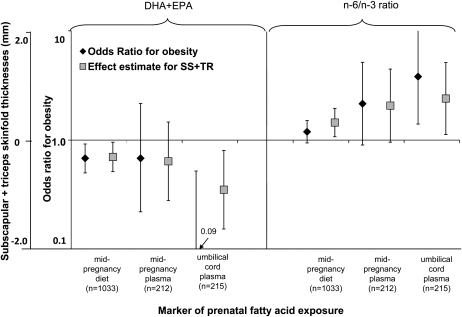
Design: In mother-child pairs in the Project Viva cohort, we assessed midpregnancy fatty acid intakes (n = 1120), maternal plasma PUFA concentrations (n = 227), and umbilical cord plasma PUFA concentrations (n = 302). We performed multivariable regression analyses to examine independent associations of n-3 PUFAs, including docosahexaenoic and eicosapentaenoic acids (DHA + EPA), n-6 PUFAs, and the ratio of n-6:n-3 PUFAs, with child adiposity at age 3 y measured by the sum of subscapular and triceps skinfold thicknesses (SS + TR) and risk of obesity (body mass index ≥95th percentile for age and sex).
Results: Mean (±SD) DHA + EPA intake was 0.15 ± 0.14 g DHA + EPA/d, maternal plasma concentration was 1.9 ± 0.6%, and umbilical plasma concentration was 4.6 ± 1.2%. In children, SS + TR was 16.7 ± 4.3 mm, and 9.4% of children were obese. In the adjusted analysis, there was an association between each SD increase in DHA + EPA and lower child SS + TR [-0.31 mm (95% CI: -0.58, -0.04 mm) for maternal diet and -0.91 mm (95% CI: -1.63, -0.20 mm) for cord plasma] and lower odds of obesity [odds ratio (95% CI): 0.68 (0.50, 0.92) for maternal diet and 0.09 (0.02, 0.52) for cord plasma]. Maternal plasma DHA + EPA concentration was not significantly associated with child adiposity. A higher ratio of cord plasma n-6:n-3 PUFAs was associated with higher SS + TR and odds of obesity.
Conclusion: An enhanced maternal-fetal n-3 PUFA status was associated with lower childhood adiposity.
Figures
References
-
- McCann JC, Ames BN. Is docosahexaenoic acid, an n−3 long-chain polyunsaturated fatty acid, required for development of normal brain function? An overview of evidence from cognitive and behavioral tests in humans and animals. Am J Clin Nutr 2005;82:281–95 - PubMed
-
- Nesheim M, Yaktine A, Seafood choices: balancing benefits and risks. Washington, DC: The National Academies Press, 2007
-
- Brenna JT, Salem N, Jr, Sinclair AJ, Cunnane SC. alpha-Linolenic acid supplementation and conversion to n−3 long-chain polyunsaturated fatty acids in humans. Prostaglandins Leukot Essent Fatty Acids 2009;80:85–91 - PubMed
-
- Harris WS, Mozaffarian D, Rimm E, et al. Omega-6 fatty acids and risk for cardiovascular disease: a science advisory from the American Heart Association Nutrition Subcommittee of the Council on Nutrition, Physical Activity, and Metabolism; Council on Cardiovascular Nursing; and Council on Epidemiology and Prevention. Circulation 2009;119:902–7 - PubMed
Publication types
MeSH terms
Substances
Grants and funding
LinkOut - more resources
Full Text Sources
Medical
Research Materials
