. 2011 Jan 11;42(1):5.
doi: 10.1186/1297-9716-42-5.

Breeding with resistant rams leads to rapid control of classical scrapie in affected sheep flocks

Affiliations

Breeding with resistant rams leads to rapid control of classical scrapie in affected sheep flocks

Gonnie Nodelijk et al. Vet Res. .

Abstract

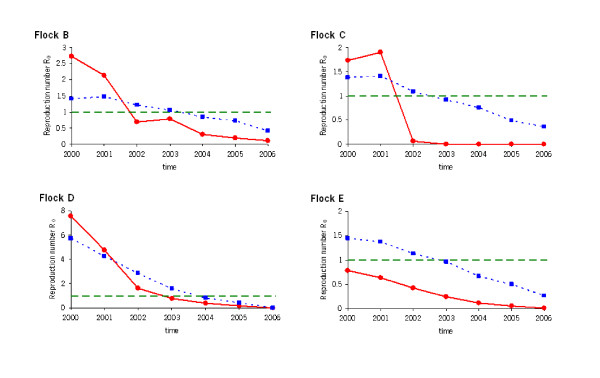
Susceptibility to scrapie, a transmissible spongiform encephalopathy in sheep, is modulated by the genetic make-up of the sheep. Scrapie control policies, based on selecting animals of resistant genotype for breeding, have recently been adopted by the Netherlands and other European countries. Here we assess the effectiveness of a breeding programme based on selecting rams of resistant genotype to obtain outbreak control in classical scrapie-affected sheep flocks under field conditions. In six commercially-run flocks following this breeding strategy, we used genotyping to monitor the genotype distribution, and tonsil biopsies and post-mortem analyses to monitor the occurrence of scrapie infection. The farmers were not informed about the monitoring results until the end of the study period of six years. We used a mathematical model of scrapie transmission to analyze the monitoring data and found that where the breeding scheme was consistently applied, outbreak control was obtained after at most four years. Our results also show that classical scrapie control can be obtained before the frequency of non-resistant animals is reduced to zero in the flock. This suggests that control at the national scale can be obtained without a loss of genetic polymorphisms from any of the sheep breeds.


Figures

Figure 1
Figure 1
Structure of our mathematical model of scrapie transmission in a sheep flock.
Figure 2
Figure 2
Distribution of the genotypes ARR/ARR (green), S/ARR (yellow) and S/S (orange) during the study period (four years for flock A & F; six years for flock B, C, D & E). Alleles different from the ARR allele are denoted by S (of susceptibility); in the present case this means that S = ARQ, AHQ or VRQ.
Figure 3
Figure 3
Change in time of the basic reproduction number R0(t) for flock B-E. Circles represent R0 values calculated using point estimates for the relative susceptibility gγ of different genotypes and age classes. Squares represent R0 values calculated using upper-bound estimates for the relative susceptibility of S/ARR genotypes and lower-bound estimates for the relative susceptibility of S/S genotypes and using an age-independent susceptibility model (α = 1). This combination of parameter choices yields the most conservative prediction of the effect of the breeding programme, i.e. the squares serve as upper confidence bounds when they exceed the results depicted as circles.

References

    1. Detwiler LA, Baylis M. The epidemiology of scrapie. Rev Sci Tech. 2003;22:121–143. - PubMed
    1. Fediaevsky A, Tongue SC, Noremark M, Calavas D, Ru G, Hopp P. A descriptive study of the prevalence of atypical and classical scrapie in sheep in 20 European countries. BMC Vet Res. 2008;4:19. doi: 10.1186/1746-6148-4-19. - DOI - PMC - PubMed
    1. Hadlow WJ, Kennedy RC, Race RE. Natural infection of Suffolk sheep with scrapie virus. J Infect Dis. 1982;146:657–664. - PubMed
    1. Schreuder BE, van Keulen LJ, Vromans ME, Langeveld JP, Smits MA. Preclinical test for prion diseases. Nature. 1996;381:563. doi: 10.1038/381563a0. - DOI - PubMed
    1. Schreuder BE, van Keulen LJ, Vromans ME, Langeveld JP, Smits MA. Tonsillar biopsy and PrPSc detection in the preclinical diagnosis of scrapie. Vet Rec. 1998;142:564–568. doi: 10.1136/vr.142.21.564. - DOI - PubMed

Publication types