


Taiwan's traffic control bundle and the elimination of nosocomial severe acute respiratory syndrome among healthcare workers
- PMID: 21316802
- PMCID: PMC7114589
- DOI: 10.1016/j.jhin.2010.12.002
Taiwan's traffic control bundle and the elimination of nosocomial severe acute respiratory syndrome among healthcare workers
Abstract
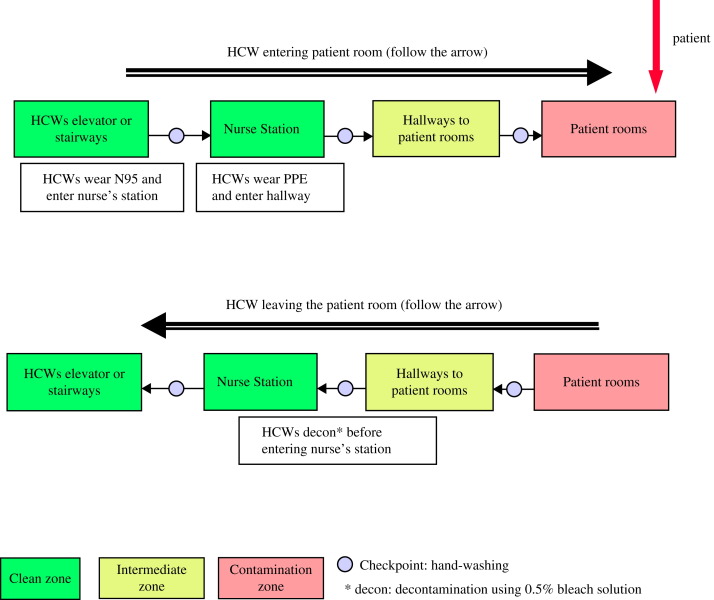
The traffic control bundle consists of procedures designed to help prevent epidemic nosocomial infection. We retrospectively studied the serial infection control measures to determine factors most effective in preventing nosocomial infections of healthcare workers (HCWs) during the 2003 Taiwanese severe acute respiratory syndrome (SARS) epidemic. Fever screening stations, triage of fever patients, separating SARS patients from other patients, separation of entrances and passageways between patients and HCWs, and increasing hand-washing facilities all demonstrated a protective effect for HCWs (univariate analysis; P<0.05). By multiple logistic regression: (i) checkpoint alcohol dispensers for glove-on hand rubbing between zones of risk, and (ii) fever screening at the fever screen station outside the emergency department, were the significant methods effectively minimising nosocomial SARS infection of HCWs (P<0.05). The traffic control bundle should be implemented in future epidemics as a tool to achieve strict infection control measures.
Copyright © 2010 the Healthcare Infection Society. Published by Elsevier Ltd. All rights reserved.
Figures
References
-
- Goh K.T., Cutter J., Heng B.H. Epidemiology and control of SARS in Singapore. Ann Acad Med Singapore. 2006;35:301–316. - PubMed
-
- Centers for Disease Control and Prevention Severe acute respiratory syndrome – Taiwan, 2003. Morb Mortal Wkly Rep. 2003;52:461–466. - PubMed
-
- Nishiyama A., Wakasugi N., Kirikae T. Risk factors for SARS infection within hospitals in Hanoi, Vietnam. Jpn J Infect Dis. 2008;61:388–390. - PubMed
Publication types
MeSH terms
LinkOut - more resources
Full Text Sources
Medical
Miscellaneous
