


Free-energy cost for translocon-assisted insertion of membrane proteins
- PMID: 21317362
- PMCID: PMC3048118
- DOI: 10.1073/pnas.1012758108
Free-energy cost for translocon-assisted insertion of membrane proteins
Abstract
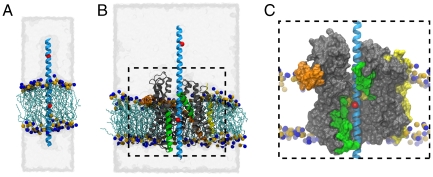
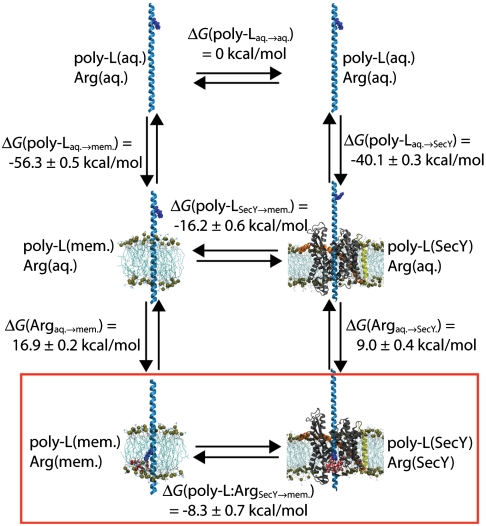
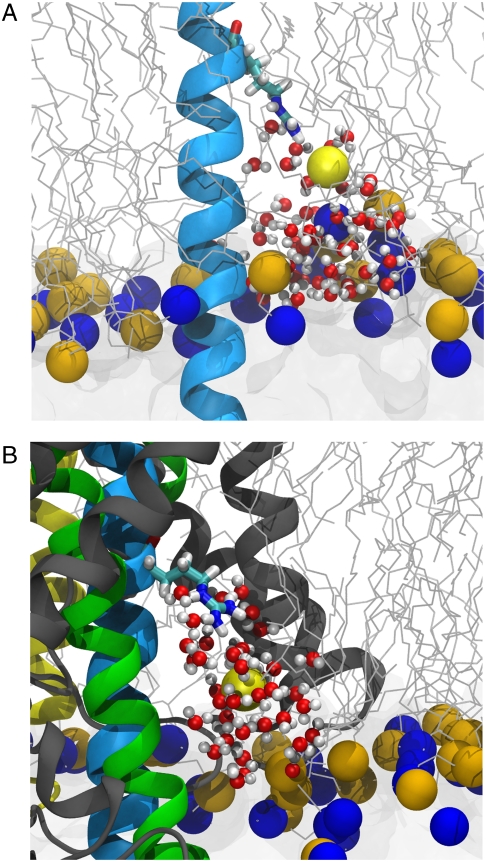
Nascent membrane proteins typically insert in a sequential fashion into the membrane via a protein-conducting channel, the Sec translocon. How this process occurs is still unclear, although a thermodynamic partitioning between the channel and the membrane environment has been proposed. Experiment- and simulation-based scales for the insertion free energy of various amino acids are, however, at variance, the former appearing to lie in a narrower range than the latter. Membrane insertion of arginine, for instance, requires 14-17 kcal/mol according to molecular dynamics simulations, but only 2-3 kcal/mol according to experiment. We suggest that this disagreement is resolved by assuming a two-stage insertion process wherein the first step, the insertion into the translocon, is energized by protein synthesis and, therefore, has an effectively zero free-energy cost; the second step, the insertion into the membrane, invokes the translocon as an intermediary between the fully hydrated and the fully inserted locations. Using free-energy perturbation calculations, the effective transfer free energies from the translocon to the membrane have been determined for both arginine and leucine amino acids carried by a background polyleucine helix. Indeed, the insertion penalty for arginine as well as the insertion gain for leucine from the translocon to the membrane is found to be significantly reduced compared to direct insertion from water, resulting in the same compression as observed in the experiment-based scale.
Conflict of interest statement
The authors declare no conflict of interest.
Figures
References
-
- Rapoport TA, Goder V, Heinrich SU, Matlack KE. Membrane-protein integration and the role of the translocation channel. Trends Cell Biol. 2004;14:568–575. - PubMed
-
- Rapoport TA. Protein translocation across the eukaryotic endoplasmic reticulum and bacterial plasma membranes. Nature. 2007;450:663–669. - PubMed
-
- Driessen AJM, Nouwen N. Protein translocation across the bacterial cytoplasmic membrane. Annu Rev Biochem. 2008;77:643–667. - PubMed
Publication types
MeSH terms
Substances
Grants and funding
LinkOut - more resources
Full Text Sources
Other Literature Sources
