. 2011 Jan;4(1):49-62.
doi: 10.1177/1756283X10377820.

Vitamin D and gastrointestinal diseases: inflammatory bowel disease and colorectal cancer

Affiliations

Vitamin D and gastrointestinal diseases: inflammatory bowel disease and colorectal cancer

Maitreyi Raman et al. Therap Adv Gastroenterol. 2011 Jan.

Abstract

Over the past 5 years, there has been a rapid resurgence of interest in vitamin D outside of its traditional role in metabolic bone disease. Some nontraditional roles ascribed to vitamin D include anti-inflammatory and immune-modulating effects. These effects have led to possible implications in the pathophysiology of immune-mediated diseases including multiple sclerosis and inflammatory bowel disease (IBD). In addition, vitamin D insufficiency has been linked to higher rates of cancers including colon, prostate and breast cancers. Given these diverse associations of vitamin D and disease states, this review describes recent advances with regard to vitamin D and gastrointestinal diseases, in particular IBD and colorectal cancer.

Keywords: colorectal cancer; immunology; inflammatory bowel disease; vitamin D.


Figures
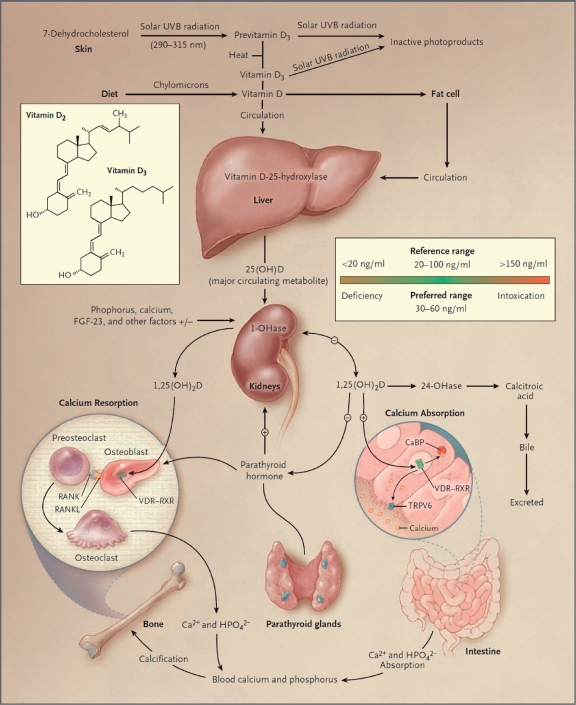
Figure 1.
Figure 1.
Classical calcium and vitamin D homeostasis pathways. Vitamin D metabolism and functions. Under ultraviolet B light exposure, 7-dehydroxycholesterol is converted to vitamin D3 in the shin. Vitamin D3 is transported to the liver where it is converted to 25-hydroxyvitamin D3 (25-OHD) by 25-hydroxylase (25-OHase). 25-hydroxyvitamin D3 (25-OHD) is further converted to 1α,25-dihydroxyvitamin D3 (1,25(OH)2D3), the hormonal metabolite, by renal 1α-hydroxylase (1-OHase). 1α-hydroxylase. the rate-limiting enzyme, is stimulated by parathyroid hormone and feedback inhibited by 1,25(OH)2D3. 25-OHD and 1,25(OH)2D3 are further metabolized by 24-hydroxylase (24-OHase) to initiate their catabolism, which is stimulated by 1,25(OH)2D3. 1,25(OH)2D3 feedback inhibits parathyroid homione production. 1,25(OH)2D3 targets the intestine, kidney and bone to regulate calcium and phosphate homeostasis. The hormone also has other noncalcemic physiologic functions. 1,25(OH)2D3, 1α,25-dihydroxyvitamin D3; 25-OHD, 25-hydroxyvitamin D3; 1-OHase, 1α-hydroxylase; 24-OHase, 24-hydroxylase; 25-OHase, 25-hydroxylase; PTH, parathyroid hormone; UVB, ultraviolet B light. [Holick, M.F. (2007) Vitamin D deficiency. N Engl J Med 357: 266-281] Copyright© [2007] Massachusetts Medical Society. All rights reserved.
Figure 2.
Figure 2.
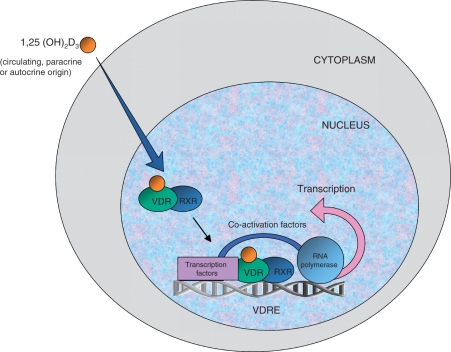
Ligand-dependent gene transcription by 1,25-dihydroxyvitamin D3 (1,25(OH)2D3). Lipid soluble 1,25(OH)2D3 from serum, autocrine or paracrine sources enters the target cell and binds to the nuclear vitamin D receptor (VDR). This induces a conformational change and promotes heterodimerization with the retinoid X receptor (RXR). The VDR/RXR has an increased affinity for the vitamin D responsive element (VDRE). VRDE is a specific sequence of nucleotides in the promoter region of the vitamin D responsive gene. Binding of the VDR/RXR complex to the VDRE attracts a complex of co-activator proteins connecting VDRE with RNA polymerase II. Gene transcription then occurs, producing mRNA transcripts, which leave the nucleus for translation into the coded protein in the cytoplasm.

References

    1. Aloia J.F., Patel M., DiMaano R., Li-Ng M., Talwar S.A., Mikhail M., et al. (2008) Vitamin D intake to attain a serried serum 25-hydroxyvitamin D concentration. Am J Clin Nutr 87: 1952–1958 - PubMed
    1. Alroy I., Towers T.L., Freedman L.P. (1995) Transcriptional repression of the interleukin-2 gene by vitamin D3: Direct inhibition of NFATp/AP-1 complex formation by a nuclear hormone receptor. Mol Cell Biol 15: 5789–5799 - PMC - PubMed
    1. Andjelkovic Z., Vojinovic J., Pejnovic N., Popovic M., Dujic A., Mitrovic D., et al. (1999) Disease modifying and immunomodulatory effects of high dose 1 alpha (OH) D3 in rheumatoid arthritis patients. Clin Exp Rheumatol 17: 453–456 - PubMed
    1. Andreassen H., Rix M., Brot C., Eskildsen P. (1998) Regulators of calcium homeostasis and bone mineral density in patients with Crohn’s disease. Scand J Gastroenterol 33: 1087–1093 - PubMed
    1. Andreassen H., Rungby J., Dahlerup J.F., Mosekilde L. (1997) Inflammatory bowel disease and osteoporosis. Scand J Gastroenterol 32: 1247–1255 - PubMed

LinkOut - more resources