Externalizing psychopathology and gain-loss feedback in a simulated gambling task: dissociable components of brain response revealed by time-frequency analysis
- PMID: 21319875
- PMCID: PMC3092030
- DOI: 10.1037/a0022124
Externalizing psychopathology and gain-loss feedback in a simulated gambling task: dissociable components of brain response revealed by time-frequency analysis
Abstract
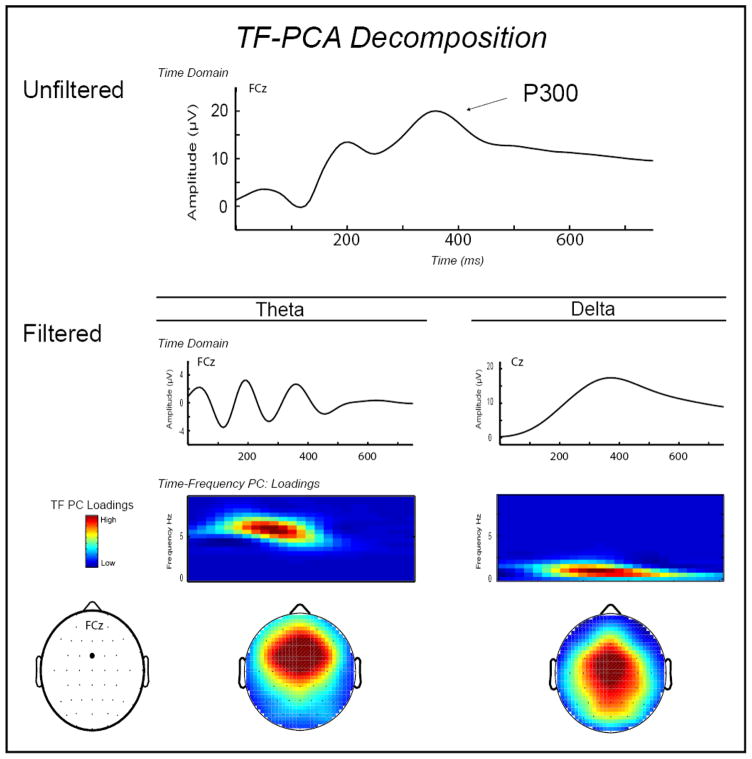
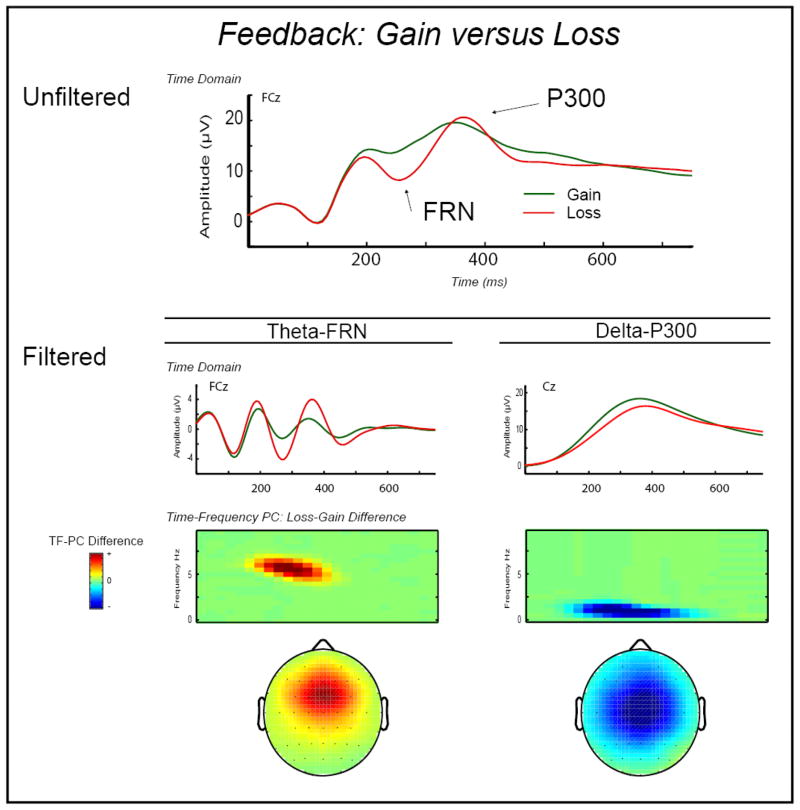
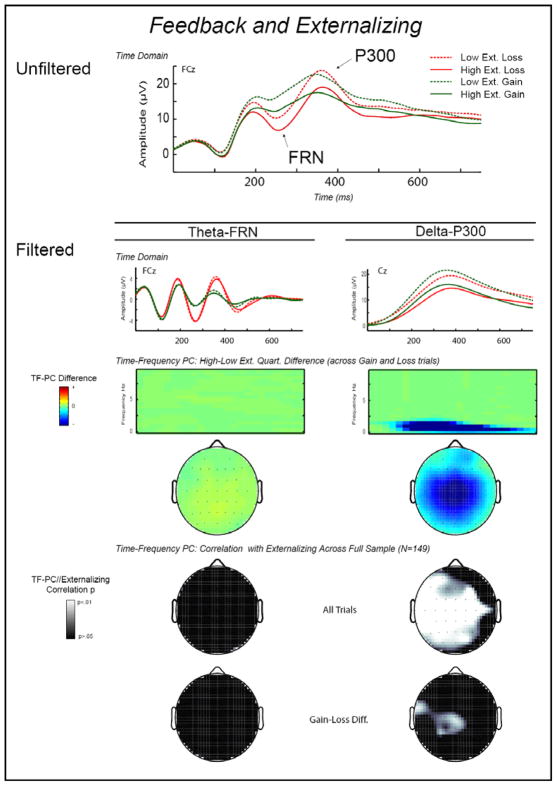
Externalizing is a broad construct that reflects propensity toward a variety of impulse control problems, including antisocial personality disorder and substance use disorders. Two event-related potential responses known to be reduced among individuals high in externalizing proneness are the P300, which reflects postperceptual processing of a stimulus, and the error-related negativity (ERN), which indexes performance monitoring based on endogenous representations. In the current study, the authors used a simulated gambling task to examine the relation between externalizing proneness and the feedback-related negativity (FRN), a brain response that indexes performance monitoring related to exogenous cues, which is thought to be highly related to the ERN. Time-frequency (TF) analysis was used to disentangle the FRN from the accompanying P300 response to feedback cues by parsing the overall feedback-locked potential into distinctive theta (4-7 Hz) and delta (<3 Hz) TF components. Whereas delta-P300 amplitude was reduced among individuals high in externalizing proneness, theta-FRN response was unrelated to externalizing. These findings suggest that in contrast with previously reported deficits in endogenously based performance monitoring (as indexed by the ERN), individuals prone to externalizing problems show intact monitoring of exogenous cues (as indexed by the FRN). The results also contribute to a growing body of evidence indicating that the P300 is attenuated across a broad range of task conditions in high-externalizing individuals.
Figures
References
-
- Achenbach TM, Edelbrock CS. The classification of child psychopathology: A review and analysis of empirical efforts. Psychological Bulletin. 1978;85(6):1275–1301. - PubMed
-
- Barratt ES, Stanford MS, Felhous AR, Kent TA. The effects of phenytoin on impulsive and premeditated aggression: A controlled study. Journal of Clinical Psychopharmacology. 1997;17:341–349. - PubMed
-
- Ba ar-Eroglu C, Ba ar E, Demiralp T, Schürmann M. P300-response: Possible psychophysiological correlates in delta and theta frequency channels. A review. International Journal of Psychophysiology. 1992;13:161–179. - PubMed
-
- Ba ar-Eroglu C, Demiralp T, Schürmann M, Ba ar E. Topological distribution of oddball ‘P300’ responses. International Journal of Psychophysiology. 2001;39:213–220. - PubMed
Publication types
MeSH terms
Grants and funding
LinkOut - more resources
Full Text Sources
Medical
Miscellaneous