. 2011 Apr 5;29(16):3021-30.
doi: 10.1016/j.vaccine.2011.01.115. Epub 2011 Feb 12.

Altered decamer and nonamer from an HLA-A0201-restricted epitope of Survivin differentially stimulate T-cell responses in different individuals

Affiliations

Altered decamer and nonamer from an HLA-A0201-restricted epitope of Survivin differentially stimulate T-cell responses in different individuals

Chantale Bernatchez et al. Vaccine. .

Abstract

Survivin is a universal tumor antigen that is being currently targeted in vaccine approaches against cancer. Our study here examined the immunogenicity of a novel variant of an HLA-A0201-binding decamer peptide from region 95 to 104 of Survivin (ELMLGEFLKL) with a T→M modification at position 3 in the peptide. We found that this new modified 10-mer peptide had enhanced HLA-A0201 binding and induced a stronger T-cell response over its wild type counterpart peptide (ELTLGEFLKL) in select HLA-A0201(+) normal donors. In addition, when compared to the previously characterized altered 96-104 peptide (LMLGEFLKL) from the same region of Survivin currently used in vaccine trials, we found that both peptides had similar immunogenicity, but donor T cells preferentially reacted strongly to either one or the other, but not strongly to both. These results suggest that these two closely related Survivin peptides yield distinct T-cell responses and that most individuals dominantly respond to one or the other altered peptide. We also found a novel association between positive reactivity to the new altered decamer Survivin peptide in some individuals and their expression of the HLA-C0701 allele along with HLA-A0201. Thus, vaccinating with both the 10-mer and 9-mer peptides would be required to immunize a maximum number of individuals in the HLA-A0201(+) population and could lead to more consistent T-cell responses against this region of Survivin.


Figures

Fig. 1
Fig. 1
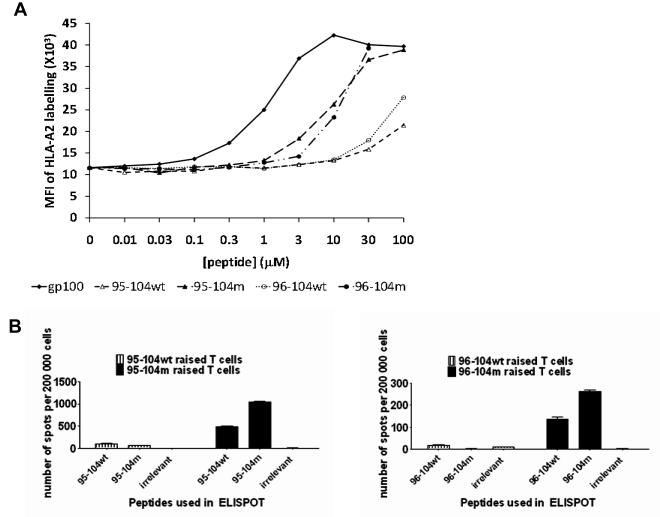
A. Binding of Survivin-derived peptides from the 95-104 amino acid sequence to the HLA-A0201 molecule. Wild type (wt) or modified (m) versions of the peptides were compared. 95-104wt (ELTLGEFLKL), 95-104m (ELMLGEFLKL), 96-104wt (LTLGEFLKL) or 96-104m (LMLGEFLKL) have been tested in a classical T2 binding assay for their capacity to stabilize HLA-A0201 expression on the surface of T2 cells (see methods). Peptide concentrations of 0.01-100uM have been tested. Results of one out two experiments with similar results are shown. B. Altered 95-104 and 96-104 peptides had increased immunogenicity in comparison to their wild type counterpart. Enumeration of cells secreting IFN-γ by ELISPOT after 3 rounds of stimulation using 95-104wt or 95-104m (left panel), 96-104wt or 96-104m (right panel). Data from left and right panel are derived from one donor. Similar data has been obtained with two additional donors.
Fig. 2
Fig. 2
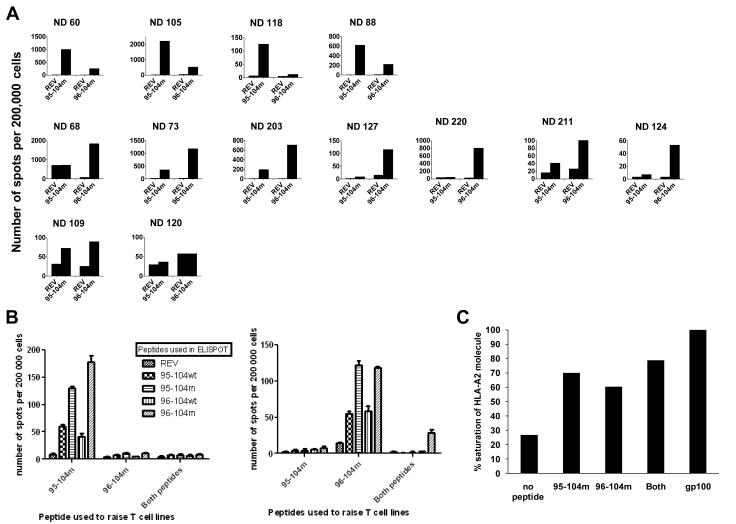
Response to 95-104 and 96-104 altered peptides in normal donors. A. Thirteen HLA-A0201 normal donor PBMCs were used to raise T cell lines against 95-104m or 96-104m Survivin peptides and reactivity to the cognate peptide was assessed after 3 rounds of stimulation by IFN-γ ELISPOT. Results are expressed in number of spots per 200,000 cells. HIV REV peptide (ILKEPVHGV) was used to control for non-specific IFN-γ secretion. For each donor, the two first columns on the left are testing the ability of the 95-104m raised T cell line to recognize 95-104m peptide (or irrelevant REV peptide). The two last columns on the right side of the graph represent the ability of the 96-104m raised T cell line to recognize 96-104m peptide (or irrelevant REV peptide). The donors have been classified according to the preference of the mounted response as 10-mer responders (top row), 9-mer responders (middle row) or no preference/very weak response (bottom row). B. Pulsing APCs with the two altered peptides simultaneously to raise T cell lines abrogates the response to any of the single peptide. Cell lines were raised against individual altered peptide or a mixture of both for 3 rounds of stimulation after which response to individual peptide or to the mixture of the two was assessed by IFN-γ ELISPOT. Left panel represents results from a 95-104m responder, and the right panel represents the results from a 96-104m responder. These experiments represent the results of two 95-104m responders and two 96-104m responders tested. C. Binding of either individual or mixed altered peptides to HLA-A0201 is equivalent. T2 binding assay using 20μm of either peptide or a mixture of both (20μM of each) was performed and % saturation of HLA-A0201 molecule was calculated relative to gp100(209-217)210M mean fluorescence intensity (MFI) at saturation.
Fig. 3
Fig. 3
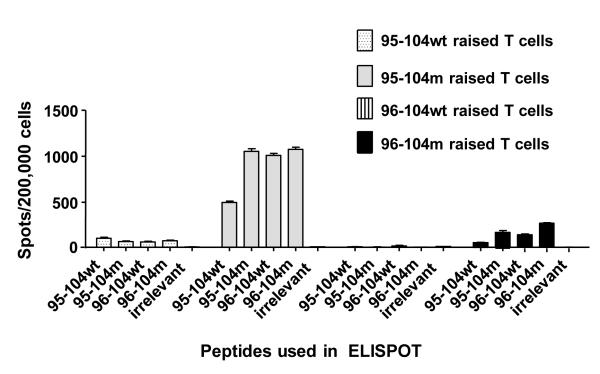
Recognition of the wild type Survivin peptides by T cell lines raised with altered Survivin peptides and plasticity of recognition between the 9-mer and 10-mer Survivin peptides. Results from one normal donor where 4 T cell lines were raised (one for each peptide) and after the third round of stimulation the cell lines were tested in IFN-γ ELISPOT for recognition of the four test peptides including the one they have been raised with. Results are representative of 8 normal donors assessed in separate experiments.
Fig. 4
Fig. 4
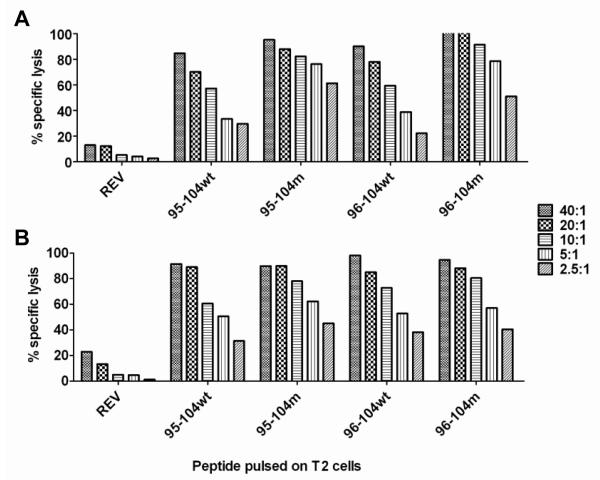
T cell lines raised with Survivin altered peptides can kill T2 targets pulsed with the 4 test peptides. T cell lines raised against 95-104m (A) or 96-104m (B) from normal donors were tested in a 51Cr-release CTL assay to evaluate their ability to kill T2 cells pulsed with the 4 test peptides (or HIV REV negative control); the 10-mer 95-104 wild type or modified, the 9-mer 96-104 wild type or modified at the different effector-to-target (E:T) ratios shown on the right. Cytotoxicity assay was performed after the fourth round of stimulation. The two cell lines showed were derived from different donors since we could not have a donor who reacted strongly to both altered peptides. This is representative of 4 separate experiments in 4 different donors.
Fig. 5
Fig. 5
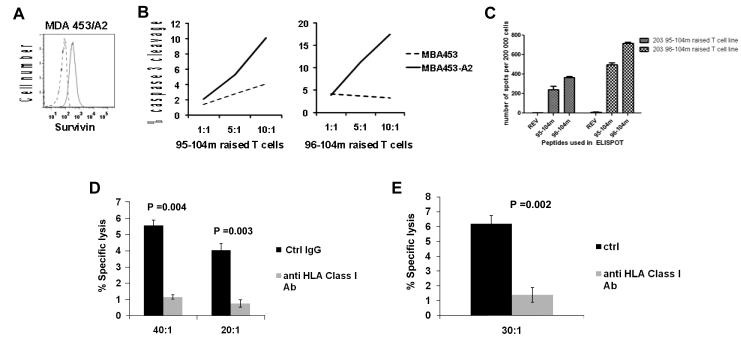
T cells raised against the new 95-104m peptide can kill unpulsed targets. A. Survivin expression in MDA 453 breast cancer cell line transduced with HLA-A0201 molecule (MDA 453/A2). Cells were fixed, permeabilized, stained with anti-Survivin-FITC or isotype control and assessed by flow cytometry analysis (isotype control in broken line, Survivin expression in black line). B. T cell lines from the same HLA-A0201+ individual raised against the Sur 95-104m or Sur 96-104m peptide by 4 rounds of stimulation with peptide-pulsed APC preferentially kill MDA 453 breast cancer cells expressing HLA-A0201, as measured using a Caspase 3-cleavage CTL assay performed using wild-type MDA 453 (HLA-A0201-negative) or MBA 453/A2 cells as targets. C. INF-γ ELISPOT showing reactivity of T cell lines used in B to Survivin peptides after 3 rounds of stimulation. D-E. 95-104m raised T cell line can kill a target naturally expressing HLA-A0201. D. Killing of a primary HLA-A0201+ melanoma cell line freshly established from a patient enrolled in an adoptive cell therapy trial at MD Anderson was assessed in a standard 51Cr assay. Targets and T cells were incubated with 40 μg/ml of an anti- HLA-Class I antibody (clone W6/32), or with the same concentration of an isotype control antibody at 40:1 or 20:1 effector:target ratio for 5 h at 37°C. E. 95-104m raised T cell line can kill pancreatic cancer cell line CF-Pac-1 (HLA-A0201+). Targets and T cells were incubated with 20 μg/ml of an anti- HLA-Class I antibody (clone W6/32), or with the same concentration of an isotype control antibody at 30:1 effector:target ratio for 5h at 37°C.
Fig. 6
Fig. 6
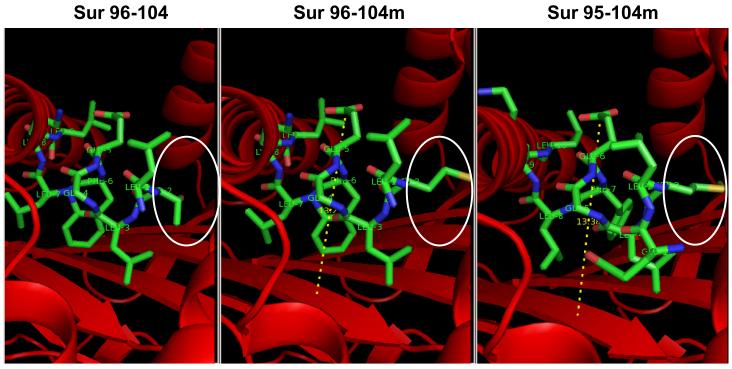
The predicted structure of Survivin peptides (green) into HLA-A0201 binding groove (red) was generated by adapting available crystallographic data from HIV gag peptide bound to HLA-A2*0201 (pdb2C7U). The HIV peptide was removed and replaced with Survivin peptides. From left to right are presented the peptide/MHC structure of the 96-104 in its wild type form (LTLGEFLKL), 96-104 modified (LMLGEFLKL) and finally our novel 95-104 modified (ELMLGEFLKL). The area circled in white highlights the difference in structure imposed by the mutation T→M at position 97, affecting both 96-104m and 95-104m peptides. The dotted line symbolizes the distance between the ‘floor’ of the HLA molecule and the highest point reached by the peptide.

Comment in

References

    1. Oble DA, Loewe R, Yu P, Mihm MC., Jr. Focus on TILs: prognostic significance of tumor infiltrating lymphocytes in human melanoma. Cancer Immun. 2009;9:3. - PMC - PubMed
    1. Andersen MH, Pedersen LO, Capeller B, Brocker E-B, Becker JC, thor Straten P. Spontaneous Cytotoxic T-Cell Responses against Survivin-derived MHC Class I-restricted T-Cell Epitopes in Situ As Well As ex Vivo in Cancer Patients. Cancer Res. 2001 Aug 1;61(16):5964–8. 2001. - PubMed
    1. Sine Reker, Becker JC, Svane IM, Ralfkiaer E, Straten Pt, Andersen MH. HLA-B35-restricted immune responses against survivin in cancer patients. International Journal of Cancer. 2004;108(6):937–41. - PubMed
    1. Reker S, Meier A, Holten-Andersen L, Svane IM, Becker JC, thor Straten P, et al. Identification of novel survivin-derived CTL epitopes. Cancer biology & therapy. 2004 Feb;3(2):173–9. - PubMed
    1. Andersen MH, Pedersen LO, Becker JC, Straten Pt. Identification of a Cytotoxic T Lymphocyte Response to the Apoptosis Inhibitor Protein Survivin in Cancer Patients. Cancer Res 2000. 2000 Feb 1;61(3):869–72. - PubMed

Publication types