


Quantifying excessive mirror overflow in children with attention-deficit/hyperactivity disorder
- PMID: 21321336
- PMCID: PMC3053337
- DOI: 10.1212/WNL.0b013e31820c3052
Quantifying excessive mirror overflow in children with attention-deficit/hyperactivity disorder
Abstract
Objectives: Qualitative observations have revealed that children with attention-deficit/hyperactivity disorder (ADHD) show increased overflow movements, a motor sign thought to reflect impaired inhibitory control. The goal of this study was to develop and implement methods for quantifying excessive mirror overflow movements in children with ADHD.
Methods: Fifty right-handed children aged 8.2-13.3 years, 25 with ADHD (12 girls) and 25 typically developing (TD) control children (10 girls), performed a sequential finger-tapping task, completing both left-handed (LHFS) and right-handed finger sequencing (RHFS). Phasic overflow of the index and ring fingers was assessed in 34 children with video recording, and total overflow in 48 children was measured by calculating the total angular displacement of the index and ring fingers with electrogoniometer recordings.
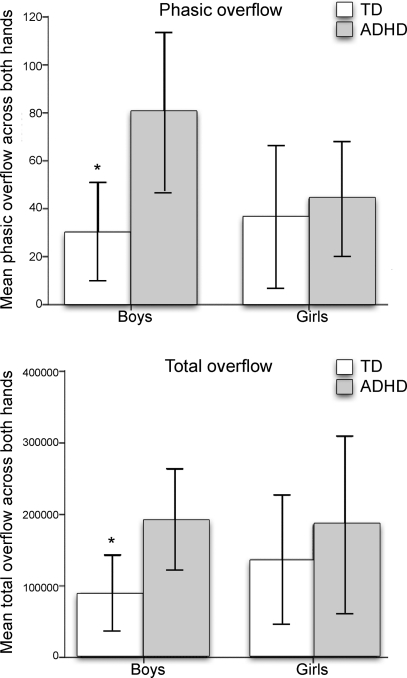
Results: Phasic overflow and total overflow across both hands were greater in children with ADHD than in TD children, particularly during LHFS. Separate gender analyses revealed that boys, but not girls, with ADHD showed significantly more total phasic overflow and total overflow than did their gender-matched control children.
Conclusions: The quantitative overflow measures used in this study support past qualitative findings that motor overflow persists to a greater degree in children with ADHD than in age-matched TD peers. The quantitative findings further suggest that persistence of mirror overflow is more prominent during task execution of the nondominant hand and reveal gender-based differences in developmental neural systems critical to motor control. These quantitative measures will assist future physiologic investigation of the brain basis of motor control in ADHD.
Figures


Comment in
-
Faulty brakes? Inhibitory processes in attention-deficit/hyperactivity disorder.Neurology. 2011 Feb 15;76(7):592-3. doi: 10.1212/WNL.0b013e31820c30f3. Neurology. 2011. PMID: 21321332 No abstract available.
References
-
- Denckla MB, Rudel RG. Anomalies of motor development in hyperactive boys. Ann Neurol 1978;3:231–233 - PubMed
-
- Szatmari P, Taylor DC. Overflow movements and behavior problems: scoring and using a modification of Fogs' test. Dev Med Child Neurol 1984;26:297–310 - PubMed
-
- Mostofsky SH, Newschaffer CJ, Denckla MB. Overflow movements predict impaired response inhibition in children with ADHD. Percept Mot Skills 2003;97:1315–1331 - PubMed
-
- Armatas CA, Summers JJ, Bradshaw JL. Mirror movements in normal adult subjects. J Clin Exp Neuropsychol 1994;16:405–413 - PubMed
-
- Mayston MJ, Harrison LM, Stephens JA. A neurophysiological study of mirror movements in adults and children. Ann Neurol 1999;45:583–594 - PubMed
Publication types
MeSH terms
Grants and funding
LinkOut - more resources
Full Text Sources
Medical
Miscellaneous
