Review
. 2010 Dec;1(8):741-750.
doi: 10.18632/oncotarget.209.

Differential activation of Toll-like receptor-mediated apoptosis induced by hypoxia

Review

Differential activation of Toll-like receptor-mediated apoptosis induced by hypoxia

Sanae Ben Mkaddem et al. Oncotarget. 2010 Dec.

Abstract

Ischemia-reperfusion injury induces intense inflammatory response and tissue damages resulting from the capacity of endogenous constituents called damageassociated molecular patterns (DAMPs) released by damaged or necrotic cells, to activate signaling pathways mediated by receptors of the innate immune systems. Among them, two members of the Toll-like receptors (TLR) family, TLR2 and TLR4 have been shown to play key roles in the induction of inflammatory response and cell apoptosis in a variety of ischemic tissues. The oxidative stress injury caused by I/R injury has been attributed to the activation of MAP kinase pathways, including those of ERK, JNK and p38. Here, we summarise recent findings concerning the role of the protein phosphatase 5 involved in the selective regulation of TLR2-mediated ERK1/2 signaling and the identification of the key role of the non-phagocytic NADPH oxidase 4 producing reactive oxygen species in the control of TLR4-mediated apoptosis in murine models of renal I/R injury and in post-hypoxic kidney tubule cells. The identification of molecules signaling involved in the ER stress-induced apoptotic signaling cascade may therefore represent potential targets to prevent the induction of apoptosis in hypoxic tissues.


Conflict of interest statement

The authors declare no conflict of interest

Figures
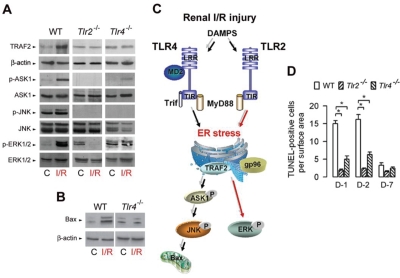
Figure 1:
Figure 1:. TLR2- and TLR4-mediated activation of ERK and JNK MAP kinases during renal ischemia/reperfusion injury
(A) Immunoblot analysis of TRAF2 and β-actin, phospho (p-) and total ASK1, JNK, and ERK1/2 in control (C), and day-1 post-ischemic (I/R) wild-type, Tlr2−/−, and Tlr4−/− kidneys. (B) Immunoblot analysis of BAX and β-actin in control (C), and day-1 post-ischemic (I/R) wild-type (WT) and Tlr4−/− kidneys. (C) Diagram depicting TLR2- and TLR4-mediated activation of ERK and JNK in kidneys subjected to I/R injury. (D) Number of apoptotic TUNEL-positive cells in non-ischemic (C) and day (D)-1, D-2, and D-7 post-ischemic WT, Tlr2−/− and Tlr4−/− kidneys. Values are means ± SE. * < p < 0.05. Redrawn from refs 58 and 78.
Figure 2:
Figure 2:. Role of the endoplasmic reticulum-resident gp96 and protein phosphatase 5 in the control of TLR2-mediated activation of ERK1/2 in hypoxic renal tubule cells
(A) Non-hypoxic (C) and day-1 post-hypoxic (H) wild-type (WT) or Tlr2−/− renal tubule cells were subjected to immunoprecipitation (IP) using an antibody against gp96, and proteins were detected using an anti-protein phosphatase 5 (PP5) antibody. (B) Schematic representation of the PP5-dependent activation of ERK1/2 in non-hypoxic and post-hypoxic WT and Tlr2−/− renal tubule cells. (C, D) Immunoblot analyses of p- and total ERK1/2 (C) or total and p-ASK1 and -JNK (D) in non-hypoxic (Control) and 24 h post-hypoxic (Hypoxia) Tlr2−/− renal tubule cells transfected (+) or not (-) with specific gp96 siRNA (C) or Pp5 siRNA. (E) Percentage of apoptotic cells measured in non-hypoxic (Control) or day-1 post-hypoxic (Hypoxia) Tlr2−/− RTECs transfected or not with a Pp5 siRNA or negative control siRNA. Values are means ± SE. * p < 0.05 between groups. (F) Schematic representation of the TLR2-mediated ERK activation in post-hypoxic renal tubule cells. Hypoxia stimulates gp96, but does not induce the dissociation of gp96 bound to PP5 in Tlr2−/− deficient renal tubule cells. Inhibition of gp96 activity by geldanamycin, or knockdown gp96 mRNA induces the reactivation of ERK1/2, but not of JNK or ASK1 in Tlr2−/− deficient RTECs. Extinction of Pp5 mRNA expression also induces the reactivation of p-ERK1/2 and p-JNK. Redrawn from ref 58.
Figure 3:
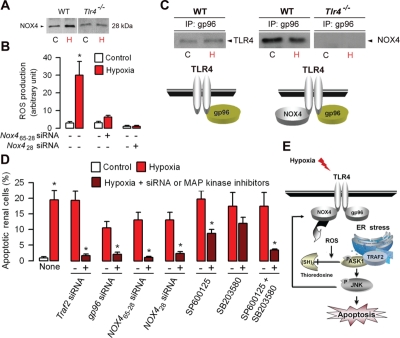
Figure 3:. Role of gp96 and NOX4 in the activation of TLR4-mediated apoptosis in hypoxic renal tubule cells
(A) Immunoblot analysis of the 28 kDa NOX4 isoform in control (C) and day-1 post-hypoxic (H) wild-type (WT) and Tlr4−/− renal tubule cells. (B) ROS production in non-hypoxic (Control) and post-hypoxic (Hypoxia) wild-type RTECs transfected (+) or not (−) with specific Nox4 siRNAs, which target sequences encoding both the full length 65-kDa and the 28-kDa isoform (Nox465-28) or only the 28-kDa NOX4 isoform (Nox428). (C) ) Immunoprecipitated lysates from non-hypoxic (C) or 24 h post-hypoxic (H) wild-type renal tubule cells using an anti-gp96 antibody were subjected to Western blot analysis using anti-TLR4 or NOX4 antibodies. (D) Percentage of apoptotic cells in non-hypoxic (Control) and day-1 post-hypoxic (Hypoxia) wild-type renal tubule cells and in post-hypoxic cells transfected (+) ot not (-) with specific Traf2, gp96, or the two Nox465-28 or Nox428 siRNAs, or incubated with (+) or without (-) the JNK inhibitor SP600125 or the ERK inhibitor SB203580. Values are means ± SE. * p < 0.05 between groups. (E) Schematic representation of the TLR4-mediated activation of ASK1/JNK inducing apoptosis. Hypoxia activates NOX4 producing ROS which induces the dissociation of thioredoxine from endogenous ASK1. Redrawn from ref 78.

References

    1. Bonventre JV, Weinberg JM. Recent advances in the pathophysiology of ischemic acute renal failure. J Am Soc Nephrol. 2003;14:2199–2210. - PubMed
    1. Boros P, Bromberg JS. New cellular and molecular immune pathways in ischemia/reperfusion injury. Am J Transplant. 2006;6:652–658. - PubMed
    1. Droge W. Free radicals in the physiological control of cell function. Physiol Rev. 2002;82:47–95. - PubMed
    1. Akira S, Takeda K. Toll-like receptor signalling. Nature Rev Immunol. 2004;4:499–511. - PubMed
    1. Barton GM, edzhitov R. Toll-like receptor signaling pathways. Science. 2003;300:1424–1425. - PubMed

Publication types

MeSH terms