


Role of allogeneic transplantation for FLT3/ITD acute myeloid leukemia: outcomes from 133 consecutive newly diagnosed patients from a single institution
- PMID: 21324374
- PMCID: PMC3110512
- DOI: 10.1016/j.bbmt.2011.02.003
Role of allogeneic transplantation for FLT3/ITD acute myeloid leukemia: outcomes from 133 consecutive newly diagnosed patients from a single institution
Abstract
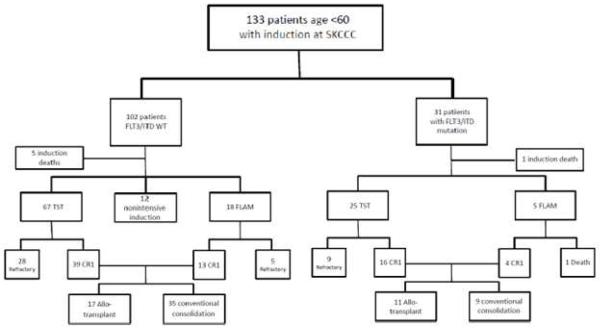
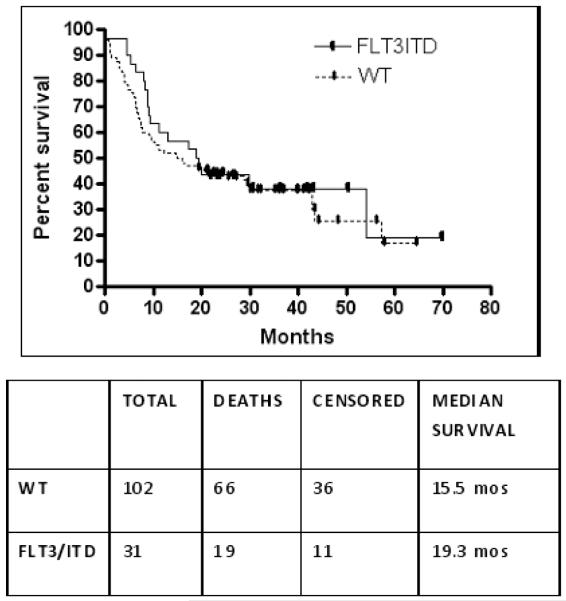
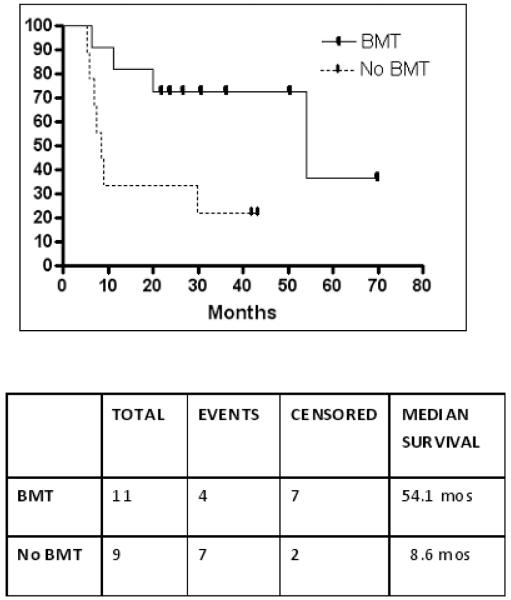
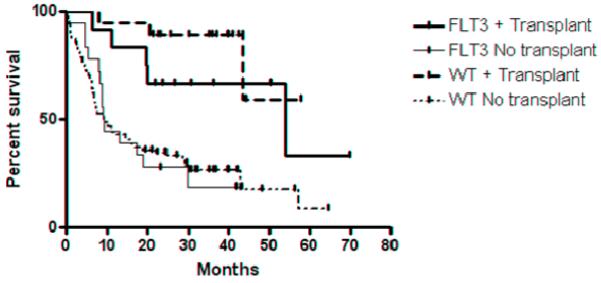
Acute myelogenous leukemia (AML) patients with FLT3/ITD mutations have an inferior survival compared to AML patients with wild-type (WT) FLT3, primarily because of an increased relapse rate. Allogeneic transplantation represents a postremission therapy that is effective at reducing the risk of relapse for many cases of poor-risk AML. Whether or not allogeneic transplantation in first complete remission (CR) can improve outcomes for patients with FLT3/ITD AML remains controversial. Our institution has adopted a policy of pursuing allogeneic transplantation, including the use of alternate donors, for FLT3/ITD AML patients in remission. As part of an instituional review board-approved study, we performed a review of the clinical data from November 1, 2004, to October 31, 2008, on all adult patients under the age of 60 presenting in consecutive fashion to the Sidney Kimmel Comprehensive Cancer Center at Johns Hopkins with newly diagnosed non-M3 AML. We followed their outcomes through August 1, 2010. During the study period, 133 previously untreated AML patients between the ages of 20 and 59 were diagnosed and received induction and consolidation therapy at our institution. Of these 133 patients, 31 (23%) harbored an FLT3/ITD mutation at diagnosis. The median overall survival (OS) from the time of diagnosis for the FLT3/ITD AML patients was compared to the OS of the entire cohort and found to be comparable (19.3 months versus 15.5 months, P = .56). Historically, OS for FLT3/ITD AML patients is significantly worse than for AML patients lacking this mutation. However, the OS for the 31 FLT3/ITD patients reported here was comparable to the 102 patients with WT FLT3 over the same 4-year time period. One difference that might have contributed to the surprising outcomes for the FLT3/ITD group is our aggressive pursuit of allogeneic bone marrow transplant (BMT) in CR1 within this group (60% of FLT3/ITD versus 17% with WT). Our single-institution study of consecutively treated AML patients supports the hypothesis that allogeneic transplant in early CR1 improves the long-term outcomes for FLT3/ITD AML.
Copyright © 2011 American Society for Blood and Marrow Transplantation. Published by Elsevier Inc. All rights reserved.
Figures
References
-
- Lowenberg B, Downing JR, Burnett A. Acute myeloid leukemia. N.Engl.J.Med. 1999;341:1051–1062. - PubMed
-
- Burnett AK, Wheatley K, Goldstone AH, et al. The value of allogeneic bone marrow transplant in patients with acute myeloid leukaemia at differing risk of relapse: results of the UK MRC AML 10 trial. Br.J.Haematol. 2002;118:385–400. - PubMed
-
- Byrd JC, Mrozek K, Dodge RK, et al. Pretreatment cytogenetic abnormalities are predictive of induction success, cumulative incidence of relapse, and overall survival in adult patients with de novo acute myeloid leukemia: results from Cancer and Leukemia Group B (CALGB 8461) Blood. 2002;100:4325–4336. - PubMed
-
- Yanada M, Matsuo K, Emi N, Naoe T. Efficacy of allogeneic hematopoietic stem cell transplantation depends on cytogenetic risk for acute myeloid leukemia in first disease remission: a metaanalysis. Cancer. 2005;103:1652–1658. - PubMed
-
- Mrozek K, Heerema NA, Bloomfield CD. Cytogenetics in acute leukemia. Blood Rev. 2004;18:115–136. - PubMed
Publication types
MeSH terms
Substances
Grants and funding
LinkOut - more resources
Full Text Sources
Medical
Research Materials
Miscellaneous
