Review
. 2011 May;32(5):290-9.
doi: 10.1016/j.tips.2011.01.001. Epub 2011 Feb 15.

Impacts of environmental toxicants on male reproductive dysfunction

Affiliations
Review

Impacts of environmental toxicants on male reproductive dysfunction

Elissa W P Wong et al. Trends Pharmacol Sci. 2011 May.

Abstract

Male infertility caused by exposure to environmental toxicants such as cadmium, mercury, bisphenol A (BPA) and dioxin is a global problem, particularly in industrialized countries. Studies in the testis and other organs have illustrated the importance of environmental toxicant-induced oxidative stress in mediating disruption to cell junctions. This, in turn, is regulated by the activation of PI3K/c-Src/FAK and MAPK signaling pathways, with the involvement of polarity proteins. This leads to reproductive dysfunction such as reduced sperm count and reduced quality of semen. In this review, we discuss how these findings can improve understanding of the modes of action of environmental toxicants in testicular dysfunction. Thus, specific inhibitors and/or antagonists against signaling molecules in these pathways may be able to 'reverse' and/or 'block' the disruptive effects of toxicant-induced damage. Additional studies comparing high-level acute exposure versus low-level chronic exposure to environmental toxicants are also needed to fully elucidate the underlying molecular mechanism(s) by which these toxicants disrupt male reproductive function.


Conflict of interest statement

Disclosure

The authors declare no conflict of interest.

Figures
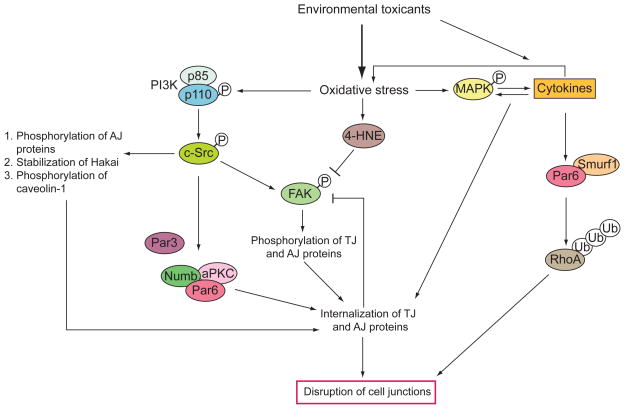
Figure 1
Figure 1. Signaling pathways activated by environmental toxicants via increase in oxidative stress
Oxidative stress induced by environmental toxicants activates the PI3K/c-Src/FAK pathway, which subsequently controls the phosphorylation of caveolin-1, TJ and/or AJ proteins, the stability of E3 ubiquitin ligase Hakai and the interaction of polarity proteins with the endocytic adaptor Numb. This leads to the internalization of TJ and AJ proteins at the cell-cell interface, which imposes a feedback mechanism to dephosphorylate FAK. Aldehydes such as 4-hydroxy-2-nonenal (4-HNE) are produced during oxidative stress to inactivate FAK. In addition, environmental toxicants induce the production of cytokines which are also regulated by the activation of MAPK via oxidative stress. Cytokines stimulates production of reactive oxygen species (ROS) from leukocytes to further increase oxidative stress. Cytokines and the activation of MAPK together result in endocytic vesicle-mediated internalization of TJ and AJ proteins. Note that polarity proteins such as Par6 are also involved in mediating the action of cytokines to recruit the E3 ubiquitin ligase Smurf1 for the polyubiquitination and degradation of RhoA, which is important for the disruption of cell junctions. This illustrates that crosstalk exists between the PI3K/c-Src/FAK and cytokines/MAPK pathways via polarity proteins as their common downstream signaling mediators.
Figure 2
Figure 2. Pathophysiological effects of environmental toxicants in the seminiferous epithelium of mammalian testes
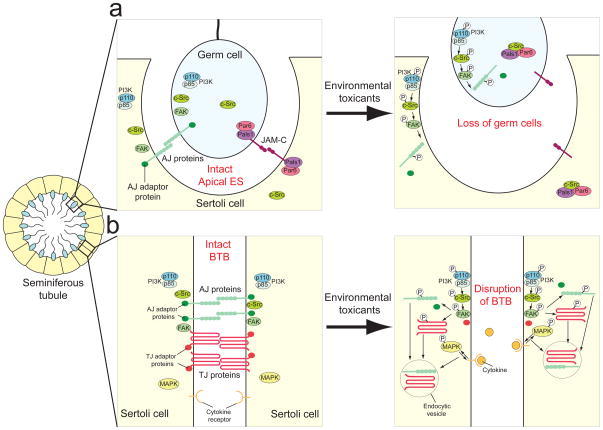
a) At the apical ES, AJ proteins (e.g. N-cadherin and nectin) are present to adhere germ cells onto the Sertoli cell in the seminiferous epithelium. JAM-C, which is regarded as a TJ protein in epithelial cells, is also found at the apical ES, although no TJ ultrastructure is visible under electron microscopy between elongating spermatids and Sertoli cells. After exposure to environmental toxicants, the PI3K/c-Src/FAK pathway is activated to phosphorylate AJ proteins. This causes the internalization of AJ proteins and dissociation from their corresponding adaptors. Adhesion of germ cells in the seminiferous epithelium is further weakened by the increase in association between c-Src and Par6/Pals1 complex, which sequesters them from JAM-C, thereby destabilizing the JAM-C-based adhesion protein complexes. As a result, germ cells eventually are released from the seminiferous epithelium prematurely due to a disruption of adhesion complexes at the apical ES. b) At the BTB, activation of PI3K/c-Src/FAK pathway by environmental toxicants causes the phosphorylation of TJ and AJ proteins. Furthermore, induction of cytokines (e.g., TGF-β3) and activation of MAPK also leads to enhancement in endocytosis of junction proteins. The cell junctions at the BTB are disrupted, which destroys the microenvironment necessary for normal germ cell development. This reduces sperm count and normal sperm, leading to male infertility or subfertility.

References

    1. Sharlip ID, et al. Best practice policies for male infertility. Fertil Steril. 2002;77:873–882. - PubMed
    1. Juul S, et al. Regional differences in waiting time to pregnancy: pregnancy-based surveys from Denmark, France, Germany, Italy and Sweden. The European Infertility and Subfecundity Study Group. Hum Reprod. 1999;14:1250–1254. - PubMed
    1. Irvine DS. Epidemiology and aetiology of male infertility. Hum Reprod. 1998;13(Suppl 1):33–44. - PubMed
    1. Kashir J, et al. Oocyte activation, phospholipase C zeta and human infertility. Hum Reprod Update. 2010;16:690–703. - PubMed
    1. Aitken RJ, et al. Seeds of concern. Nature. 2004;432:48–52. - PubMed

Publication types

Substances