


Zoledronic acid preserves bone mineral density in premenopausal women who develop ovarian failure due to adjuvant chemotherapy: final results from CALGB trial 79809
- PMID: 21324674
- PMCID: PMC4211594
- DOI: 10.1016/j.ejca.2010.11.024
Zoledronic acid preserves bone mineral density in premenopausal women who develop ovarian failure due to adjuvant chemotherapy: final results from CALGB trial 79809
Abstract
Background: Chemotherapy-induced ovarian failure (CIOF) is a frequent side-effect of adjuvant chemotherapy that results in rapid bone loss. We hypothesised that zoledronic acid (ZA), a third-generation amino bisphosphonate, would prevent bone loss in premenopausal women who developed CIOF.
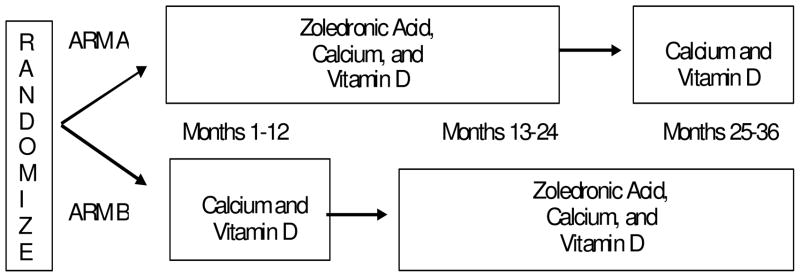
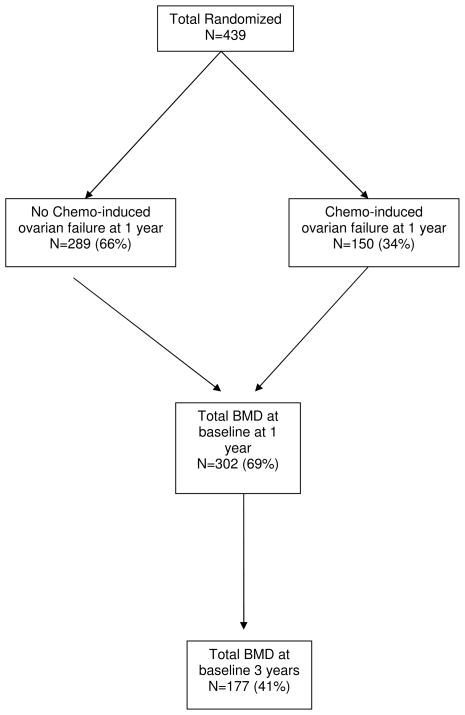
Methods: Women (439) were randomised to intravenous (i.v.) ZA 4 mg every 3 months for 2 years starting within 1-3 months after randomization (arm A) or 1 year after randomization (arm B, controls). CIOF was prospectively defined as ≥ 3 months of amenorrhoea, follicle-stimulating hormone (FSH) ≥ 30 MIU/ml and non-pregnant at 1 year. The primary end-point was the percentage change in bone mineral density (BMD) in the lumbar spine (LS) from baseline to 12 months in the ZA and in control groups in women who developed CIOF; the secondary end-point was BMD in LS at 3 years in all randomised women.
Findings: One hundred and fifty (56%) met the definition of CIOF at 1 year. Overall, grade 3 toxicities of ZA were fatigue (1%) arthralgias (21%) and pain (84%). The median percent change (interquartile range, IQR) at 1 year was +1.2% (-0.5% to +2.8%) and -6.7% (-9.7% to -2.9%) p<0.001 and at 3 years was +1.0% (-1.6% to +5.2%) and -0.5% (-3.7% to +3.2%) p=0.019 in arms A and B, respectively.
Interpretation: ZA every 3 months is well tolerated and prevents rapid bone loss in premenopausal women that develop CIOF. Giving ZA with rather than 1 year after the start of adjuvant chemotherapy is the preferred sequence to prevent bone loss.
Copyright © 2010 Elsevier Ltd. All rights reserved.
Figures
References
-
- Molina JR, Barton DL, Loprinzi CL. Chemotherapy-induced ovarian failure: manifestations and management. Drug Saf. 2005;28:401–16. - PubMed
-
- Knobf MT. The Influence of Endocrine Effects of Adjuvant Therapy on Quality of Life Outcomes in Younger Breast Cancer Survivors. Oncologist. 2006;11:96–110. - PubMed
-
- Oktem O, Oktay K. Quantitative assessment of the impact of chemotherapy on ovarian follicle reserve and stromal function. Cancer. 2007;110:2222–9. - PubMed
-
- Schover LR. Premature Ovarian Failure and Its Consequences: Vasomotor Symptoms, Sexuality, and Fertility. J Clin Oncol. 2008;26:753–758. - PubMed
-
- Meskhi A, Seif MW. Premature ovarian failure. Curr Opin Obstet Gynecol. 2006;18:418–26. - PubMed
Publication types
MeSH terms
Substances
Grants and funding
LinkOut - more resources
Full Text Sources
Medical
Miscellaneous
