


Melanoma risk for CDKN2A mutation carriers who are relatives of population-based case carriers in Australia and the UK
- PMID: 21325014
- PMCID: PMC7432952
- DOI: 10.1136/jmg.2010.086538
Melanoma risk for CDKN2A mutation carriers who are relatives of population-based case carriers in Australia and the UK
Abstract
Background: CDKN2A mutations confer a substantial risk of cutaneous melanoma; however, the magnitude of risk is uncertain.
Methods: The study estimated the hazard ratio (HR) and the average age specific cumulative risk (ie, penetrance) of reported melanoma for CDKN2A mutation carriers in case families using a modified segregation analysis of the first and higher degree relatives of 35 population-based cases. The study sample included 223 relatives of 13 melanoma cases diagnosed when aged 18-39 years from Melbourne, Sydney and Brisbane, Australia, and 322 relatives of 22 melanoma cases diagnosed at any age from Yorkshire, UK.
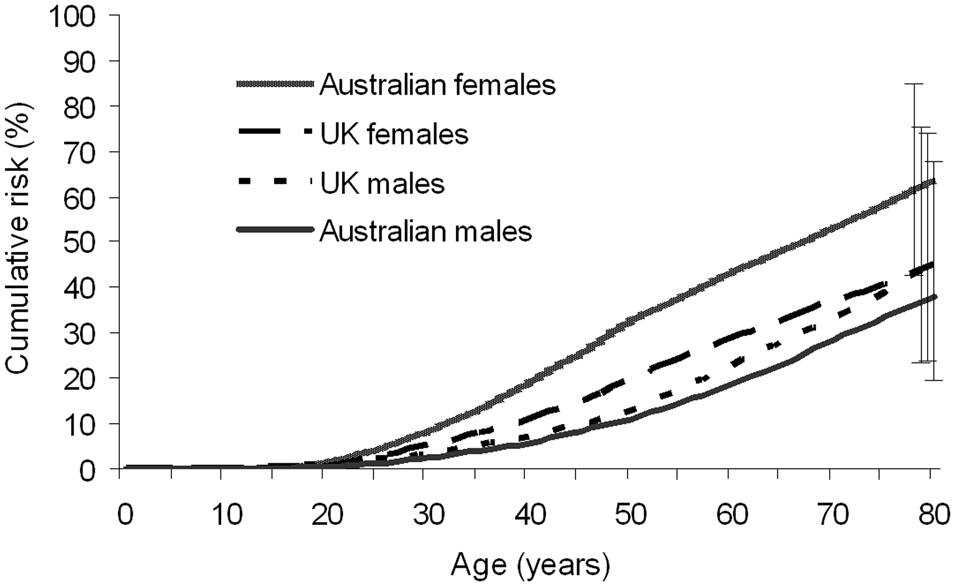
Results: The estimated HR for melanoma for mutation carriers relative to the general population decreased with regions of increasing ambient ultraviolet (UV) irradiance, being higher for the UK than Australia (87, 95% CI 50 to 153 vs 31, 95% CI 20 to 50, p=0.008), and across Australia, 49 (95% CI 24 to 98) for Melbourne, 44 (95% CI 22 to 88) for Sydney, and 9 (95% CI 2 to 33) for Brisbane (p=0.02). Penetrance did not differ by geographic region. It is estimated that 16% (95% CI 10% to 27%) of UK and 20% (95% CI 13% to 30%) of Australian CDKN2A mutation carriers would be diagnosed with melanoma by age 50 years, and 45% (95% CI 29% to 65%) and 52% (95% CI 37% to 69%), respectively, by age 80 years.
Conclusions: Contrary to the strong association between UV radiation exposure and melanoma risk for the general population, CDKN2A mutation carriers appear to have the same cumulative risk of melanoma irrespective of the ambient UV irradiance of the region in which they live.
Figures
References
-
- Meyle KD, Guldberg P. Genetic risk factors for melanoma. Hum Genet 2009;126:499–510. - PubMed
-
- Kamb A, Shattuck-Eidens D, Eeles R, Liu Q, Gruis NA, Ding W, Hussey C, Tran T, Miki Y, Weaver-Feldhaus J, et al. Analysis of the p16 gene (CDKN2) as a candidate for the chromosome 9p melanoma susceptibility locus. Nat Genet 1994;8:23–6. - PubMed
-
- Begg CB, Orlow I, Hummer AJ, Armstrong BK, Kricker A, Marrett LD, Millikan RC, Gruber SB, Anton-Culver H, Zanetti R, Gallagher RP, Dwyer T, Rebbeck TR, Mitra N, Busam K, From L, Berwick M. Lifetime risk of melanoma in CDKN2A mutation carriers in a population-based sample. J Natl Cancer Inst 2005;97:1507–15. - PubMed
-
- Bishop DT, Demenais F, Goldstein AM, Bergman W, Bishop JN, Bressac-de Paillerets B, Chompret A, Ghiorzo P, Gruis N, Hansson J, Harland M, Hayward N, Holland EA, Mann GJ, Mantelli M, Nancarrow D, Platz A, Tucker MA. Geographical variation in the penetrance of CDKN2A mutations for melanoma. J Natl Cancer Inst 2002;94:894–903. - PubMed
-
- Antoniou A, Pharoah PD, Narod S, Risch HA, Eyfjord JE, Hopper JL, Loman N, Olsson H, Johannsson O, Borg A, Pasini B, Radice P, Manoukian S, Eccles DM, Tang N, Olah E, Anton-Culver H, Warner E, Lubinski J, Gronwald J, Gorski B, Tulinius H, Thorlacius S, Eerola H, Nevanlinna H, Syrjakoski K, Kallioniemi OP, Thompson D, Evans C, Peto J, Lalloo F, Evans DG, Easton DF. Average risks of breast and ovarian cancer associated with BRCA1 or BRCA2 mutations detected in case series unselected for family history: a combined analysis of 22 studies. Am J Hum Genet 2003;72:1117–30. - PMC - PubMed
Publication types
MeSH terms
Grants and funding
LinkOut - more resources
Full Text Sources
Medical
Miscellaneous
